1,267 posters, 47 videos, 13 topics, 4 sessions, 853 authors
ePostersLive by SciGen Technologies S.A. All rights reserved.
SOHO 2026 Annual Meeting
September 9 - 12, 2026 | George R. Brown Convention Center, Houston, Texas

CT - 413
CAR T-Cell Therapy vs Bispecific Antibodies in Relapsed/Refractory B-Cell Malignancies: Response Rates, Durability, and Toxicity
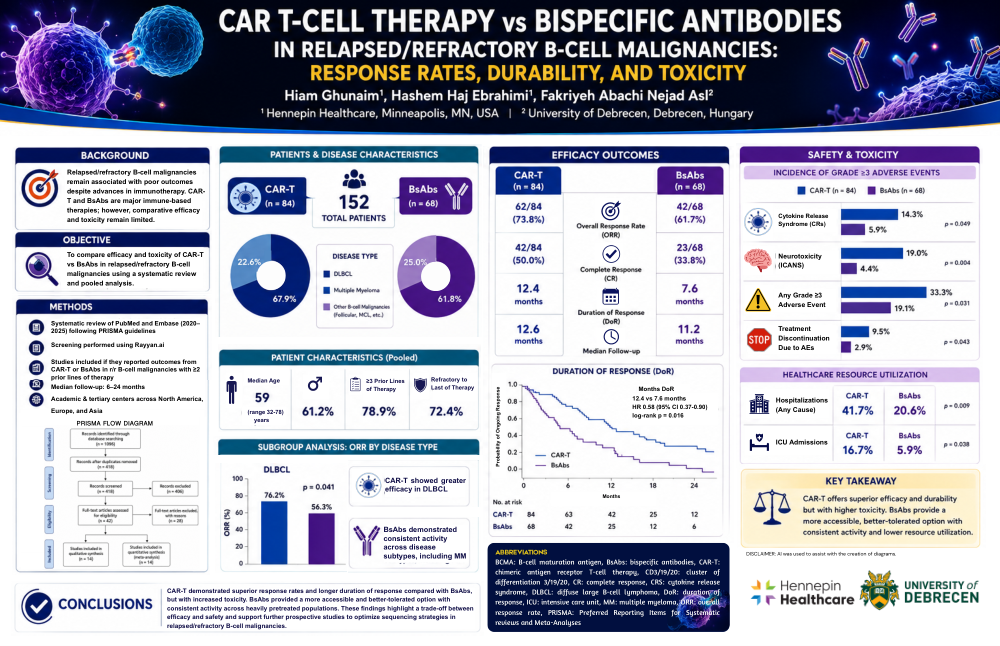
Poster Presenter
Authors
Part of Topic
Cellular Therapy (CT)
CAR T-Cell Therapy vs Bispecific Antibodies in Relapsed/Refractory B-Cell Malignancies: Response Rates, Durability, and Toxicity Hiam Ghunaim 1, Hashem Haj Ebrahimi1, Fakriyeh Abachi Nejad Asl2 1 Hennepin Healthcare, Minneapolis, MN, USA 2 University of Debrecen, Debrecen, Hungary Abstract Context Relapsed/refractory B-cell malignancies remain associated with poor outcomes despite advances in immunotherapy. CAR-T and BsAbs are major immune-based therapies; however, comparative efficacy and toxicity remain limited. Objective To compare efficacy and toxicity of CAR-T vs BsAbs in relapsed/refractory B-cell malignancies using a systematic review and pooled analysis. Design A systematic review of PubMed and Embase (2020–2025) was conducted following PRISMA guidelines. Screening was performed using Rayyan.ai. Studies were analyzed that reported outcomes from CAR-T or BsAbs meeting inclusion criteria. A total of 152 patients were analyzed. Median follow-up ranged from 6 to 24 months across studies. Data were extracted at study level and pooled to generate aggregate response and toxicity estimates. Settings Academic and tertiary referral centers across North America, Europe, and Asia. Patients Adults with relapsed/refractory B-cell malignancies, including DLBCL and MM, treated with ≥2 prior lines of therapy. All studies reported evaluable response outcomes. Interventions CAR-T targeting CD19 or BCMA and BsAbs targeting CD20/CD3 or BCMA/CD3. Main Outcomes Measures Primary outcomes were ORR and CR. Secondary outcomes included DoR, CRS, neurotoxicity, and treatment discontinuation. The hypothesis was prespecified. Results Among 152 pooled patients (CAR-T: n=84; BsAbs: n=68), CAR-T demonstrated higher ORR (62/84, 73.8%) compared with BsAbs (42/68, 61.7%) and higher CR rates (42/84, 50.0% vs 23/68, 33.8%). CAR-T showed longer DoR (12.4 vs 7.6 months). Grade 3 or higher CRS occurred more frequently with CAR-T (12/84, 14.3%) compared with BsAbs (4/68, 5.9%), as did neurotoxicity (16/84, 19.0% vs 3/68, 4.4%, respectively). BsAbs were associated with fewer hospitalizations and ICU admissions. Subgroup analyses suggested greater efficacy of CAR-T in DLBCL, whereas BsAbs demonstrated consistent activity across disease subtypes, including MM. Conclusions CAR-T demonstrated superior response rates and longer DoR compared with BsAbs, but with increased toxicity. BsAbs provided a more accessible and better-tolerated option with consistent activity across heavily pretreated populations. These findings highlight a trade-off between efficacy and safety and support further prospective studies to optimize sequencing strategies in relapsed/refractory B-cell malignancies. BCMA: B-cell maturation antigen, BsAbs: bispecific antibodies, CAR-T: chimeric antigen receptor T-cell therapy, CD3/19/20: cluster of differentiation 3/19/20, CR: complete response, CRS: cytokine release syndrome, DLBCL: diffuse large B-cell lymphoma, DoR: duration of response, ICU: intensive care unit, MM: multiple myeloma, ORR: overall response rate, PRISMA: Preferred Reporting Items for Systematic reviews and Meta-Analyses