1,267 posters, 47 videos, 13 topics, 4 sessions, 853 authors
ePostersLive by SciGen Technologies S.A. All rights reserved.
SOHO 2026 Annual Meeting
September 9 - 12, 2026 | George R. Brown Convention Center, Houston, Texas

MM - 351
Extraosseous Plasmacytoma: Real-World Outcomes of a Rare Plasma Cell Neoplasm using the SEER Database
Poster Presenter
Authors
Part of Topic
Multiple Myeloma (MM)
Background- Extraosseous plasmacytoma (EOP), also termed extramedullary plasmacytoma, is a rare plasma cell neoplasm that arises in soft tissues outside the bone marrow. It accounts for approximately 3-5% of all plasma cell neoplasms. Given the extreme rarity of this entity, population-level data describing its epidemiology and survival outcomes remain limited. This study evaluates incidence patterns, demographics, anatomic distribution, and overall survival of extraosseous plasmacytoma using the Surveillance, Epidemiology, and End Results (SEER) database. The goal of this study is to assist better in understanding this lesser known and rare condition.
Methods- A retrospective analysis was performed using the Surveillance, Epidemiology, and End Results (SEER) 17 registries from 2000 to 2022. We identified 1957 histologically confirmed extraosseous plasmacytoma cases diagnosed between 0 to 90 years using the ICD code 9734/3. Overall survival (OS) was estimated using the Kaplan-Meier method with log-rank testing for group comparisons. Univariate and multivariate Cox proportional hazards regression identified independent prognostic factors.
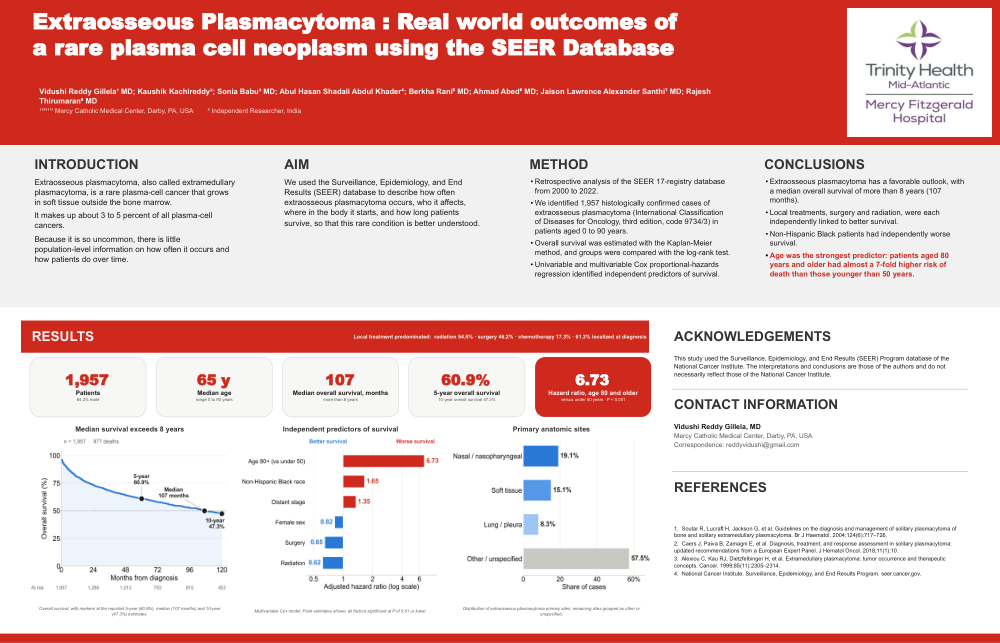
Results- The cohort comprised 1,957 patients (64.2% male; median age 65 years). The most common primary sites were nasal/nasopharyngeal (19.1%), soft tissue (15.1%), and lung/pleura (8.3%). Most patients presented with localized disease (61.3%). Treatment included radiation (54.5%), surgery (46.2%), and chemotherapy (17.3%). Median OS was 107 months with 5-year and 10-year OS rates of 60.9% and 47.3%, respectively.
On multivariate Cox regression, independent predictors of worse survival were older age (HR=6.73 for age 80+ vs <50, P<0.001), Non-Hispanic Black race (HR=1.65, P<0.001) and distant stage (HR=1.35, P<0.001). Surgery (HR=0.65, P<0.001), radiation (HR=0.62, P<0.001), and female sex (HR=0.82, P=0.010) were independently associated with improved survival.
Conclusion - Extra osseous plasmacytoma demonstrates a favorable prognosis with median overall survival exceeding 8 years. Local therapies including surgery and radiation are associated with significantly improved outcomes among patients. Non-Hispanic Black race was independently associated with worse survival. Age emerges as the most powerful prognostic factor. Patients older than 80 years face an almost 7-fold increase in mortality, highlighting the critical impact of advanced age on survival in this rare plasma cell neoplasm.