1,267 posters, 47 videos, 13 topics, 4 sessions, 853 authors
ePostersLive by SciGen Technologies S.A. All rights reserved.
SOHO 2026 Annual Meeting
September 9 - 12, 2026 | George R. Brown Convention Center, Houston, Texas

MPN - 331
Ruxolitinib Dose, Treatment-Emergent Transfusion Dependence, and Survival Outcomes in Myelofibrosis: Real-World Evidence From Taiwan
Poster Presenter
Authors
Part of Topic
Myeloproliferative Neoplasms (MPN)
TITLE:
RUXOLITINIB DOSE, TREATMENT-EMERGENT TRANSFUSION DEPENDENCE, AND SURVIVAL OUTCOMES IN MYELOFIBROSIS: REAL-WORLD EVIDENCE FROM TAIWAN
AUTHORS:
TC Tseng1, YS Chang2, CH Wei3, FM Tien1, XCH Tsai1, CC Lin1, SH Lee1, YY Kuo4, YL Peng1, BS Ko3, M Yao1, HF Tien1,5, HA Hou1, WC Chou1
AFFILIATIONS:
1. Division of Hematology, Department of Internal Medicine, National Taiwan University Hospital, Taipei, Taiwan.
2. Division of Hematology, Department of Internal Medicine, National Taiwan University Hospital Hsin-Chu Branch, Hsin-Chu, Taiwan.
3. Department of Hematological Oncology, National Taiwan University Cancer Center, Taipei, Taiwan.
4. Tai-Chen Cell Therapy Center, National Taiwan University, Taipei, Taiwan.
5. Department of Internal Medicine, Far-Eastern Memorial Hospital, New Taipei City, Taipei, Taiwan.
INTRODUCTION:
Myelofibrosis (MF) is a Philadelphia chromosome-negative myeloproliferative neoplasm that typically presents with anemia, cytokines production-related symptoms, and splenomegaly1. Ruxolitinib has been broadly utilized to treat patients with MF in the first-line setting. Following the phase 3 trials2,3, several cohorts have shown the real-world efficacy of ruxolitinib in MF and identified prognostic factors4,5. However, data remains to be supplemented in Eastern populations. Also, key issues regarding the prognostic factors remain to be elucidated.
AIM:
We aim to characterize treatment outcomes of ruxolitinib on patients with JAK inhibitor (JAKi)-naïve MF, primary or secondary (post essential thrombocythemia MF [post ET-MF] or post polycythemia vera MF [post PV-MF]), in the real-world setting, and to identify treatment related indicators of prognostic significance.
METHOD:
Study cohort: JAKi-naïve MF patients receiving ruxolitinib and followed up at National Taiwan University Hospital were reviewed.
Definition and analysis: For time-to-event analyses, the index date was defined as the date of ruxolitinib initiation. DIPSS for primary MF and MYSEC-PM for secondary MF were applied for risk stratification6,7. A doubly robust, inverse probability treatment weighting (IPTW)-adjusted multivariate Cox proportional hazards model was constructed to clarify the prognostic relevance of platelet-count adjusted ruxolitinib dose.
RESULTS (text part):
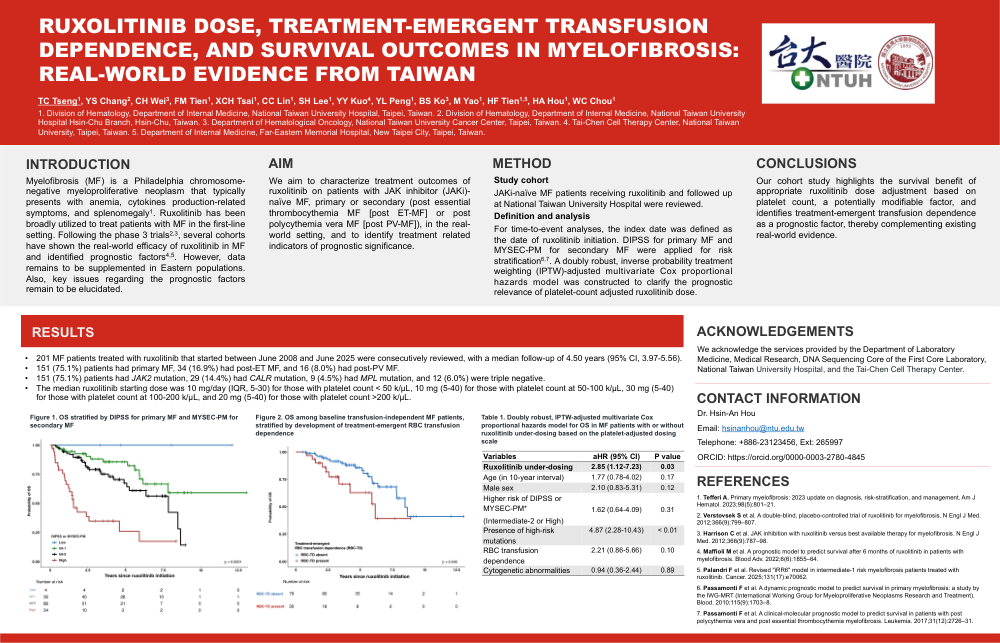
• 201 MF patients treated with ruxolitinib that started between June 2008 and June 2025 were consecutively reviewed, with a median follow-up of 4.50 years (95% CI, 3.97-5.56).
• 151 (75.1%) patients had primary MF, 34 (16.9%) had post-ET MF, and 16 (8.0%) had post-PV MF.
• 151 (75.1%) patients had JAK2 mutation, 29 (14.4%) had CALR mutation, 9 (4.5%) had MPL mutation, and 12 (6.0%) were triple negative.
• The median ruxolitinib starting dose was 10 mg/day (IQR, 5-30) for those with platelet count < 50 k/µL, 10 mg (5-40) for those with platelet count at 50-100 k/µL, 30 mg (5-40) for those with platelet count at 100-200 k/µL, and 20 mg (5-40) for those with platelet count >200 k/µL.
Figure and table legends:
Figure 1. OS stratified by DIPSS for primary MF and MYSEC-PM for secondary MF
Figure 2. OS among baseline transfusion-independent MF patients, stratified by development of treatment-emergent RBC transfusion dependence
Table 1. Doubly robust, IPTW-adjusted multivariate Cox proportional hazards model for OS in MF patients with or without ruxolitinib under-dosing based on the platelet-adjusted dosing scale
CONCLUSIONS:
Our cohort study highlights the survival benefit of appropriate ruxolitinib dose adjustment based on platelet count, a potentially modifiable factor, and identifies treatment-emergent transfusion dependence as a prognostic factor, thereby complementing existing real-world evidence.
ACKNOWLEDGEMENTS:
We acknowledge the services provided by the Department of Laboratory Medicine, Medical Research, DNA Sequencing Core of the First Core Laboratory, National Taiwan University Hospital, and the Tai-Chen Cell Therapy Center.
CONTACT INFORMATION:
Dr. Hsin-An Hou
Email: hsinanhou@ntu.edu.tw
Telephone: +886-23123456, Ext: 265997
ORCID: https://orcid.org/0000-0003-2780-4845
REFERENCES:
1. Tefferi A. Primary myelofibrosis: 2023 update on diagnosis, risk-stratification, and management. Am J Hematol. 2023;98(5):801–21.
2. Verstovsek S et al. A double-blind, placebo-controlled trial of ruxolitinib for myelofibrosis. N Engl J Med. 2012;366(9):799–807.
3. Harrison C et al. JAK inhibition with ruxolitinib versus best available therapy for myelofibrosis. N Engl J Med. 2012;366(9):787–98.
4. Maffioli M et al. A prognostic model to predict survival after 6 months of ruxolitinib in patients with myelofibrosis. Blood Adv. 2022;6(6):1855–64.
5. Palandri F et al. Revised "iRR6" model in intermediate-1 risk myelofibrosis patients treated with ruxolitinib. Cancer. 2025;131(17):e70062.
6. Passamonti F et al. A dynamic prognostic model to predict survival in primary myelofibrosis: a study by the IWG-MRT (International Working Group for Myeloproliferative Neoplasms Research and Treatment). Blood. 2010;115(9):1703–8.
7. Passamonti F et al. A clinical-molecular prognostic model to predict survival in patients with post polycythemia vera and post essential thrombocythemia myelofibrosis. Leukemia. 2017;31(12):2726–31.