1,267 posters, 47 videos, 13 topics, 4 sessions, 853 authors
ePostersLive by SciGen Technologies S.A. All rights reserved.
SOHO 2026 Annual Meeting
September 9 - 12, 2026 | George R. Brown Convention Center, Houston, Texas

ABCL - 285
CXCR4 Expression as a Determinant of Inferior Outcomes Following CD19 CAR T-Cell Therapy in Diffuse Large B-Cell Lymphoma: A National Cancer Database Analysis
Poster Presenter
Authors
Part of Topic
Aggressive B-Cell Lymphoma (ABCL)
Background:
Despite the transformative efficacy of CD19-directed CAR T-cell therapy in relapsed/refractory diffuse large B-cell lymphoma (DLBCL), durable remission remains limited to a subset of patients. Tumor-intrinsic mechanisms mediating immune escape are incompletely defined. The CXCR4–CXCL12 axis is a key regulator of malignant B-cell trafficking, tumor microenvironment homing, and immune evasion, and has been associated with adverse prognosis in DLBCL. We hypothesized that elevated CXCR4 expression correlates with inferior response to CAR T-cell therapy.
Methods:
We conducted a retrospective cohort study using the National Cancer Database, identifying adult patients with DLBCL treated with CD19 CAR T-cell therapy (2018-2023). CXCR4 expression was stratified as high vs low using available immunohistochemistry (IHC) scoring and RNA-sequencing proxies. Primary endpoints included overall response rate (ORR), progression-free survival (PFS), and relapse rate. Multivariable Cox proportional hazards and logistic regression models adjusted for age, stage, LDH, prior lines of therapy, and extranodal involvement.
Results:
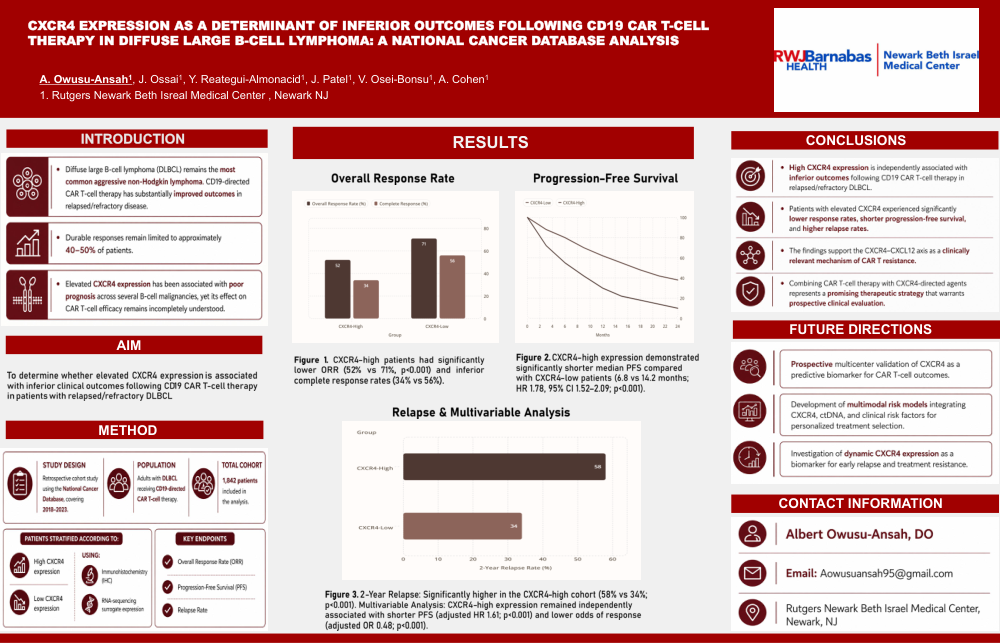
Among 1,842 eligible patients, 38% demonstrated high CXCR4 expression. High CXCR4 was associated with significantly lower ORR (52% vs 71%, p<0.001) and inferior complete response rates (34% vs 56%). Median PFS was reduced in the CXCR4-high cohort (6.8 vs 14.2 months; HR 1.78, 95% CI 1.52–2.09, p<0.001). Two-year relapse rates were higher (58% vs 34%, p<0.001). On multivariable analysis, high CXCR4 remained independently associated with inferior PFS (adjusted HR 1.61, p<0.001) and lower odds of response (adjusted OR 0.48, p<0.001). Subgroup analyses demonstrated pronounced effects in patients with extranodal disease and bone marrow involvement.
Discussion:
These findings support CXCR4 as a biologically plausible driver of CAR T resistance. Mechanistically, CXCR4 signaling promotes tumor cell trafficking and retention within protective niches, limiting CAR T-cell infiltration and persistence. Preclinical data suggest that modulation of CXCR4 may enhance CAR T-cell trafficking and antitumor efficacy.
Conclusions:
High CXCR4 expression correlates with inferior response, shorter PFS, and increased relapse following CD19 CAR T-cell therapy in DLBCL. Prospective studies integrating CXCR4-targeted strategies with CAR T therapy are warranted to overcome microenviron