1,267 posters, 47 videos, 13 topics, 4 sessions, 853 authors
ePostersLive by SciGen Technologies S.A. All rights reserved.
SOHO 2026 Annual Meeting
September 9 - 12, 2026 | George R. Brown Convention Center, Houston, Texas

MPN - 204
Projected Healthcare Resource Use and Budget Impact of Once-Daily Extended-Release vs Twice-Daily Immediate-Release Ruxolitinib in Myelofibrosis
Poster Presenter
Authors
Part of Topic
Myeloproliferative Neoplasms (MPN)
MPN - 204
Projected Healthcare Resource Use and Budget Impact of Once-Daily
Extended-Release vs Twice-Daily Immediate-Release Ruxolitinib in Myelofibrosis
Sumit Verma,1 Jordan Fortunato,1 Yijia Sun,2 Precious Nchekwube,2 Jialu He,2 Samuel Wagner,2 Shreekant Parasuraman1
1 Incyte Corporation, HEOR Oncology, Wilmington, DE, USA; 2 Columbia Data Analytics, New York, NY, USA
Introduction
● Maintaining long-term treatment continuity is central to symptom control in myelofibrosis (MF), but regimen complexity may adversely affect adherence1,2
● A once-daily extended-release (XR) formulation of ruxolitinib may reduce healthcare resource utilization (HCRU) relative to twice-daily immediate-release (IR) treatment3-6
Objective
● Estimate the projected budget impact associated with adherence-related changes in HCRU following adoption
of once-daily XR vs twice-daily IR ruxolitinib in MF
Methods
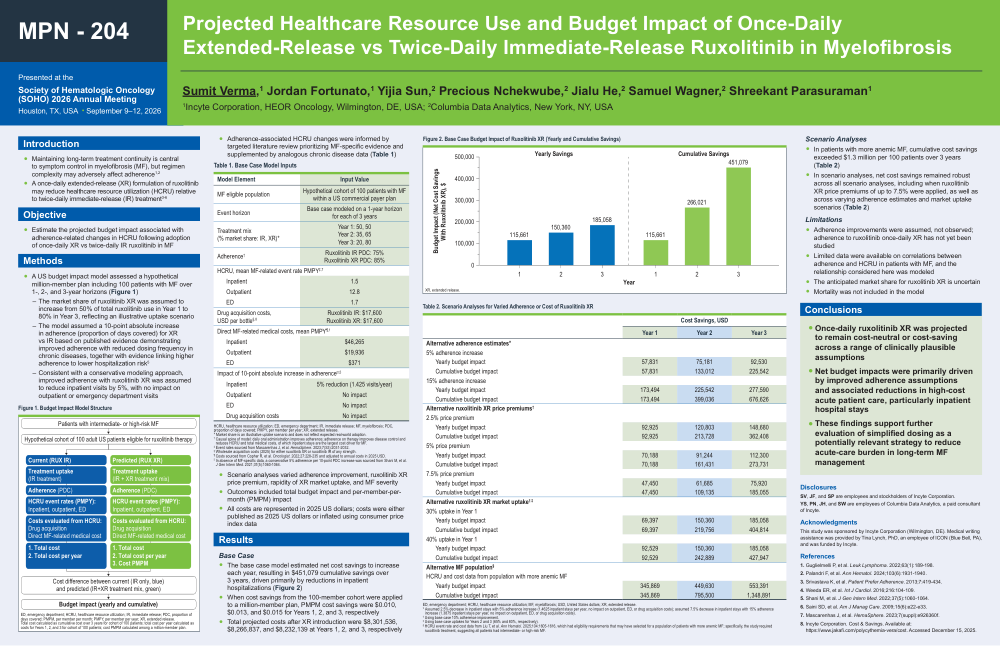
● A US budget impact model assessed a hypothetical million-member plan including 100 patients with MF over 1-, 2-, and 3-year horizons (Figure 1)
– The market share of ruxolitinib XR was assumed to increase from 50% of total ruxolitinib use in Year 1 to 80% in Year 3, reflecting an illustrative uptake scenario
– The model assumed a 10-point absolute increase in adherence (proportion of days covered) for XR vs IR based on published evidence demonstrating improved adherence with reduced dosing frequency in chronic diseases, together with evidence linking higher adherence to lower hospitalization risk5
– Consistent with a conservative modeling approach, improved adherence with ruxolitinib XR was assumed to reduce inpatient visits by 5%, with no impact on outpatient or emergency department visits
● Adherence-associated HCRU changes were informed by targeted literature review prioritizing MF-specific evidence and supplemented by analogous chronic disease data (Table 1)
● Adherence-associated HCRU changes were informed by targeted literature review prioritizing MF-specific evidence and supplemented by analogous chronic disease data (Table 1)● Scenario analyses varied adherence improvement, ruxolitinib XR price premium, rapidity of XR market uptake, and MF severity
● Outcomes included total budget impact and per-member-per-month (PMPM) impact
● All costs are represented in 2025 US dollars; costs were either published as 2025 US dollars or inflated using consumer price index data
Results
Base Case
● The base case model estimated net cost savings to increase each year, resulting in $451,079 cumulative savings over
3 years, driven primarily by reductions in inpatient hospitalizations (Figure 2)
● When cost savings from the 100-member cohort were applied to a million-member plan, PMPM cost savings were $0.010, $0.013, and $0.015 for Years 1, 2, and 3, respectively
● Total projected costs after XR introduction were $8,301,536, $8,266,837, and $8,232,139 at Years 1, 2, and 3, respectively
Scenario Analyses
● In patients with more anemic MF, cumulative cost savings exceeded $1.3 million per 100 patients over 3 years
(Table 2)
● In scenario analyses, net cost savings remained robust across all scenario analyses, including when ruxolitinib XR price premiums of up to 7.5% were applied, as well as across varying adherence estimates and market uptake scenarios (Table 2)
Limitations
● Adherence improvements were assumed, not observed; adherence to ruxolitinib once-daily XR has not yet been studied
● Limited data were available on correlations between adherence and HCRU in patients with MF, and the relationship considered here was modeled
● The anticipated market share for ruxolitinib XR is uncertain
● Mortality was not included in the model
Conclusions
● Once-daily ruxolitinib XR was projected to remain cost-neutral or cost-saving across a range of clinically plausible assumptions
● Net budget impacts were primarily driven by improved adherence assumptions and associated reductions in high-cost acute patient care, particularly inpatient
hospital stays
● These findings support further evaluation of simplified dosing as a potentially relevant strategy to reduce acute-care burden in long-term MF management