1,267 posters, 47 videos, 13 topics, 4 sessions, 853 authors
ePostersLive by SciGen Technologies S.A. All rights reserved.
SOHO 2026 Annual Meeting
September 9 - 12, 2026 | George R. Brown Convention Center, Houston, Texas

CLL - 183
Cardiovascular Cause-of-Death Trends in Chronic Lymphocytic Leukemia in the BTK Inhibitor Era: A Population-Based Competing Risk Analysis (SEER 2005-2022)
Poster Presenter
Authors
Part of Topic
Chronic Lymphocytic Leukemia (CLL)
TITLE: CARDIOVASCULAR CAUSE-OF-DEATH TRENDS IN CHRONIC LYMPHOCYTIC LEUKEMIA IN THE BTK-INHIBITOR ERA: A POPULATION-BASED COMPETING RISK ANALYSIS (SEER 2005 - 2022)
AUTHORS: Shammas Muzammil1 ,Salman Masood2 ,Jahanzed Akhtar 3 ,Nouman Saeed4 ,Muhammad Rafay Rafique 5 ,Ghulam Shah2 ,Aatiqa Altaf 2 ,Abdullah Akram5 , Memoona Maryam6 ,Muhammad Kabbas6
1Shifa Tameer e Millat University,Islamabad 2Federal Medical College, Islamabad 3Central Park Medical College, Lahore 4Karachi Institute of Medical Sciences, Karachi 5Nawaz Sharif Medical College, Gujaranwala 6Fazaia Medical College, Islamabad
INTRODUCTION:
Chronic lymphocytic leukemia (CLL) is the most common adult leukemia in the United States and predominantly affects older adults, a population already at increased risk for cardiovascular disease. The introduction of Bruton tyrosine kinase inhibitors (BTKi) has transformed CLL treatment and significantly improved disease control and survival. However, BTK inhibitors are associated with important cardiovascular toxicities, particularly atrial fibrillation and hypertension, raising concerns about their potential impact on cardiovascular mortality. As survival improves and patients live longer with CLL, non-malignant causes of death, including cardiovascular disease, may represent an increasingly important component of overall mortality. The population-level impact of the BTKi era on cardiovascular cause-of-death in CLL remains unclear.
AIM:
To evaluate temporal trends in cardiovascular mortality among patients with chronic lymphocytic leukemia (CLL) before and after the introduction of Bruton tyrosine kinase inhibitors (BTKi), using population-based competing-risk analysis to determine whether the BTKi era was associated with changes in cardiovascular cause-of-death.
METHOD:
STUDY DESIGN AND DATA SOURCE
Population-based retrospective cohort study using the Surveillance, Epidemiology, and End Results (SEER) database (2005–2022). Patients with CLL/SLL (ICD-O-3: 9823/3) were identified.
STUDY POPULATION
60,994 patients with CLL/SLL were included.
• Pre-BTKi era: 2005 – 2013 (n=25,316)
• BTKi era: 2014 – 2022 (n=35,678)
OUTCOMES
PRIMARY OUTCOME: Cardiovascular cause-of-death based on SEER cause-ofdeath recoding.
COMPETING EVENT: CLL-specific death
STATISTICAL ANALYSIS
Cumulative incidence functions (CIFs) were used to estimate the probability of cardiovascular death in the presence of competing risks.
Gray’s test was used to compare cumulative incidence between eras.
Fine-Gray competing-risk regression was performed to estimate subdistribution hazard ratios (SHRs) with 95% confidence intervals.
Multivariable models were adjusted for age, sex, race/ethnicity, chemotherapy receipt, marital status, income quintile, and rural–urban classification. Era × sex and era × race/ethnicity interactions were assessed.
Statistical significance was defined as p < 0.05.
RESULTS:
• 60,994 CLL/SLL patients were included; 58.2% were male and 80.9% were Non-Hispanic White.
• Overall survival improved in the BTKi era, with 12- month OS increasing from 89.9% to 92.7% (HR 0.856; p<0.0001).
• CLL-specific mortality declined significantly in the BTKi era (SHR 0.624; p<0.0001).
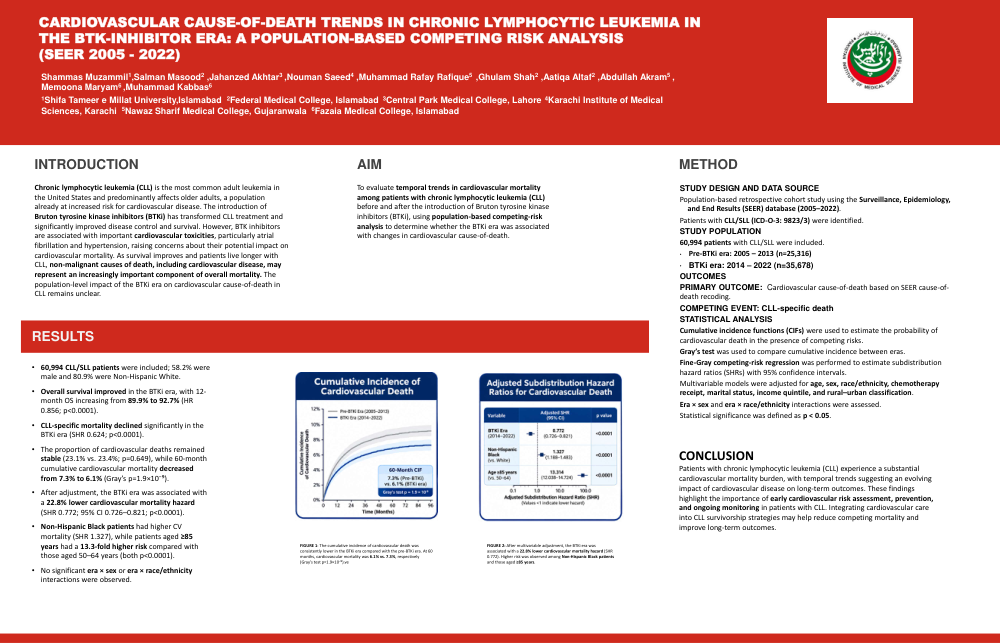
• The proportion of cardiovascular deaths remained stable (23.1% vs. 23.4%; p=0.649), while 60-month cumulative cardiovascular mortality decreased from 7.3% to 6.1% (Gray’s p=1.9×10⁻⁹).
• After adjustment, the BTKi era was associated with a 22.8% lower cardiovascular mortality hazard (SHR 0.772; 95% CI 0.726–0.821; p<0.0001).
• Non-Hispanic Black patients had higher CV mortality (SHR 1.327), while patients aged ≥85 years had a 13.3-fold higher risk compared with those aged 50–64 years (both p<0.0001).
• No significant era × sex or era × race/ethnicity interactions were observed.
CONCLUSION:
Patients with chronic lymphocytic leukemia (CLL) experience a substantial cardiovascular mortality burden, with temporal trends suggesting an evolving impact of cardiovascular disease on long-term outcomes. These findings highlight the importance of early cardiovascular risk assessment, prevention, and ongoing monitoring in patients with CLL. Integrating cardiovascular care into CLL survivorship strategies may help reduce competing mortality and improve long-term outcomes.