1,267 posters, 47 videos, 13 topics, 4 sessions, 853 authors
ePostersLive by SciGen Technologies S.A. All rights reserved.
SOHO 2026 Annual Meeting
September 9 - 12, 2026 | George R. Brown Convention Center, Houston, Texas

MPN - 032
The Clinical, Prognostic, and Therapeutic Implications of Mutational Profiles in Essential Thrombocythemia: Insights from a Retrospective Study at a Leading Single Center
Poster Presenter
Authors
Part of Topic
Myeloproliferative Neoplasms (MPN)
The Clinical, Prognostic, and Therapeutic Implications of Mutational Profiles in Essential Thrombocythemia: Insights From a Retrospective Study at a Leading Single Center
Nesrine Ben Sayed1,2, Aidli Rim1 , Ameni Ben Amor1 , Amira Rahal1 , Nadia Sassi1 , Monia Guermazi1 , Kmira Zahra1 , Haifa Regaieg1 , Ben Youssef Yosra1 1 Farhat Hached, Sousse, Tunisia 2 Ibn Jazzar Medical College, Sousse, Tunisia
Abstract
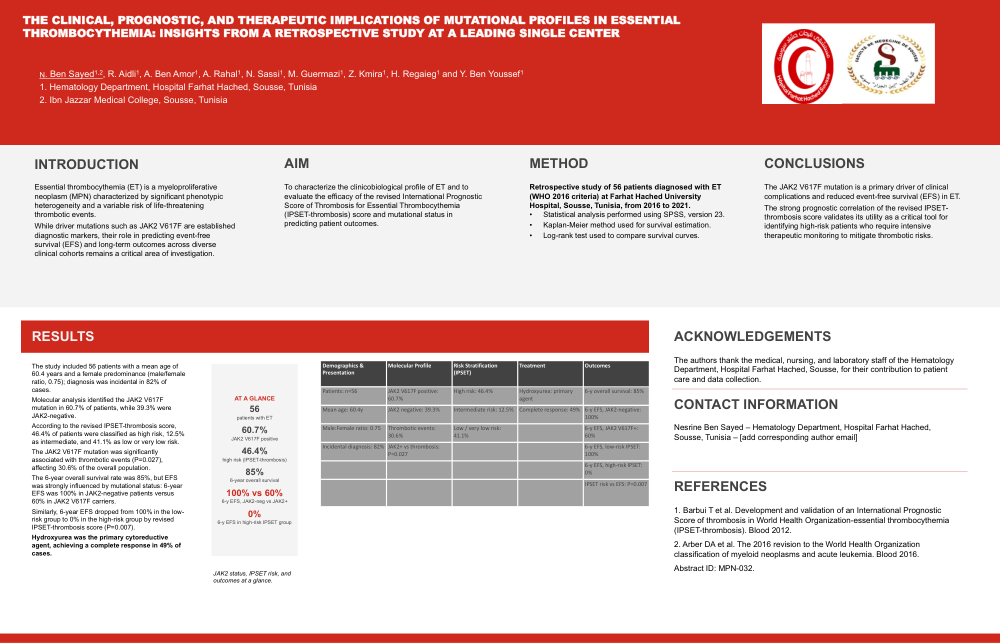
Background :Essential thrombocythemia (ET) is a myeloproliferative neoplasm (MPN) characterized by significant phenotypic heterogeneity and a variable risk of life-threatening thrombotic events. While driver mutations, such as Janus kinase 2 (JAK2 ) V617F, are established diagnostic markers, their role in predicting event-free survival (EFS) and long-term outcomes across diverse clinical cohorts remains a critical area of investigation.
Aim :To characterize the clinicobiological profile of ET and to evaluate the efficacy of the revised International Prognostic Score of Thrombosis for Essential Thrombocythemia (IPSET-thrombosis) score and mutational status in predicting patient outcomes.
Methods: This retrospective study analyzed 56 patients diagnosed with ET (World Health Organization 2016 criteria) at Farhat Hached University Hospital (Sousse, Tunisia) from 2016 to 2021. Statistical analysis was performed using SPSS, version 23, utilizing the Kaplan-Meier method for survival estimation and the log-rank test for comparing survival curves.
Results: The study included 56 patients with a mean age of 60.4 years and a female predominance (male/female ratio, 0.75), with incidental diagnosis in 82% of cases. Molecular analysis identified the JAK2 V617F mutation in 60.7% of patients, while 39.3% were JAK2 negative. According to the revised IPSET-thrombosis score, 46.4% of patients were classified as high risk, 12.5% as intermediate, and 41.1% as low or very low risk. The JAK2 V617F mutation was significantly associated with thrombotic events (P =0.027), affecting 30.6% of the overall population. Although the 6-year overall survival rate was 85%, EFS was strongly influenced by mutational status and prognostic scores. The 6-year EFS was 100% in JAK2 -negative patients, compared with 60% in those carrying the JAK2 V617F mutation. Similarly, the 6-year EFS dropped from 100% in low-risk groups to 0% in the high-risk group, according to the revised IPSET-thrombosis score (P =0.007). Regarding treatment, hydroxyurea was the primary cytoreductive agent, achieving a complete response in 49% of cases.
Conclusion Our findings demonstrate that the JAK2 V617F mutation is a primary driver of clinical complications and reduced EFS in ET.The strong prognostic correlation of the revised IPSET-thrombosis score validates its utility as a critical tool for identifying high-risk patients who require intensive therapeutic monitoring to mitigate thrombotic risks.
Keywords MPN, ET, essential thrombocythemia, thrombosis, JAK2 mutation