1,267 posters, 47 videos, 13 topics, 4 sessions, 853 authors
ePostersLive by SciGen Technologies S.A. All rights reserved.
SOHO 2026 Annual Meeting
September 9 - 12, 2026 | George R. Brown Convention Center, Houston, Texas

ABCL - 003
Impact of Diagnostic Delay on Stage and Treatment Response in High-Grade Lymphomas
Poster Presenter
Authors
Part of Topic
Aggressive B-Cell Lymphoma (ABCL)
INTRODUCTION
High-grade B-cell non-Hodgkin lymphomas progress rapidly, and delays between symptom onset and diagnosis may significantly affect disease stage at diagnosis and treatment response. The aim of this study was to evaluate the impact of diagnostic delay on disease stage and treatment response in patients treated at the Hematology Department of CLCC Béchar, southern Algeria, between January 2021 and December 2024. Understanding this relationship is essential to optimize patient management and outcomes.
Aim
The primary objective was to assess whether prolonged diagnostic delay was associated with a more advanced disease stage at diagnosis.
Secondary objectives were to evaluate the relationship between diagnostic delay and treatment response, as well as to describe relapse, survival, and clinical outcome in this real-world cohort.
METHOD
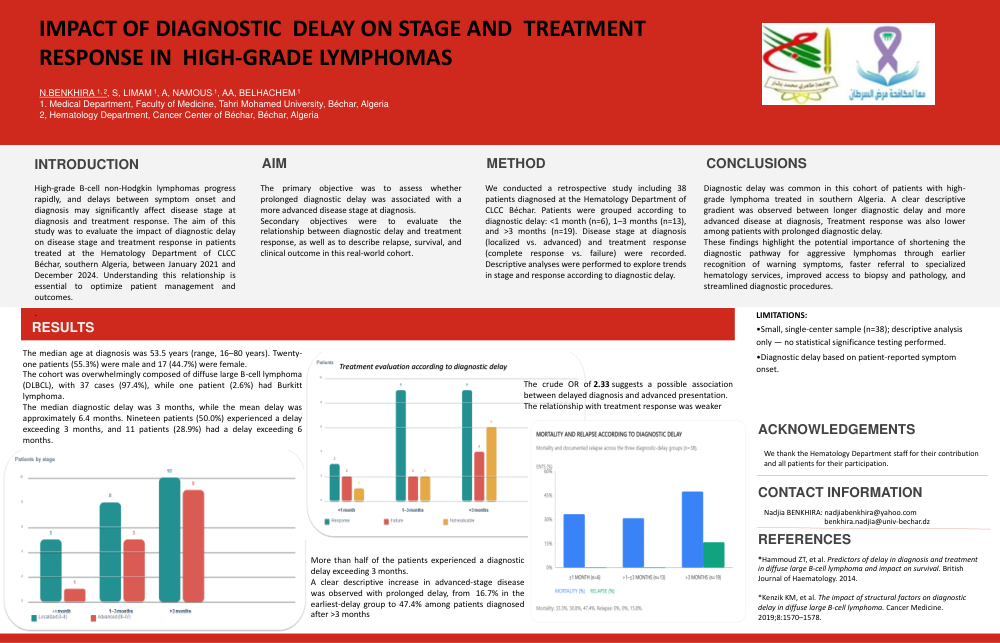
We conducted a retrospective study including 38 patients diagnosed at the Hematology Department of CLCC Béchar. Patients were grouped according to diagnostic delay: <1 month (n=6), 1–3 months (n=13), and >3 months (n=19). Disease stage at diagnosis (localized vs. advanced) and treatment response (complete response vs. failure) were recorded. Descriptive analyses were performed to explore trends in stage and response according to diagnostic delay.
RESULTS
The median age at diagnosis was 53.5 years (range, 16–80 years). Twenty-one patients (55.3%) were male and 17 (44.7%) were female.
The cohort was overwhelmingly composed of diffuse large B-cell lymphoma (DLBCL), with 37 cases (97.4%), while one patient (2.6%) had Burkitt lymphoma.
The median diagnostic delay was 3 months, while the mean delay was approximately 6.4 months. Nineteen patients (50.0%) experienced a delay exceeding 3 months, and 11 patients (28.9%) had a delay exceeding 6 months.

More than half of the patients experienced a diagnostic delay exceeding 3 months.
A clear descriptive increase in advanced-stage disease was observed with prolonged delay, from 16.7% in the earliest-delay group to 47.4% among patients diagnosed after >3 months
The crude OR of 2.33 suggests a possible association between delayed diagnosis and advanced presentation.The relationship with treatment response was weaker.

Treatment evaluation according to diagnostic delay

CONCLUSIONS
Diagnostic delay was common in this cohort of patients with high-grade lymphoma treated in southern Algeria. A clear descriptive gradient was observed between longer diagnostic delay and more advanced disease at diagnosis, Treatment response was also lower among patients with prolonged diagnostic delay.
These findings highlight the potential importance of shortening the diagnostic pathway for aggressive lymphomas through earlier recognition of warning symptoms, faster referral to specialized hematology services, improved access to biopsy and pathology, and streamlined diagnostic procedures.
LIMITATIONS:
• Small, single-center sample (n=38); descriptive analysis only — no statistical significance testing performed.
• Diagnostic delay based on patient-reported symptom onset.