1,267 posters, 47 videos, 13 topics, 4 sessions, 853 authors
ePostersLive by SciGen Technologies S.A. All rights reserved.
SOHO 2026 Annual Meeting
September 9 - 12, 2026 | George R. Brown Convention Center, Houston, Texas

ABCL - 489
Primary Outcomes from the Phase 3 Study of Tafasitamab (Tafa) Plus Lenalidomide (Len) and R-CHOP for Patients with Newly Diagnosed Diffuse Large B-Cell Lymphoma (DLBCL) (frontMIND)
Poster Presenter
Authors
Part of Topic
Aggressive B-Cell Lymphoma (ABCL)
Video
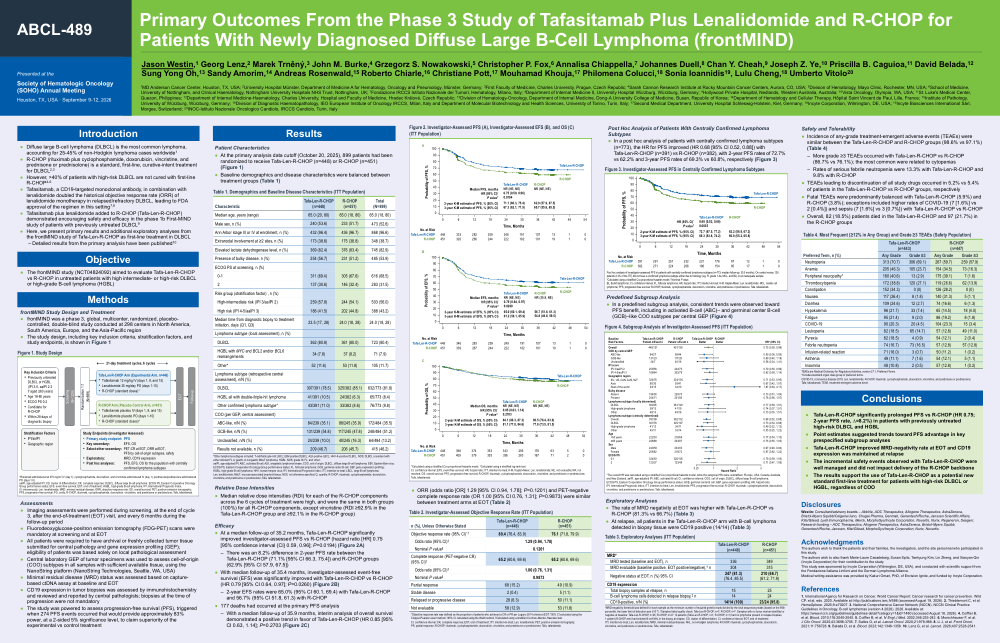
CONTEXT: In the phase 1b First-MIND study, Tafa (anti-CD19 mAb)-Len-R-CHOP demonstrated safety and efficacy in patients with previously untreated DLBCL.
OBJECTIVE: frontMIND, a phase 3, double-blind, placebo-controlled study, compared Tafa-Len-R-CHOP vs R-CHOP in patients with high-risk aggressive BCLs.
DESIGN: Patients (18–80y) with previously untreated, high intermediate- and high-risk (IPI 3–5, aaIPI 2–3 if ≤60y) DLBCL or HGBL and ECOG PS ≤2 were randomized 1:1 to Tafa-Len-R-CHOP or R-CHOP. Primary endpoint was investigator-assessed PFS; secondary endpoints included: EFS, OS, CR, ORR, safety. CD19 expression in tumor biopsies collected at baseline and relapse was assessed centrally and measured by IHC.
RESULTS: At primary analysis (data cutoff October 20, 2025), 899 patients were assigned to Tafa-Len-R-CHOP (n=448) or R-CHOP (n=451); baseline characteristics were similar between arms. At median follow-up of 35.2 months, Tafa-Len-R-CHOP significantly improved PFS vs R-CHOP (HR 0.75 [95% CI: 0.59, 0.96]; P=0.019) with 24-month PFS of 71.1% vs 62.9% in the overall population; in patients with centrally confirmed lymphoma subtypes (n=773), PFS HR was 0.68 (95% CI: 0.52, 0.88) and 24-months PFS was 72.7% vs 62.2%. Point estimates suggested PFS benefit with Tafa-Len-R-CHOP across almost every prespecified subgroup, including ABC and GCB molecular subtypes. Tafa-Len-R-CHOP significantly improved EFS; CR and ORR were similar between arms, and the HR for OS was 0.85 (95% CI: 0.63, 1.14) (final OS at 5y). At relapse, all patients in the Tafa-Len-R-CHOP arm with lymphoma detected in biopsy tissue were CD19 positive (14/14). For Tafa-Len-R-CHOP vs R-CHOP, any-grade TEAEs were similar (98.6% vs 97.1%), more grade ≥3 TEAEs occurred with Tafa-Len-R-CHOP (86.7% vs 76.1%) and TEAEs led to all study drug discontinuation in 5.2% vs 5.4% of patients, respectively. More fatal TEAEs occurred with Tafa-Len-R-CHOP vs R-CHOP (5.9% vs 3.8%), but fewer deaths overall (18.5% vs 21.7%).
CONCLUSIONS: Tafa-Len-R-CHOP resulted in a significant 25% reduction in risk of disease progression or death vs R-CHOP, without affecting CD19 expression in relapse biopsies. TEAEs were manageable and consistent with the expected safety profile. Tafa-Len-R-CHOP represents a new first-line standard of care option for patients with high-risk DLBCL or HGBL, regardless of COO molecular subtype.