516 posters, 59 topics, 63 sessions, 1,127 authors, 353 institutions
ePostersLive by SciGen Technologies S.A. All rights reserved.
2026 SOAP Annual Meeting
April 29 - May 3, 2026 | Montreal, Quebec Canada

2341617
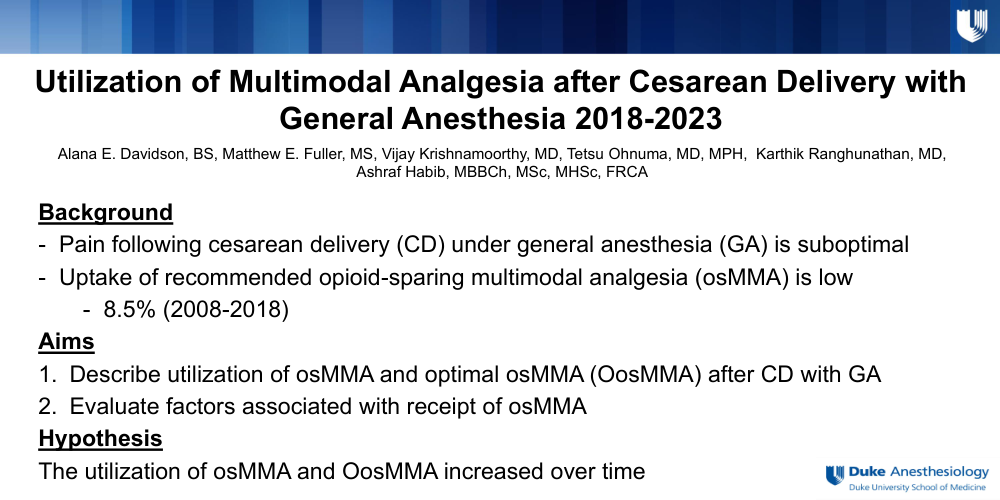
Utilization of Multimodal Analgesia after Cesarean Delivery with General Anesthesia 2018-2023
Part of Topic
Pain Control
Utilization of Multimodal Analgesia after Cesarean Delivery with
General Anesthesia 2018-2023
Alana E. Davidson, BS, Matthew E. Fuller, MS, Vijay Krishnamoorthy, MD, Tetsu Ohnuma, MD, MPH, Karthik Ranghunathan, MD, Ashraf Habib, MBBCh, MSc, MHSc, FRCA
Background
- Pain following cesarean delivery (CD) under general anesthesia (GA) is suboptimal
- Uptake of recommended opioid-sparing multimodal analgesia (osMMA) is low
- 8.5% (2008-2018)
Aims
1. Describe utilization of osMMA and optimal osMMA (OosMMA) after CD with GA
2. Evaluate factors associated with receipt of osMMA
Hypothesis
The utilization of osMMA and OosMMA increased over time
Study Design and Methods
• Retrospective cohort study in Premier Healthcare database
• Patients ≥ 18 years with CD under GA from 2018-2023
• Descriptive statistics and mixed-effects logistic regression models
Results
• 244,047 CDs
• osMMA = 44.4%
• OosMMA = 10.0%
– Local anesthetic = 21.8%
• ↓ osMMA
– Black, public insurance
– Medical + obstetric comorbidities
– Non-teaching status
– ICC = 0.55
Conclusion & Discussion
osMMA use increased substantially
Local anesthetic technique use = unchanged
Hospital-level variation persists