516 posters, 59 topics, 63 sessions, 1,127 authors, 353 institutions
ePostersLive by SciGen Technologies S.A. All rights reserved.
2026 SOAP Annual Meeting
April 29 - May 3, 2026 | Montreal, Quebec Canada

2340933
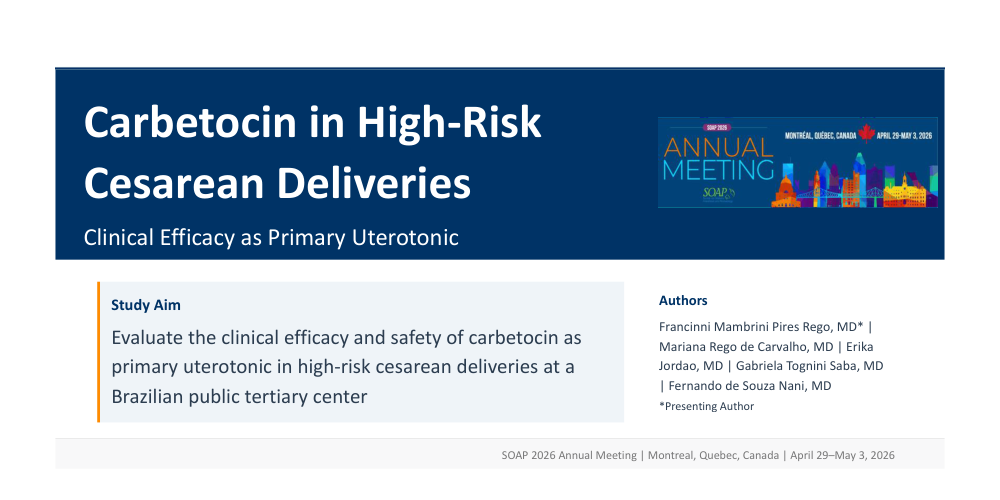
Clinical Efficacy of Carbetocin as Primary Uterotonic in High-Risk Cesarean Deliveries: A Retrospective Case Series from a Brazilian Public Tertiary Center
Poster Presenter
Authors
Francinni Mambrini Pires Rego, Mariana Rego de Carvalho, Erika Jordao, Gabriela Saba, Fernando Nani
Affiliations
null,
Part of Topic
Uterotonics and TXA
Clinical Efficacy of Carbetocin as Primary Uterotonic in High-Risk Cesarean Deliveries: A Retrospective Case Series from a Brazilian Public Tertiary Center
Author(s)
Authors:
Francinni Mambrini Pires Rego, MD* | Mariana Rego de Carvalho, MD | Erika Jordao, MD | Gabriela Tognini Saba, MD | Fernando de Souza Nani, MD
SLIDE 1: Background & Hypothesis
The Clinical Problem
• Postpartum hemorrhage remains a leading cause of maternal morbidity and mortality
• Uterotonic selection is critical in high-risk cesarean deliveries
• Resource-limited public systems face logistical constraints with continuous infusions
Why Carbetocin?
• Long-acting oxytocin analogue with ~40-minute half-life
• Single IV bolus eliminates need for infusion pumps
• Reduces nursing workload and improves medication safety
• Efficacy established in developed-country cohorts
The Evidence Gap
• Limited data from public health systems managing high-risk populations
• Unknown performance in resource-constrained tertiary centers
• Need for real-world effectiveness data in Brazilian context
Study Aim
Evaluate the clinical efficacy and safety of carbetocin as primary uterotonic in high-risk cesarean deliveries at a Brazilian public tertiary center.
SLIDE 2: Study Design and Methods
Study Design & Setting
• Retrospective consecutive case series
• Public hospital, Brazilian Unified Health System (SUS)
• Tertiary care center serving high-risk obstetric population
• Study Period: December 16–23, 2025 | Sample: n = 22 cesarean deliveries
Anesthesia Profile
• Spinal anesthesia: 77.3% (n = 17)
• Combined spinal-epidural: 22.7% (n = 5)
Intervention
• Protocol: 100 mcg carbetocin IV bolus after umbilical cord clamping
• Single-dose regimen; no infusion required
Outcomes
• Primary: Therapeutic failure (need for additional uterotonic)
• Secondary: Quantitative blood loss (gravimetric method), hemodynamics, transfusion requirement, adverse effects
Study Flow:
Consecutive Cesarean Deliveries (Dec 16–23, 2025) → n = 22 enrolled → Carbetocin 100 mcg IV bolus (post-cord clamp) → Outcomes: Efficacy, QBL, Transfusion, Adverse Effects
SLIDE 3: Results
Sample Characteristics
• Mean age: 30.6 ± 5.8 years | BMI: 28.3 ± 11.7 kg/m²
• Gestational age: 36.7 ± 3.4 weeks
• Comorbidities present in 90.9% (20/22)
• 54.5% (12/22) with ≥1 risk factor
PRIMARY OUTCOME: Efficacy
• Carbetocin Monotherapy Successful: 86.4% (19/22; 95% CI 72.0–100.7%)
• Therapeutic Failure: 13.6% (3/22)
•Case 1: Twins → methylergometrine added | QBL 930 mL
•Case 2: HTN, diabetes, endometriosis, IVF → methylergometrine + misoprostol | QBL 1064 mL
•Case 3: Thrombocytopenia (77K), anemia → methylergometrine + tranexamic acid | QBL 506 mL
Quantitative Blood Loss (QBL)
• QBL ≥1000 mL: 9.1% (2/22)
• QBL in failures: 833 ± 291 mL vs. successes: 467 ± 238 mL
Transfusion & Adverse Effects
• Transfusions: 0%
• Adverse effects: 0% (no nausea, vomiting, flushing, headache, or chest pain)
Notable Case
• Focal placenta accreta managed with carbetocin monotherapy
SLIDE 4: Conclusion and Discussion
Key Findings
• Carbetocin achieved 86.4% efficacy as sole uterotonic in high-risk cesarean deliveries
• Zero transfusions and zero adverse effects in this consecutive case series
• Single-dose regimen eliminates infusion pumps and reduces nursing workload
Clinical Implications
• Carbetocin offers a practical first-line option in resource-limited public settings
• Logistical advantages: simplified medication administration, reduced equipment dependency
• Efficacy comparable to published data from developed-country cohorts
• Immediate availability of second-line agents (methylergometrine, misoprostol) remains essential
Predictors of Failure (Observed Trends)
• Uterine overdistension (twins)
• Multiple comorbidities (hypertension, diabetes, endometriosis)
• Hematologic compromise (thrombocytopenia, anemia)
Study Limitations
• Small sample size (n = 22) and one-week timeframe
• Retrospective design; selection bias mitigated by consecutive case capture
• Findings hypothesis-generating; larger prospective studies needed
Conclusion
In this consecutive case series, carbetocin demonstrated favorable efficacy and safety as primary uterotonic in high-risk cesarean deliveries at a Brazilian public tertiary center. The single-dose regimen offers meaningful logistical advantages in resource-constrained settings. However, 13.6% of cases required rescue therapy, particularly in uterine overdistension or multiple comorbidities. These findings support carbetocin as a first-line uterotonic in government-funded high-risk cesarean deliveries, provided immediate second-line agents are available. Larger prospective studies are needed to identify predictors of failure and optimize patient selection.
REFERENCES:
1.Widmer M,et al.N Engl J Med.2018;379:743-52. 2.WHO.Uterotonics for PPH prevention.2018. 3.ACOG Committee Opinion 794.Obstet Gynecol.2019;134:e150-6. 4.Esposito ML,et al.Acta Obstet Gynecol Scand.2021;100:1025-35. 5.Gallos ID,et al.Cochrane Database Syst Rev.2018;12:CD011689.