516 posters, 59 topics, 63 sessions, 1,127 authors, 353 institutions
ePostersLive by SciGen Technologies S.A. All rights reserved.
2026 SOAP Annual Meeting
April 29 - May 3, 2026 | Montreal, Quebec Canada

2341449
Management of Delivery in a Parturient with Vascular Ehlers Danlos Syndrome
Poster Presenter
Authors
Affiliations
Part of Topic
NEUROVASCULAR CHALLENGES
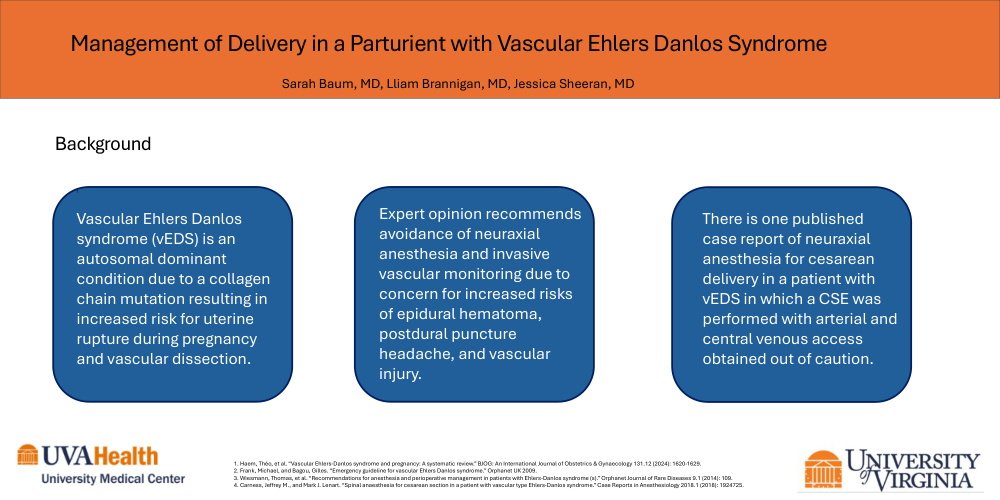
Vascular Ehlers Danlos syndrome (vEDS) is an autosomal dominant condition due to a collagen chain mutation resulting in increased risk for uterine rupture during pregnancy and vascular dissection. Expert opinion recommends avoidance of neuraxial anesthesia and invasive vascular monitoring due to concern for increased risks of epidural hematoma, postdural puncture headache, and vascular injury. There is one published case report of neuraxial anesthesia for cesarean delivery in a patient with vEDS in which a CSE was performed with arterial and central venous access obtained out of caution.
A 38yoF G1P0 with vEDS came to discuss anesthesia for an elective caesarean section. CTA showed no aortic dilation. TTE showed normal heart function with mild MR. During preoperative anesthesia consultation, general anesthesia was recommended over neuraxial anesthesia. The patient strongly preferred neuraxial anesthesia and demonstrated understanding of the associated risks. She underwent uncomplicated spinal anesthesia for caesarean section without invasive monitoring. The intraoperative and immediate postoperative courses were uneventful, and she was discharged on POD 3. Her postpartum course was complicated by preeclampsia with pulmonary edema, heart failure with moderate-severe MR, and pulmonary emboli.
The patient underwent successful neuraxial anesthesia for cesarean delivery without perioperative or neurologic complications. Neuraxial anesthesia may be feasible in carefully selected patients with vEDS following multidisciplinary evaluation and informed shared decision-making. It is possible to safely incorporate patient preference into anesthetic planning when evidence is limited and existing guidelines are based largely on expert opinion.