516 posters, 59 topics, 63 sessions, 1,127 authors, 353 institutions
ePostersLive by SciGen Technologies S.A. All rights reserved.
2026 SOAP Annual Meeting
April 29 - May 3, 2026 | Montreal, Quebec Canada

2337410
Development and Evaluation of a Low-Cost 3D-Printed Scoliosis Neuraxial Training Model
Poster Presenter
Authors
Man Kuan Lei, Lauren Nguyen, Scott Drapeau, Alexander Butwick, Pedram Aleshi, Peter Yeh, Jeremy Juang
Affiliations
, UCSF
Part of Topic
Oral Research Presentations - 4
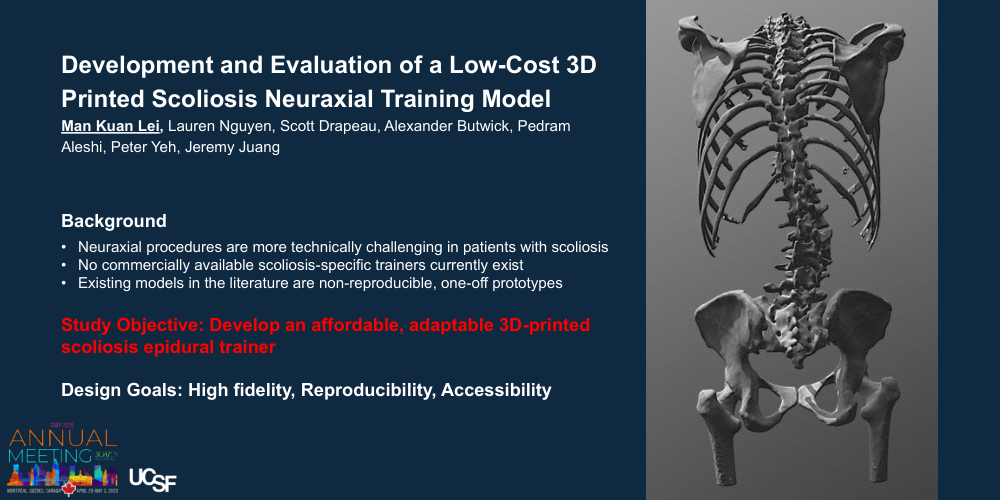
Development and Evaluation of a Low-Cost 3D Printed Scoliosis Neuraxial Training Model
Man Kuan Lei, Lauren Nguyen, Scott Drapeau, Alexander Butwick, Pedram Aleshi, Peter Yeh, Jeremy Juang
Background
Neuraxial procedures are more technically challenging in patients with scoliosis
No commercially available scoliosis-specific trainers currently exist
Existing models in the literature are non-reproducible, one-off prototypes
Study Objective: Develop an affordable, adaptable 3D-printed scoliosis epidural trainer
Design Goals: High fidelity, Reproducibility, Accessibility
Study Design/Methods
Model adaptable on Genesis trainer base
Open-source scoliotic spine file
Fabrication: Blender, standard desktop 3D printers, silicone
Low cost: ~$40 per unit
Results
33 participants total: 20 residents (60%), 13 attendings/fellows (40%)
Results
NASA Simulation Task Load Index (SIM-TLX) assessment tool
Results
Performance feedback
Conclusion
Moderate cognitive workload
Low physical/environmental burden
Strong perceived fidelity and educational value
Scalable Low-cost
Next Steps
Improve realism and cost-efficiency
Ultrasound-compatibility
Simulator performance → clinical outcomes?
References
1. 3D Print Med 2025. doi:10.1186/s41205-025-00266-x
2. PloS one 2018. doi: 10.1371/journal.pone.0191664
3. Virtual Reality 2020. doi: 10.1007/s10055-019-00422-9
4. Scoliosis. Sketchfab. https://skfb.ly/6BNMP