516 posters, 59 topics, 63 sessions, 1,127 authors, 353 institutions
ePostersLive by SciGen Technologies S.A. All rights reserved.
2026 SOAP Annual Meeting
April 29 - May 3, 2026 | Montreal, Quebec Canada

2340517
Anesthetic Challenges in a Parturient with history of Peripartum Cardiomyopathy status post AICD Implantation, and Morbid Obesity: A Case Report
Poster Presenter
Part of Topic
ARRHYTHMIAS, AICDS, AND PACEMAKERS
Anesthetic Challenges in a Parturient with History of Peripartum Cardiomyopathy Status Post AICD Implantation and Morbid Obesity
Soujanya Tirupati, MD, MBBS; Nithya Narayana, BS; Kylie Bui, BS; David Hundley, DO; Kristin Falce, MD; Onyi Onuoha, MD, MPH
Department of Anesthesiology, Critical Care, and Pain Medicine, Obstetric Anesthesia Division, UTHealth Houston McGovern Medical School
Peripartum Cardiomyopathy
• PPCM: rare, life-threatening cardiomyopathy of unknown etiology.
• Occurs in the peripartum period in previously healthy women.
• Leading cause of maternal mortality in the USA and the UK.
• Hallmark: reduced ejection fraction →heart failure.
• Physiologic pregnancy changes (↑blood volume, ↑ CO, ↓ SVR) precipitate decompensation.
Morbid Obesity Compounds Risk
• BMI ≥ 40: independently elevates cardiovascular and anesthetic risk.
• ↑ Risk of VTE, cardiac decompensation, and perioperative complications.
• Anesthetic challenges: difficult neuraxial access, high-risk airway.
• Obesity + heart disease = markedly increased risk of maternal cardiovascular events.
AICD in the Parturient
• Prior PPCM → recurrence risk in subsequent pregnancies.
• H/o of AICD implantation in prior pregnancy signals severe cardiomyopathy with arrhythmia risk.
• Perioperative AICD considerations: Electromagnetic interference, magnetic use protocols.
• Requires dedicated cardiac anesthesia and electrophysiology planning.
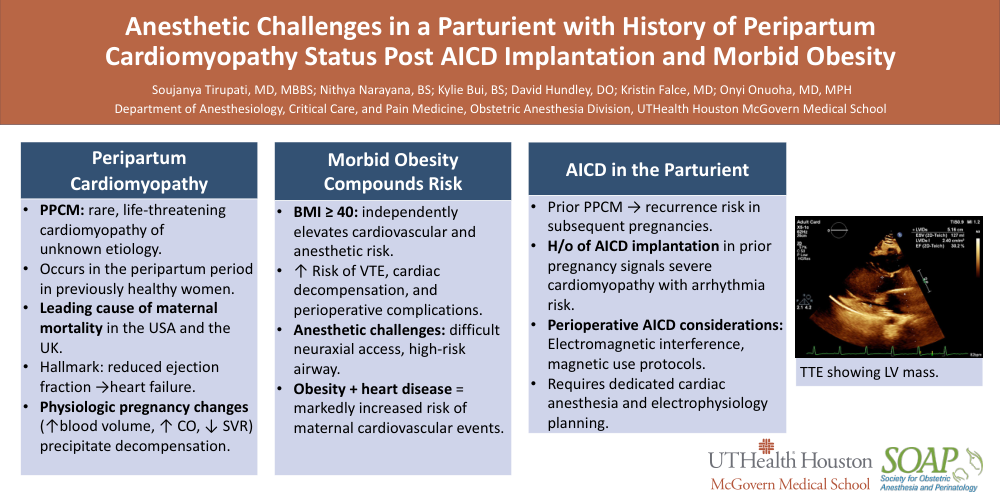
TTE showing LV mass.
Case Presentation: 29 y/o, G2P1, 37w2d
Patient Profile and Findings
Age / Gravidity: 29-year-old female, G2P1
Gestational Age: 37 weeks 2 days
Planned Procedure: Repeat cesarean section
Morbid Obesity: BMI 53
Chronic Hypertension: documented
OB Hx: PPCM in Prior Pregnancy s/p AICD placement
Pre-op TTE Findings
LV: Mildly dilated, moderately reduced systolic function
Ejection Fraction: 35%
RV: Normal size and function
ICD Lead: Visualized on echo
RVSP: 48 mmHg (elevated)
Anesthetic and Perioperative Management
1. Multidisciplinary team: MFM, Cardiology, OB Anesthesia, Cardiac Anesthesia
2. FloTrac arterial line: for monitoring advanced hemodynamic parameters, such as MAP, SV, SVV, CO, CI, and SVR
3. Neuraxial anesthesia- Epidural L3-L4: gradual titration of 0.5% Bupivacaine + 2% Lidocaine with epinephrine
4. Phenylephrine infusion: to maintain BP and avoid sudden hemodynamic shifts
5. ECMO sheaths: placed in the OR prophylactically, after neuraxial placement but before surgery
6. Epinephrine infusion on standby: ready for inotropic (contractility) support
7. Uneventful intraoperative course → Cardiac ICU postoperatively
Post-op: ECMO sheaths removed
POD 1 & discharged POD 4
Teaching Points & Key Takeaways
Preconception Counseling
Obesity is a modifiable risk factor and prior h/o PPCM is concerning. Both BMI optimization and cardiac workup should begin before subsequent pregnancies.
Multidisciplinary Planning is Essential
Early involvement of MFM, cardiology, OB anesthesia, and cardiac anesthesia improves preparedness and maternal outcomes.
Anticipate the Worst, Plan for Rescue
ECMO sheath pre-placement enables rapid escalation if circulatory collapse occurs post-delivery due to autotransfusion with ↑↑ CO.
Neuraxial Anesthesia is Preferred
Reduces 30-day mortality, avoids highrisk airway manipulation, decreases catecholamine release, and provides superior analgesia vs. general anesthesia.
Titrated Epidural > Single-Shot Spinal
In reduced-EF patients, gradual titration avoids precipitous preload/afterload shifts that can cause decompensation.
Postoperative ICU Monitoring is Critical
Hemodynamic instability risk persists beyond delivery. Cardiac ICU monitoring is essential in the immediate postoperative period.
References
1. Sumikura H, Hamada T, Idei M. Anesthetic management of parturients with peripartum cardiomyopathy. Masui. 2014 Jan;63(1):31-38
2. Pfaller B, Siu SC, D'Souza R, Wichert-Schmitt B, Nair GKK, Haberer K, Maxwell C, Silversides CK. Impact of obesity on outcomes of pregnancy in women with heart disease. J Am Coll Cardiol. 2021 Mar 16;77(10):1317-1326
3. Taylor CR, Dominguez JE, Habib AS. Obesity and obstetric anesthesia: current insights. Local Reg Anesth. 2019 Nov 18;12:111-124