516 posters, 59 topics, 63 sessions, 1,127 authors, 353 institutions
ePostersLive by SciGen Technologies S.A. All rights reserved.
2026 SOAP Annual Meeting
April 29 - May 3, 2026 | Montreal, Quebec Canada

2341881
POST-DURAL PUNCTURE HEADACHE COMPLICATED BY INTRACRANIAL HEMORRHAGE: CASE REPORT
Poster Presenter
Authors
Affiliations
Part of Topic
ELEVATED ICP
POST-DURAL PUNCTURE HEADACHE COMPLICATED BY INTRACRANIAL HEMORRHAGE: CASE REPORT
Introduction
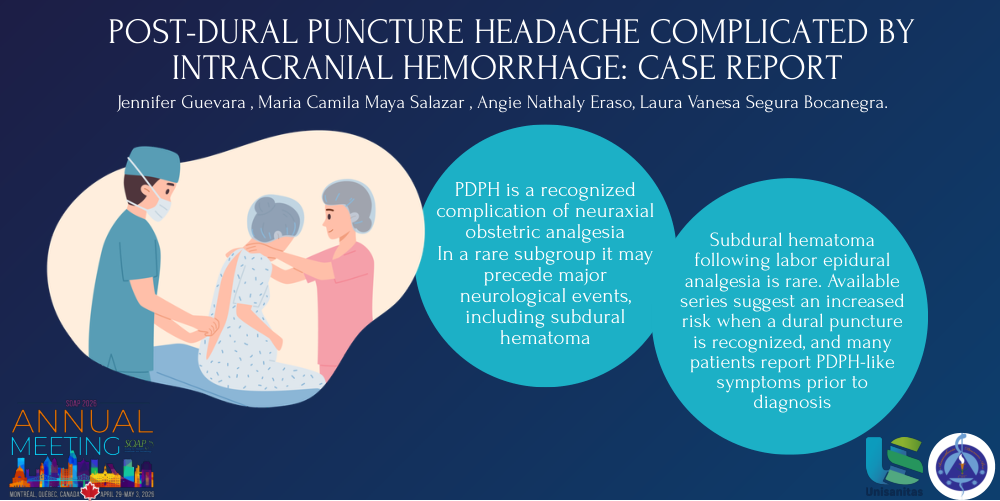
Post-dural puncture headache (PDPH) is a recognized complication of neuraxial obstetric analgesia; however, in a rare subgroup it may precede major neurological events, including subdural hematoma (1). The initial presentation may resemble typical PDPH and later evolve into persistent, non-orthostatic headache and/or neurological deterioration (3). We report an unusual puerperal case of subdural and intraparenchymal hemorrhage, emphasizing the need to broaden the differential diagnosis when postpartum headache does not follow the expected course.
Case presentation
A 38-year-old woman, ASA II, G2P1V1, was admitted to our labor and delivery unit in active labor. Epidural analgesia was requested; an accidental dural puncture occurred with a Tuohy 18G needle. The needle was removed, and the technique was repeated at another interspace. She subsequently had an instrument-assisted delivery without complications. At 24 hours, follow-up revealed no evidence of PDPH, and she was discharged with recommendations. Two days later she presented with holocranial headache, predominantly occipital, rated VAS 8/10, with an orthostatic pattern and cervical radiation. Multimodal management was initiated; magnetic resonance imaging and venography were within normal limits. Seventy-two hours later, an epidural blood patch was performed with 20 ml of autologous blood, resulting in partial pain relief (VAS 3/10). Overnight she developed confusion. Non-contrast head CT revealed a left parietal intraparenchymal hematoma (34.5 × 35.1mm) with perilesional edema and a 9.5mm midline shift. Angio-MRI demonstrated a 22cc lesion, consistent with an acute hemorrhagic venous infarct, associated with an ipsilateral laminar subdural hematoma (8mm) and diffuse pachymeningeal enhancement. Neurological examination showed Glasgow 14/15, disorientation, fluent aphasia with paraphasias, and homonymous hemianopsia. She was transferred to the ICU for medical management and monitoring. Her clinical course remained stationary with digital agnosia and acalculia. Three days later follow-up CT demonstrated a stable parieto-occipital intraparenchymal hematoma and a left laminar subdural hematoma with slight reduction. Fourteen days after the event, the patient improved; she continued to exhibit retrograde amnesia and persistent acalculia, without impairment of other major executive functions, and was discharged.
Discussion
Subdural hematoma following labor epidural analgesia is rare. Available series suggest an increased risk when a dural puncture is recognized, and many patients report PDPH-like symptoms prior to diagnosis (3,4). This case highlights that deviations from the expected PDPH pattern—such as persistence, loss of orthostatic features, or new neurological signs—should prompt urgent reassessment and repeat neuroimaging in postpartum headache.