516 posters, 59 topics, 63 sessions, 1,127 authors, 353 institutions
ePostersLive by SciGen Technologies S.A. All rights reserved.
2026 SOAP Annual Meeting
April 29 - May 3, 2026 | Montreal, Quebec Canada

2341083
Apgar score according to neonates’ race and associations with skin-to-skin initiation and resuscitative interventions
Poster Presenter
Authors
Part of Topic
Potpourri
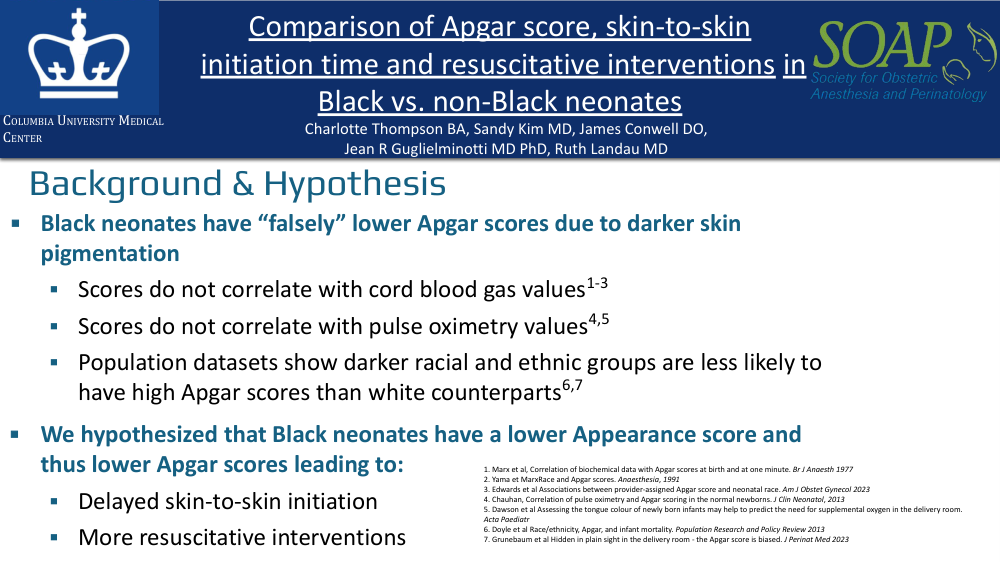
Comparison of Apgar score, skin-to-skin initiation time and resuscitative interventions in Black vs. non-Black neonates.
Black neonates have “falsely” lower Apgar scores due to darker skin pigmentation
Scores do not correlate with cord blood gas values1-3
Scores do not correlate with pulse oximetry values4,5
Population datasets show darker racial and ethnic groups are less likely to have high Apgar scores than white counterparts6,7
We hypothesized that Black neonates have a lower Appearance score and thus lower Apgar scores leading to:
Delayed skin-to-skin initiation
More resuscitative interventions
An observational cross-sectional study of neonates born via cesarean delivery between 11/2023 and 11/2025 at two centers
Exposure of neonate race
Primary outcome was Apgar score at 1 min (Appearance score)
Secondary outcomes are skin-to-skin initiation time and resuscitative interventions
Resuscitative interventions included O2 blowby, positive pressure ventilation, intubation, NICU admission
Lower Apgar scores are associated with delayed skin-to-skin times and more interventions
Black neonates have significantly later skin-to-skin initiation times and lower Apgar scoring, due to lower Appearance scores, than Hispanic neonates.
There was no difference in resuscitation interventions in Black vs. non-Black neonates
This could be due to differences of interpretations of Apgar scores based on neonate race, or if resuscitation efforts are based on clinical indications rather than Apgar scores.
Future studies evaluating modified Apgar score without appearance component and its effect on downstream outcomes such as skin-to-skin initiation times and resuscitative interventions is warranted.