516 posters, 59 topics, 63 sessions, 1,127 authors, 353 institutions
ePostersLive by SciGen Technologies S.A. All rights reserved.
2026 SOAP Annual Meeting
April 29 - May 3, 2026 | Montreal, Quebec Canada

2330000
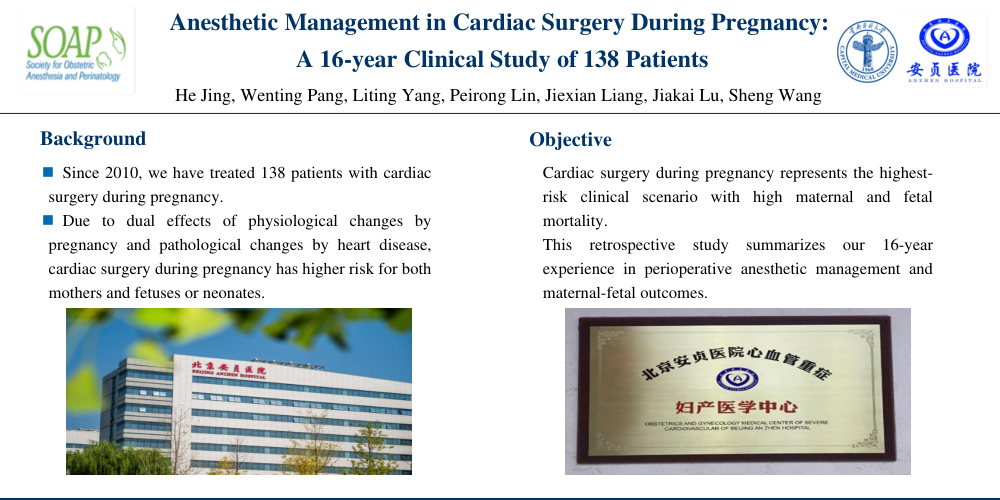
Anesthetic management in cardiac surgery during pregnancy: a 16-year clinical study of 138 patients
Part of Topic
Cardiac and Misc
Anesthetic management in cardiac surgery during pregnancy: a 16-year clinical study of 138 patients
He Jing, Wenting Pang, Liting Yang, Peirong Lin, Jiexian Liang, Jiakai Lu, Sheng Wang
Objective: Cardiac surgery during pregnancy represents the highest-risk clinical scenario with high maternal and fetal mortality. This retrospective study summarizes our 16-year experience in perioperative anesthetic management and maternal-fetal outcomes.
Methods: This study pooled clinical data from two major national cardiovascular centers in China, including 138 patients who underwent cardiac surgery during pregnancy (2010–2025). Patients were divided into two groups by fetal management: Cardiac surgery with fetus in situ or Cesarean delivery (CS) prior to cardiac surgery.
Results: A total of 138 patients undergoing cardiac surgery during pregnancy were included. The most common etiologies were aortic dissection (35.5%) and valvular heart disease (28.3%). All patients underwent preoperative multidisciplinary team discussion. The median time from presentation to surgery was 19 days. 61 patients (44.2%) underwent emergency surgery. The utilization rate of intraoperative transesophageal echocardiography (TEE) was 64.5%, and that of advanced hemodynamic monitoring with cardiac output measurement (FloTrac or pulmonary artery catheter) was 42%. Continuous fetal heart rate monitoring was employed in 37.0% of cases. Intraoperative autologous blood transfusion was used in all patients, and the incidence of massive transfusion (>10 units of red blood cells) was 3.6%. The median of the peak intraoperative vasoactive-inotropic score (VIS) was 5 mg.kg-1.min-1. Immediate extubation in the operating room was achieved in 12.3% of patients, and multimodal regional analgesia was applied in 15.9% of cases. The median duration of postoperative mechanical ventilation was 21 hours, and the median intensive care unit (ICU) length of stay was 3 days. There were 4 maternal deaths. No intraoperative maternal death occurred; all four deaths occurred postoperatively between 10 and 30 days after surgery. The overall fetal-neonatal mortality rate was 23.9%. In the Cardiac surgery with fetus in situ group, there were 3 intraoperative fetal deaths and 25 postoperative fetal deaths, which occurred at a median of 10 days (range, 4-20 days) after maternal surgery. In the CS prior to cardiac surgery group 5 neonates died after delivery.
Conclusion: Maternal and fetal safety during cardiac surgery in pregnancy is highly dependent on precise, anesthesia-centered perioperative management. The core principles include: 1) conducting comprehensive preoperative evaluation (multidisciplinary discussion, risk stratification); 2) assuming the role of the central coordinator for in-operating room resuscitation, aligning multidisciplinary efforts towards unified goals; and 3) implementing goal-directed interventions (comprehensive monitoring, precise blood management, vasoactive drug administration and enhanced recovery principles).