516 posters, 59 topics, 63 sessions, 1,127 authors, 353 institutions
ePostersLive by SciGen Technologies S.A. All rights reserved.
2026 SOAP Annual Meeting
April 29 - May 3, 2026 | Montreal, Quebec Canada

2338802
Avoiding Pheochromocytoma Crisis During Delivery in a Parturient with a Large Tumor and Lynch Syndrome
Poster Presenter
Authors
Julio-Santiago Perez, Fred Mihm, Dominique Arce, Kelly Joyce, Fatine Karkri, Emily Stockert
Affiliations
Part of Topic
STRANGE CONDITIONS
Avoiding Pheochromocytoma Crisis During Delivery in a Parturient with a Large Tumor and Lynch Syndrome
Julio-Santiago Pérez, MD; Fred Mihm, MD; Dominique Arce, MD, MPH; Kelly Thomas Joyce MD; Fatine Karkri, MD; Emily Stockert, MD, MBA
Patient:
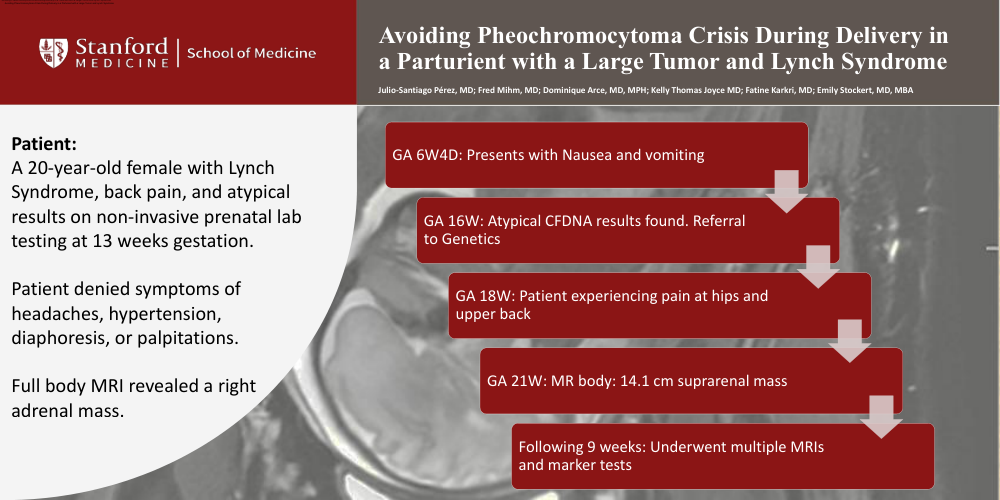
A 20-year-old female with Lynch Syndrome in 2023 had atypical results on non-invasive prenatal testing at 13 weeks gestation and reported back pain.
Full body MRI revealed a right adrenal mass.
Patient denied symptoms of headaches, hypertension, diaphoresis, or palpitations.
GA 6W4D: Presents with Nausea and vomiting
GA 16W: Atypical CFDNA results found. Referral to Stanford Genetics
GA 18W: Patient experiencing back pain level at hips and upper back
GA 21W: MR body: 14.1 cm suprarenal mass
Following 9W: Underwent multiple MRIs and marker tests
GA 33W6D: Cesarean Delivery of healthy baby girl
7W post-delivery: Open right adrenalectomy and tumor resection
Characteristics and Hunt for Diagnosis
Abnormal Lab findings
- Urine normetanephrines 4115 (nl 103-390)
- VMA 118.4 (nl 7)
- HVA 83.8 (nl <8)
- metanephrine 193 (nl 30-180)
- total 4308 (normal 142-510)
Normal Lab Findings
- Urine dopamine 194
- Epinephrine 1.5
- Norepinephrine 49
Cesarean Delivery for Suspected Pheochromocytoma (PCC)
Timing:
- Elective, controlled setting, and avoiding labor.
- Delivery typically 34-37 wks
- CD first then resection later.
Optimization:
- Volume expansion
- Alpha-blockade > Beta-Blockade
Anesthesia:
- Neuraxial (epidural/spinal) preferred
- Avoid abdominal compression
- Avoid catecholamine release
- Ketamine & ephedrine
- Pain
- IV access & arterial BP
- Infusions/medications for hemodynamics
Preoperative management
Multidisciplinary team
• Interval imaging
• Labs (genetic)
• Clinical assessments
• Optimization with Doxazosin (shorter half-life)
Operative Management
• Cesarean Delivery at 33w6d
Vascular Access:
• RIJ central line (CVP)
• Arterial line
Neuraxial Analgesia:
• CSE Fent 25 mcg, morph 0.1 mg, 1 mL 0.7% bupi
Infusions:
• Nitroprusside
• Clevidipine
• Esmolol
• Oxytocin 1U / 7.5 U/hr
• Normosol 1,500 mL
Surgical Technique
• Generous uterine incision for easy extraction
Complications:
• POD9: ED with postpartum endometriosis and bacterial vaginosis.
• fever, tachycardia, and uterine tenderness.
• Treated with Abx.