516 posters, 59 topics, 63 sessions, 1,127 authors, 353 institutions
ePostersLive by SciGen Technologies S.A. All rights reserved.
2026 SOAP Annual Meeting
April 29 - May 3, 2026 | Montreal, Quebec Canada

2338422
Reflections on 2 high-risk cardio-obstetrical patients
Poster Presenter
Authors
Affiliations
Part of Topic
CARDIO OBSTETRIC CHALLENGES
Introduction
With the advancement in medical care, increased maternal age, and multiple comorbidities, the high-risk cardio-obstetrical patients are more prevalent and account for the foremost cause of maternal mortality in high-income countries, with Canada reporting an 8% rate.
The literature cites an increase in indications and use of peripartum ECMO.
The literature cites an increase in indications and use of peripartum ECMO.
Case One
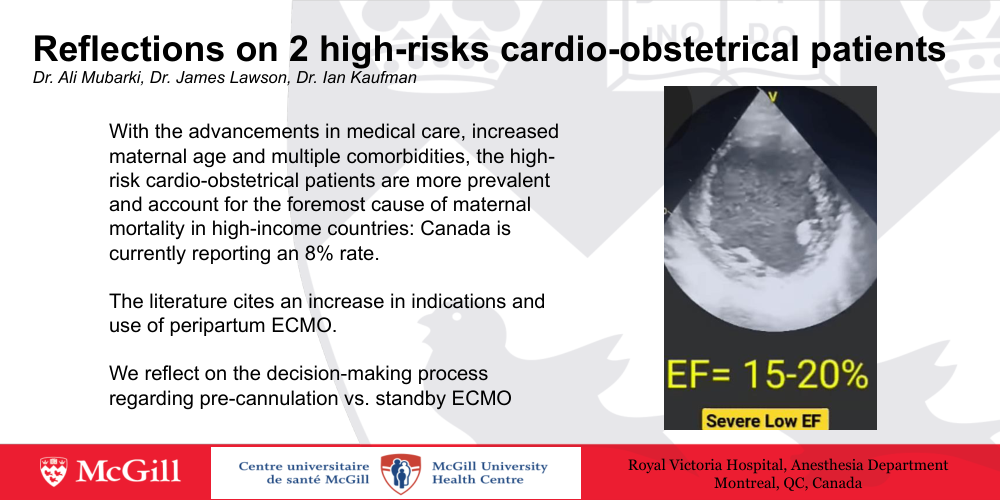
29 yo, G1P0, previously healthy, presented at 37+ 5 w GA with sudden onset of dyspnea. Investigations revealed de novo severe heart failure with LVEF 15–20% and moderate mitral regurgitation, suggestive of peripartum cardiom yopathy. An urgent cesarean delivery was performed under carefully titrated epidural anesthesia. A peripherally inserted central catheter (Picc line) was placed before surgery, whereas the arterial line and ExtraCorporeal Membrane Oxygenation (ECMO) catheters were placed in the operating room, before performing the neuraxial anesthesia. The procedure went uneventfully; the patient needed Norepinephrine during and immediately after the case, but no ECMO. Two weeks postpartum, the patient was discharged with an EF 30%, asymptomatic.
Case Two
38 yo, G4P2A1, obese, stable multiple sclerosis, with placenta praevia, and suspected of accreta, presented at 25 w GA with preterm premature rupture of membranes and dyspnea with orthopnea: the echocardiography shows severe biventricular systolic dysfunction with LVEF 10%, pulmonary hypertension sPAP 46 mmHg, and severe mitral regurgitation. Due to the gravity and urgency of the clinical deterioration, with increased lactate and need for hemodynamic support with inotropes and vasopressors, the patient underwent emergent cesarean delivery under general anesthesia. Central triple lumen catheter, arterial line and ECMO femoral lines were placed before the induction of general anesthesia. The procedure was uneventful, and the patient was extubated at the end of the case; 2 weeks postpartum EF was still 10%, therefore, a PM/ICD was installed, and at 30 days, the patient was discharged home.
Discussion
A multidisciplinary team was involved in each case. Cardiac risk stratification tools (mWHO, CARPREG) were used. Individualized treatment and strategic plans were made based on patients' cardiac lesions, pregnancy and fetal status, following the who-what-when-where-how delivery framework.
We chose VA precannulation ECMO for both of our cases; we did not have to initiate the ECMO therapy. Both patients were safely decannulated in the postpartum period; no complications related to the ECMO lines were reported
We reflect on the decision-making process regarding the precannulation vs. standby ECMO. We choose based on predictability + reversibility + time -to-rescue criterias. There are no guidelines yet.
We chose VA precannulation ECMO for both of our cases; we did not have to initiate the ECMO therapy. Both patients were safely decannulated in the postpartum period; no complications related to the ECMO lines were reported
We reflect on the decision-making process regarding the precannulation vs. standby ECMO. We choose based on predictability + reversibility + time -to-rescue criterias. There are no guidelines yet.