516 posters, 59 topics, 63 sessions, 1,127 authors, 353 institutions
ePostersLive by SciGen Technologies S.A. All rights reserved.
2026 SOAP Annual Meeting
April 29 - May 3, 2026 | Montreal, Quebec Canada

2336782
Patterns of intravenous access used for labor and delivery at Society for Obstetric Anesthesia and Perinatology Centers of Excellence – a cross-sectional survey study
Poster Presenter
Part of Topic
Efficiency, Education, Access
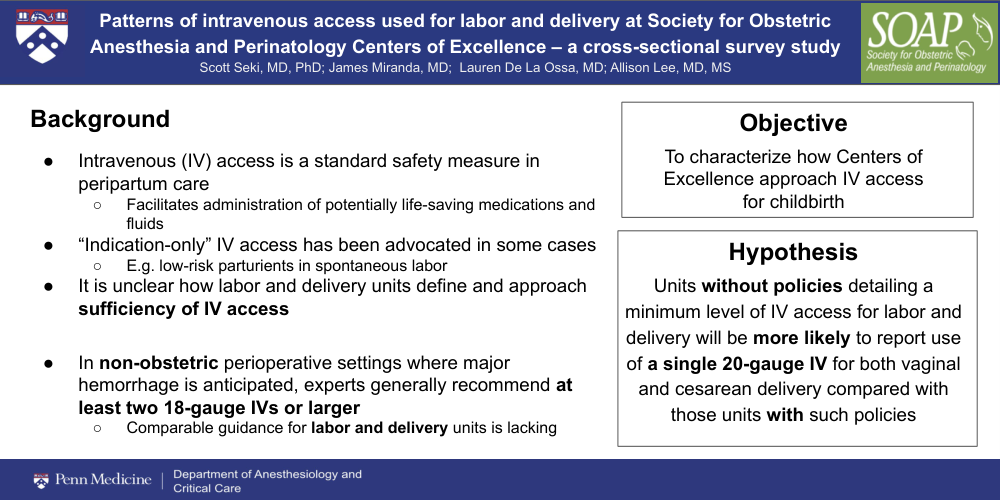
Background ● Intravenous (IV) access is a standard safety measure in peripartum care ○ Facilitates administration of potentially life-saving medications and fluids ● “Indication-only” IV access has been advocated in some cases ○ E.g. low-risk parturients in spontaneous labor ● It is unclear how labor and delivery units define and approach sufficiency of IV access ● In non-obstetric perioperative settings where major hemorrhage is anticipated, experts generally recommend at least two 18-gauge IVs or larger ○ Comparable guidance for labor and delivery units is lacking Objective To characterize how CoEs approach IV access for childbirth Hypothesis Units without policies detailing a minimum level of IV access for labor and delivery will be more likely to report use of a single 20-gauge IV for both vaginal and cesarean delivery compared with those units with such policies Patterns of intravenous access used for labor and delivery at Society for Obstetric Anesthesia and Perinatology Centers of Excellence – a cross-sectional survey study Scott Seki, James Miranda, Lauren De La Ossa, Allison Lee Study design and methods ● Survey of labor and delivery units designated by the Society for Obstetric Anesthesia and Perinatology (SOAP) as Centers of Excellence (CoEs) in February 2025 ● Survey asked respondents to describe their existing division policies and practices related to venous access for labor and delivery Primary outcome: Rate at which respondents reported “commonly” using a single 20-gauge IV or smaller for vaginal or cesarean delivery Secondary outcome: To understand how clinical contexts influenced decision-making regarding IV access ○ Ex: elevated hemorrhage risk, difficult venous access Patterns of intravenous access used for labor and delivery at Society for Obstetric Anesthesia and Perinatology Centers of Excellence – a cross-sectional survey study Scott Seki, James Miranda, Lauren De La Ossa, Allison Lee Results IV = intravenous; VD = Vaginal Delivery; CD = Cesarean Delivery Type of policy related to IV access for labor and delivery Number with policy / total number of respondents (%) Policy specifying minimum level of IV access needed for routine labor and delivery by any means 24/38 (63.2%) Risk stratification tool to identify parturients at high risk of postpartum hemorrhage 37/38 (97.3%) Policy specifying minimum level of IV access needed when postpartum hemorrhage risk is high 29/38 (76.3%) Policy detailing how to approach IV access in parturients where it is known to be difficult 15/38 (39.5%) Unit policy detailing minimum IV access appropriate for childbirth Yes (n=24) No/Unsure (n=14) VD Single 20-gauge IV or smaller commonly used for delivery Yes 3 (12.5%) 3 (21.4%) No 21 (87.5%) 11 (78.6%) Multiple IVs commonly used for delivery Yes 8 (33.3%) 1 (7.1%) No 16 (66.7%) 13 (92.9%) CD Single 20-gauge IV or smaller commonly used for delivery Yes 3 (12.5%) 3 (21.4%) No 21 (87.5%) 11 (78.6%) Multiple IVs commonly used for delivery Yes 8 (33.3%) 2 (14.3%) No 16 (66.7%) 12 (85.7%) Type of assistive device / personnel reportedly available Number with / total number of respondents (%) Ultrasound with vascular probe 33/38 (86.8%) Nurses trained in ultrasound IV access 9/38 (23.7%) Anesthesia providers trained in ultrasound IV access 34/38 (89.5%) Vein illuminator 13/38 (34.2%) Vascular access team 23/38 (60.5%) Patterns of intravenous access used for labor and delivery at Society for Obstetric Anesthesia and Perinatology Centers of Excellence – a cross-sectional survey study Scott Seki, James Miranda, Lauren De La Ossa, Allison Lee Conclusion & Discussion ● Labor and delivery units frequently reported using only a single 20-gauge IV catheter for childbirth ○ This is especially true of those without policies related to IV access ● Units without a policy reported use of a single 20-gauge IV for childbirth by any mode of delivery nearly twice as often as those with policies ● The perceived impact of a society guideline to standardize the approach to IV access for labor and delivery was mixed ○ Potential to improve communication and outcomes vs concern for unintended potential consequences A society guideline related to approaching IV access for labor and delivery may help standardize care, but should incorporate stakeholder perspectives Patterns of intravenous access used for labor and delivery at Society for Obstetric Anesthesia and Perinatology Centers of Excellence – a cross-sectional survey study Scott Seki, James Miranda, Lauren De La Ossa, Allison Lee Additional research is needed to inform evidence-based guidelines and assess their impact on maternal outcomes.