516 posters, 59 topics, 63 sessions, 1,127 authors, 353 institutions
ePostersLive by SciGen Technologies S.A. All rights reserved.
2026 SOAP Annual Meeting
April 29 - May 3, 2026 | Montreal, Quebec Canada

2318168
Placenta Percreta involving the bladder requiring massive transfusion protocol
Poster Presenter
Authors
Andrew Tseng, Parth Rajguru, Natasha Sinai-Hede, John Wenzel
Affiliations
Part of Topic
COMPLEX ACCRETA
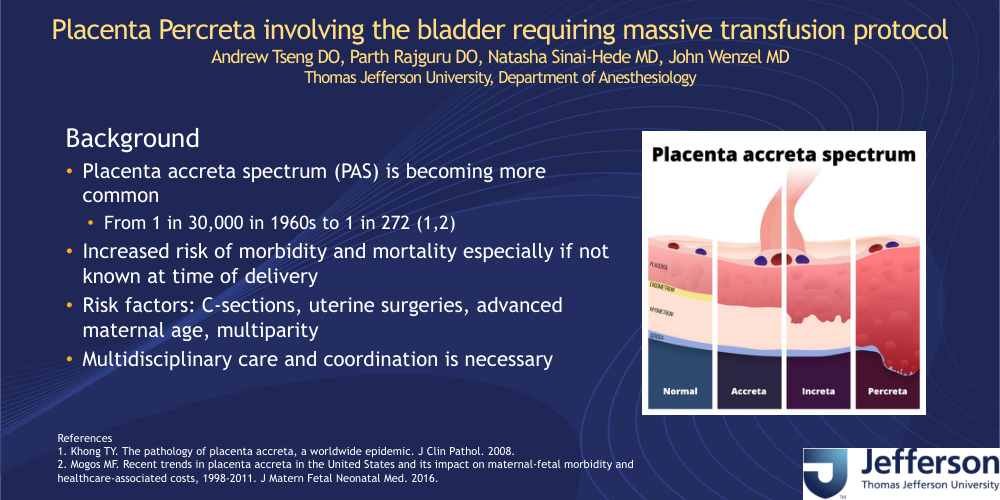
Background
•Placenta accreta spectrum (PAS) is becoming more common
•From 1 in 30,000 in 1960s to 1 in 272 (1,2)
•Increased risk of morbidity and mortality especially if not known at time of delivery
•Risk factors: C-sections, uterine surgeries, advanced maternal age, multiparity
•Multidisciplinary care and coordination is necessary
Case
•37 year-old G6P4013, two prior C-sections and a D&C diagnosed with placenta percreta by ultrasound and MRI at 15 weeks gestation after an episode of vaginal bleeding
•Hematuria and vaginal bleeding at 33w3d with expedited delivery at 33w6d
•Known bladder involvement
•Planned for multidisciplinary C-hysterectomy with OB, MFM, gyn-onc, urology
•Accommodated staffing and personnel changes at a high surgical volume tertiary hospital
•C-hysterectomy under CSE with planned conversion to GA
•EBL ~17L; 24 pRBC, 17 FFP, 5 pooled platelets, 3 pooled cryoprecipitate, 3g TXA, 4g fibrinogen concentrate, 14L crystalloid
•ACS and Interventional Radiology involvement for packing and gelfoam embolization
•Abdominal closure POD1, extubated POD1, epidural removed POD3, discharged POD5
•Complicated post-partum course with 3 additional urologic surgeries and hospitalizations
Teaching points
•Delivery at III or IV care center for known PAS
•Careful coordination and team selection with back ups and flexibility
•Obstetric complex care coordination committee
•Obstetricians, MFM, anesthesiology, nursing, neonatal ICU, cardiology, blood bank and more
•Average blood loss is 3-5L
•Balanced lab guided resuscitation
•Epidural management post-operatively