516 posters, 59 topics, 63 sessions, 1,127 authors, 353 institutions
ePostersLive by SciGen Technologies S.A. All rights reserved.
2026 SOAP Annual Meeting
April 29 - May 3, 2026 | Montreal, Quebec Canada

2333009
Needles, Numbers, and Nuance: Two Cases of Neuraxial Anesthesia in FXI Deficiency
Poster Presenter
Authors
Part of Topic
Misc Hematology
Needles, Numbers, and Nuance: Two Cases of Neuraxial Anesthesia in FXI Deficiency
Fatine Karkri, MD Kimberly Mendoza, MD, PhD, MPH Holgar Mua Fang, MD, MPH, DESAIC Caroline Berube, MD, FRCPC
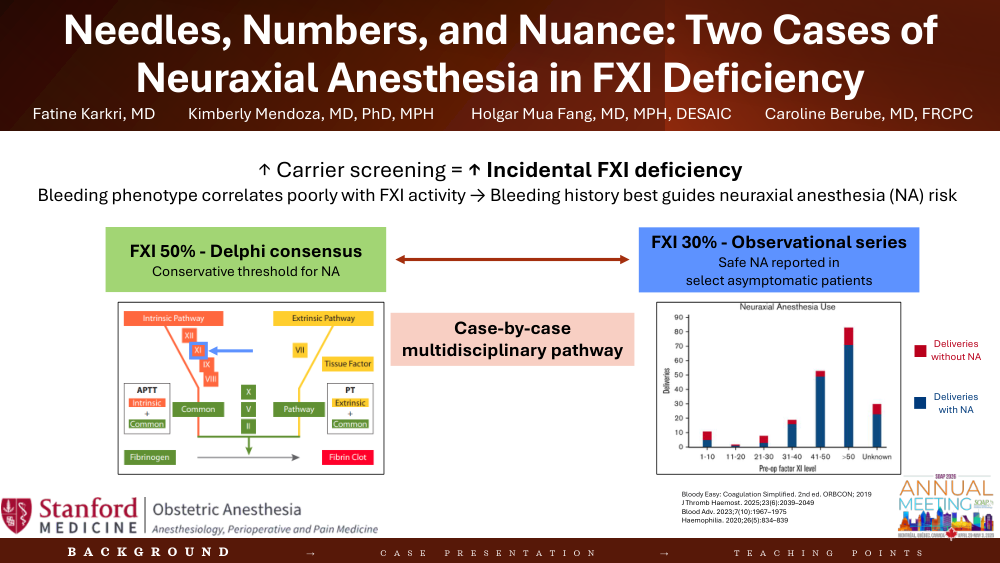
↑ Carrier screening = ↑ Incidental FXI deficiency
Bleeding phenotype correlates poorly with FXI activity → Bleeding history best guides neuraxial anesthesia (NA) risk
FXI 50% - Delphi consensus
Conservative threshold for NA
Case-by-case multidisciplinary pathway
FXI 30% - Observational series
Safe NA reported in
select asymptomatic patients
Patient 1
♀ 43 y/o G1P0
F11 variant by genetics
∅ Bleeding history, prior myomectomy
FXI 42% (35+0 weeks)
Elective cesarean at 37+3 weeks
Single‑shot spinal (uncomplicated)
QBL 1,233 mL
Discharged POD4
Patient 2
♀ 31 y/o G1P0
Heterozygous carrier
Minor prior bleeding
FXI 60% → 36% → 42% (35+2 weeks)
Vaginal delivery at 39+5 weeks
Labor epidural (uncomplicated)
QBL 808 mL
Discharged PPD2
Use bleeding history + targeted 3rd trimester FXI testing to guide NA decisions
•Routine prophylactic TXA or factor replacement was not used in these select cases
Consider point‑of‑care viscoelastic testing (ROTEM/TEG) to complement FXI activity, although not yet validated
→ FXI is usually stable in pregnancy, consider lab variability
Interpret single intermediate FXI values in clinical context
Multidisciplinary team
Hematology-Obstetrics-Anesthesiology
→ Individualize NA decisions for FXI 30–50%
Multidisciplinary planning enabled safe NA in two asymptomatic patients with third‑trimester FXI ≈30-50%