516 posters, 59 topics, 63 sessions, 1,127 authors, 353 institutions
ePostersLive by SciGen Technologies S.A. All rights reserved.
2026 SOAP Annual Meeting
April 29 - May 3, 2026 | Montreal, Quebec Canada

2336409
Burden of chronic postsurgical pain after caesarean delivery on maternal quality of life: a systematic review
Poster Presenter
Authors
Samira Alwahabi, Rebekah Reville Joy, Payton Marshall, Lindsay Blake, Brendan Carvalho, Pervez Sultan, Sarah Ciechanowicz
Affiliations
Charles E. Schmidt College of Medicine, Florida Atlantic University, Boca Raton, FL, USA, Hospital Care Programme, NHS North West London Integrated Care Board, London, UK, Department of Anesthesiology, Perioperative and Pain Medicine, Stanford University School of Medicine, Stanford, CA, USA, University of Arkansas for Medical Sciences Library, Little Rock, AR, USA, University College London Hospitals NHS Foundation Trust, London, UK; Imperial College London, London UK
Part of Topic
Recovery: Pain, Sleep, Anxiety
Background: Chronic postsurgical pain after caesarean delivery is increasingly recognized as a
significant postpartum complication; however, its impact on maternal health-related quality of
life and functional recovery has not been comprehensively synthesized.
Objectives: To evaluate the impact of chronic postsurgical pain on quality of life, including
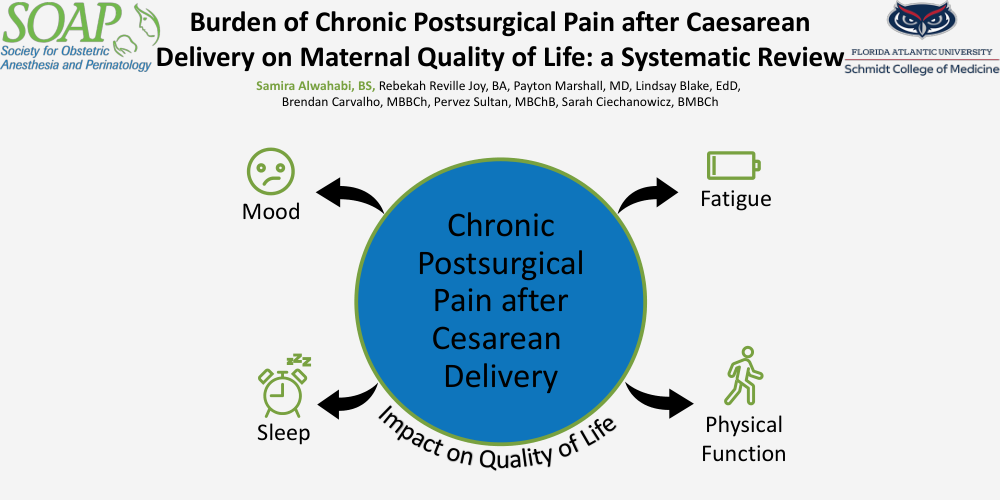
temporal patterns of pain-related interference with physical function, sleep, mood, and fatigue.
Methods: We conducted a PROSPERO-registered systematic review of studies reporting quality
of life outcomes ≥3 months after caesarean delivery in women with persistent pain. Seven
databases were searched through 20 September 2025. Eligible studies included randomized
controlled trials, cohort studies, cross-sectional studies, and prospective observational studies.
Two reviewers independently screened studies, extracted data, and assessed risk of bias. Due to
heterogeneity in chronic postsurgical pain definitions and outcome measures, narrative synthesis
was performed.
Results: Thirty studies involving more than 25,000 women were included. Chronic postsurgical
pain after caesarean delivery was consistently associated with persistent interference in daily
activities, sleep, mood, and energy. Across Brief Pain Inventory cohorts, activity-related
interference was most prominent at 3 months postpartum, while mood-related interference
became increasingly dominant at 6 and 12 months, despite declining pain intensity. Fatigue
showed minimal improvement over time. Postpartum depression was common, and depressive
symptoms and fatigue were frequently associated with chronic postsurgical pain.
Conclusions: Chronic postsurgical pain after caesarean delivery is associated with sustained,
multidimensional impairment in postpartum recovery that extends beyond pain severity alone.
These findings underscore the importance of assessing pain interference and psychosocial
outcomes after caesarean delivery and support the need for standardized, patient-centered quality
of life measures in obstetric anesthesia research.