516 posters, 59 topics, 63 sessions, 1,127 authors, 353 institutions
ePostersLive by SciGen Technologies S.A. All rights reserved.
2026 SOAP Annual Meeting
April 29 - May 3, 2026 | Montreal, Quebec Canada

2340955
Prepare to Fail? The impact of developing an institutional protocol on improving confidence in the management of the failing epidural.
Poster Presenter
Authors
Part of Topic
Making Epidurals Better
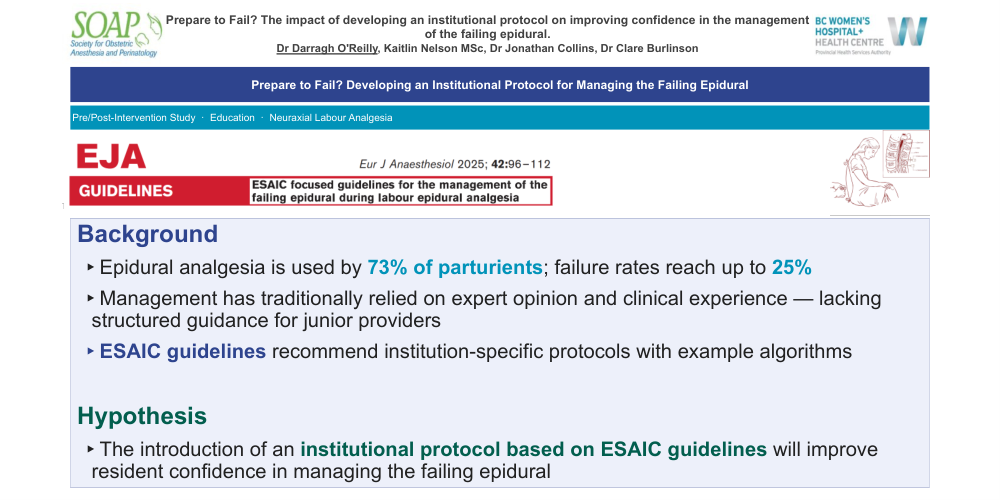
Prepare to Fail? The impact of developing an institutional protocol on improving confidence in the management of the failing epidural.
Dr Darragh O'Reilly, Kaitlin Nelson MSc, Dr Jonathan Collins, Dr Clare Burlinson
SLIDE 1
Pre/Post-Intervention Study · Education · Neuraxial Labour Analgesia
Background
- Epidural analgesia is used by 73% of parturients; failure rates reach up to 25%
- Management has traditionally relied on expert opinion and clinical experience — lacking structured guidance for junior providers
- ESAIC guidelines recommend institution-specific protocols with example algorithms
Hypothesis
- The introduction of an institutional protocol based on ESAIC guidelines will improve resident confidence in managing the failing epidural
SLIDE 2
(Full-bleed image slide — no text content)
SLIDE 3 — Study Overview: Methods & Results
METHODS
Study Design
- Pre/post-intervention study
- Residents stratified: junior vs. senior
Intervention
- Locally developed failing epidural algorithm
- Based on ESAIC guidelines, local practice & expert consultation
Survey & Analysis
- 21 questions, 5-point Likert scale
- Troubleshooting scenarios & non-technical factors
- Descriptive: means & frequency, pre vs. post
RESULTS
Full Cohort (n=36 pre → n=25 post)
- Improved confidence in all domains bar one neutral result
- Exception: low block — neutral (mean 4.08/5)
- Resource awareness: +1.22/5 (2.74 → 3.96)
Subgroup Analysis
Junior
- Improved across most domains
- Unilateral block: mean +0.72/5
Senior cohort
- Sacral sparing: mean +1.21/5
- 50% → 100% very/extremely confident
SLIDE 4 — Conclusion & Discussion
- Education: Using our guideline during targeted teaching increased residents' confidence in managing failing epidurals.
- Senior residents improved less — likely due to greater clinical experience at baseline and informal bedside teaching during junior rotations.
- Our results support using structured, algorithm-based teaching tailored to the institution.
- We hope this work contributes to improving overall epidural analgesia quality and patient experience.