516 posters, 59 topics, 63 sessions, 1,127 authors, 353 institutions
ePostersLive by SciGen Technologies S.A. All rights reserved.
2026 SOAP Annual Meeting
April 29 - May 3, 2026 | Montreal, Quebec Canada

2336406
Making rarity routine: anesthetic and systems approach to TRAP sequence laser ablation in a smaller center
Poster Presenter
Authors
Affiliations
Part of Topic
A TRAP and many EXITS - FETAL HOUR
Making rarity routine: anesthetic and systems approach to TRAP sequence laser ablation in A COMMUNITY HOSPITAL SYSTEM
Authors:
Jessica Bonilla, DO1; Angelica Delgado, MD1,2; Ryan Stalder, MD1. 1 Department of Anesthesiology, Memorial Healthcare System; 2 Division of Anesthesia, Envision Healthcare
Background
Our approach
-
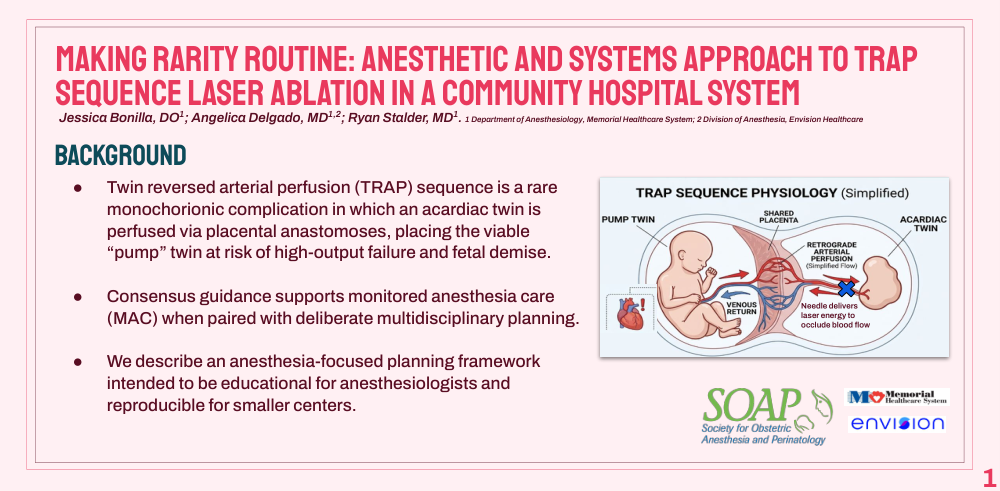
Twin reversed arterial perfusion (TRAP) sequence is a rare monochorionic complication in which an acardiac twin is perfused via placental anastomoses, placing the viable “pump” twin at risk of high-output failure and fetal demise.
-
Consensus guidance supports monitored anesthesia care (MAC) when paired with deliberate multidisciplinary planning.
-
We describe an anesthesia-focused planning framework intended to be educational for anesthesiologists and reproducible for smaller centers.
Our approach
ANESTHETIC MANAGEMENT & SYSTEMS READINESS FRAMEWORK FOR TRAP SEQUENCE
Preop:
Facility Resources: ACOG Level IV maternal and NICU availability.
Multidisciplinary Planning: Defined leads across OB, MFM, anesthesia, and nursing with completed OR walk-throughs.
Patient Assessment & Counseling: Formal anesthesia consult and shared decision-making regarding MAC vs. general anesthesia.
Intraop:
Primary Anesthetic Strategy: MAC using remifentanil, dexmedetomidine and midazolam with local infiltration.
Conversion-to-GA Readiness: Immediate availability of airway equipment and induction agents.
Explicit Triggers: Predefined triggers for conversion to general anesthesia, including maternal intolerance, emesis, or procedural escalation.
Postop:
Defined Recovery Plan: Predetermined recovery location with a clear multidisciplinary hand-off and fetal surveillance per MFM / NICU.
A 31-year-old G2P1 at 19w5d undergoing interstitial laser ablation for TRAP with MAC anesthesia.
Teaching points
This work describes a streamlined and reproducible approach for rare, high-stakes fetal interventions.
-
Anesthetic selection as a shared decision, balancing procedural invasiveness, aspiration/airway risk, and need for maternal cooperation.
-
Explicit, prebriefed conversion triggers (maternal intolerance, refractory emesis/aspiration concern, or procedural escalation/poor visualization requiring change in approach).
-
A systems checklist emphasizing rehearsals, role clarity, equipment readiness, and escalation pathways (NICU, maternal ICU, emergent delivery capability).
A structured workflow can make complex fetal procedures safely achievable outside large referral centers.
Case Conclusion:
Surgery proceeded without maternal or fetal instability. Postprocedural ultrasound showed persistent but minimal arterial flow to the acardiac twin. The patient delivered by cesarean section at 27 weeks after PPROM associated with vaginal infection; the acardiac mass was removed at delivery.