516 posters, 59 topics, 63 sessions, 1,127 authors, 353 institutions
ePostersLive by SciGen Technologies S.A. All rights reserved.
2026 SOAP Annual Meeting
April 29 - May 3, 2026 | Montreal, Quebec Canada

2340433
Seconds to Deliver: Maternal Arrest and Resuscitative Cesarean Delivery in Suspected Amniotic Fluid Embolism
Poster Presenter
Part of Topic
Call for ECMO!
BACKGROUND
* Amniotic Fluid Embolism (AFE) is a rare but severe obstetric emergency, occurring in approximately 1 in 40,000 U.S. deliveries.¹
* AFE results from amniotic fluid or fetal material entering maternal circulation, triggering an acute systemic inflammatory and cardiopulmonary response.¹
* Presentation is variable, including cardiovascular collapse, respiratory failure, seizures, nausea, vomiting, and confusion.¹
* AFE often includes two phases:
1. Initial cardiopulmonary collapse
2. Hemorrhagic/coagulopathic phase.²
CLINICAL PRESENTATION
38-year-old G3P2 at 39w3d presented after spontaneous rupture of membranes requiring labor augmentation with oxytocin and epidural analgesia.
Labor → Collapse
Hypotension + fetal decels
* Vasopressors / repositioning / terbutaline
* Anxiety, nausea/vomiting, worsening hypotension, unresponsiveness, seizure-like activity
→ PEA arrest
* CPR
* Perimortem cesarean after 3 mins → ROSC (neonate survived)
* POCUS: RV strain
* Dobutamine initiated
Hemorrhage Phase
Massive postpartum hemorrhage
* FAST: hemoperitoneum
* Uterotonics / tranexamic acid / JADA device / massive transfusion
* Emergent laparotomy
Secondary Collapse
Transport for uterine artery embolization
* Recurrent VT/VF arrest → CPR
* VA-ECMO initiated
* Limited response due to abdominal compartment physiology and severe LV dilation
TABLES AND FIGURES
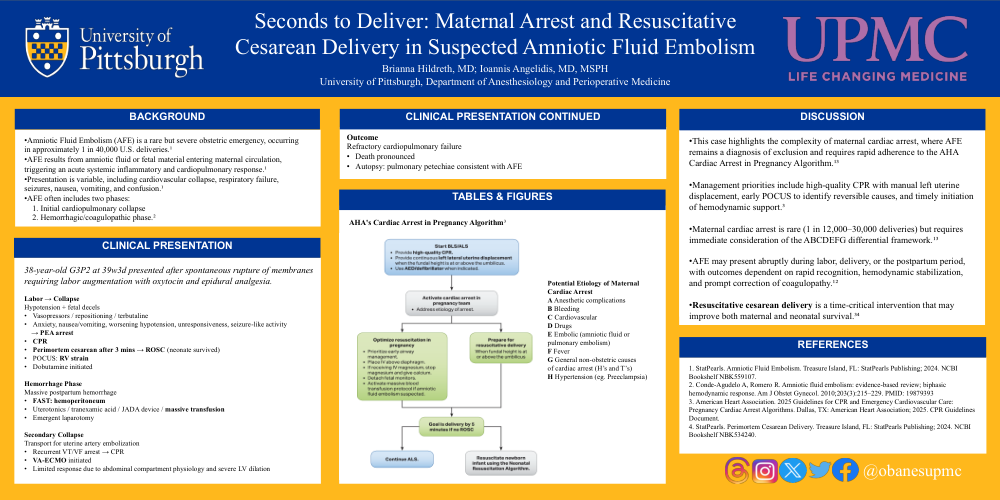
AHA's Cardiac Arrest in Pregnancy Algorithm³
(TABLE)
Potential Etiology of Maternal Cardiac Arrest
A Anesthetic complications
B Bleeding
C Cardiovascular
D Drugs
E Embolic (amniotic fluid or pulmonary embolism)
F Fever
G General non-obstetric causes of cardiac arrest (H’s and T’s)
H Hypertension (eg. Preeclampsia)
DISCUSSION
* This case highlights the complexity of maternal cardiac arrest, where AFE remains a diagnosis of exclusion and requires rapid adherence to the AHA Cardiac Arrest in Pregnancy Algorithm.¹³
* Management priorities include high-quality CPR with manual left uterine displacement, early POCUS to identify reversible causes, and timely initiation of hemodynamic support.³
* Maternal cardiac arrest is rare (1 in 12,000–30,000 deliveries) but requires immediate consideration of the ABCDEFG differential framework.¹³
* AFE may present abruptly during labor, delivery, or the postpartum period, with outcomes dependent on rapid recognition, hemodynamic stabilization, and prompt correction of coagulopathy.¹²
* Resuscitative cesarean delivery is a time-critical intervention that may improve both maternal and neonatal survival.³⁴
REFERENCES
1. StatPearls. Amniotic Fluid Embolism. Treasure Island, FL: StatPearls Publishing; 2024. NCBI Bookshelf NBK559107.
2. Conde-Agudelo A, Romero R. Amniotic fluid embolism: evidence-based review; biphasic hemodynamic response. Am J Obstet Gynecol. 2010;203(3):215–229. PMID: 19879393
3. American Heart Association. 2025 Guidelines for CPR and Emergency Cardiovascular Care: Pregnancy Cardiac Arrest Algorithms. Dallas, TX: American Heart Association; 2025. CPR Guidelines Document.
4. StatPearls. Perimortem Cesarean Delivery. Treasure Island, FL: StatPearls Publishing; 2024. NCBI Bookshelf NBK534240.