516 posters, 59 topics, 63 sessions, 1,127 authors, 353 institutions
ePostersLive by SciGen Technologies S.A. All rights reserved.
2026 SOAP Annual Meeting
April 29 - May 3, 2026 | Montreal, Quebec Canada

2341113
FROM SPONTANEOUS UNSCARRED UTERINE RUPTURE WITH OCCULT RETROPERITONEAL HEMATOMA TO UPPER EXTREMITY PHLEGMASIA CERULEA DOLENS: A CASCADE OF COAGULOPATHY AND PARADOXICAL THROMBOSIS
Poster Presenter
Authors
Francinni Mambrini Pires Rego, Andre Miller, Mariana Rego de Carvalho, Fernando Nani
Affiliations
null,
Part of Topic
UTERINE RUPTURE!
CASE REPORT: Spontaneous Uterine Rupture to Upper Extremity Thrombosis
Autores: Francinni Mambrini, Andre Miller, Mariana Rego, Fernando Nani
Evento: SOAP 2026 Annual Meeting (Montréal, Québec, Canada)
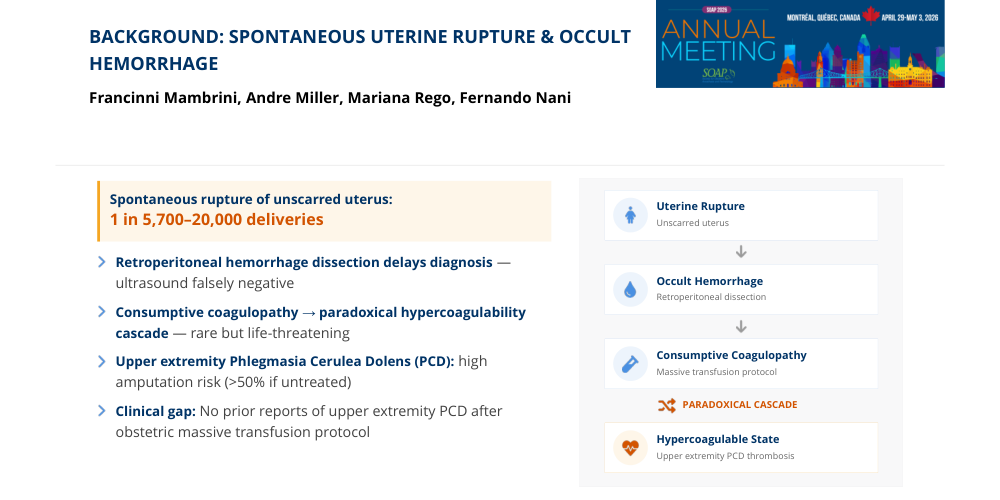
Slide 1: Background - Spontaneous Uterine Rupture & Occult Hemorrhage
Destaque
Spontaneous rupture of unscarred uterus: 1 in 5,700–20,000 deliveries
Pontos Principais
• Retroperitoneal hemorrhage dissection delays diagnosis — ultrasound falsely negative.
• Consumptive coagulopathy → paradoxical hypercoagulability cascade — rare but life-threatening.
• Upper extremity Phlegmasia Cerulea Dolens (PCD): high amputation risk (>50% if untreated).
• Clinical gap: No prior reports of upper extremity PCD after obstetric massive transfusion protocol.
Cascata Paradoxal (Diagrama)
1. Uterine Rupture (Unscarred uterus)
2. Leva a: Occult Hemorrhage (Retroperitoneal dissection)
3. Leva a: Consumptive Coagulopathy (Massive transfusion protocol)
4. Cascata Paradoxal leva a: Hypercoagulable State (Upper extremity PCD thrombosis)
Slide 2: Clinical Course - From Shock to Limb-Threatening Thrombosis
Dados Clínicos
• 3,500 mL: Isolated retroperitoneal hematoma (missed by U/S)
• 5,200 mL: Estimated blood loss requiring massive transfusion
• 18 hours: Post-op initiation of therapeutic enoxaparin
• 72 hours: Complete resolution of thrombosis
Linha do Tempo (Timeline)
• T0: Presentation - Sudden Collapse
◦ 35yo primigravida, 40+1 wks. Severe hypotension, tachycardia, profuse bleeding after epidural.
• T1: Diagnostic Delay - Negative Ultrasound
◦ No scar/trauma. Bleeding in retroperitoneum, not free fluid. Progressive shock.
• T2: Intraoperative - Emergency Laparotomy
◦ Spontaneous rupture confirmed. Hysterectomy, massive transfusion activated.
• T3: POD +6 hours - Upper Extremity PCD
◦ Sudden cyanosis, severe pain and edema in left arm. DVT in brachial/cephalic/basilic veins.
• T4: POD +9 days - Resolution & Discharge
◦ Anticoagulation started at 18h. Complete resolution in 72h; preserved limb function.
Slide 3: Teaching Points - Recognition & Management of a Cascade
1. Diagnostic Awareness
• Suspect uterine rupture even without uterine scar.
• Retroperitoneal hemorrhage → falsely negative ultrasound.
• Delay in diagnosis intensifies shock and coagulopathy.
2. Hemostatic Cascade
• Prolonged shock + massive resuscitation activate Virchow’s triad.
• Monitor all extremities after massive transfusion protocol.
• Aggressive IV access may contribute to thrombosis; consider site rotation.
3. Critical Intervention
• Early anticoagulation prevents amputation in PCD.
• Therapeutic heparin at 18h POD → complete resolution 72h.
• Do not delay anticoagulation awaiting coagulopathy normalization.
4. Clinical Pearl
• Upper extremity PCD after obstetric MTP: first reported case.
• Requires high suspicion and rapid Doppler imaging.
• Limb salvage depends on prompt recognition and intervention.
Key Messages (Mensagens-Chave)
• Suspect rupture even without scar.
• Retroperitoneal bleed → falsely negative U/S.
• Early anticoagulation = limb salvage.
Referências
1. Am J Obstet Gynecol 2021;225:497
2. J Thromb Thrombolysis 2023;55:345
3. Lancet Haematol 2023;10:e21
4. Vasc Med 2024;29:88