516 posters, 59 topics, 63 sessions, 1,127 authors, 353 institutions
ePostersLive by SciGen Technologies S.A. All rights reserved.
2026 SOAP Annual Meeting
April 29 - May 3, 2026 | Montreal, Quebec Canada

2341489
Emergent cesarean section in a parturient with an unbalanced atrioventricular (AV) canal defect status post complete repair.
Poster Presenter
Authors
Alexia Gagliardi, Irina Chugaieva, John Cahir, Susanne Rupert
Affiliations
Part of Topic
HEART: CONGENITAL AND VALVE CHALLENGES
EMERGENT CESAREAN SECTION IN A PARTURIENT WITH AN UNBALANCED ATRIOVENTRICULAR (AV) CANAL DEFECT STATUS POST COMPLETE REPAIR.
ALEXIA GAGLIARDI, MD, IRINA CHUGAIEVA, MD, JOHN CAHIR, MD, SUSANNE RUPERT, MD
BACKGROUND
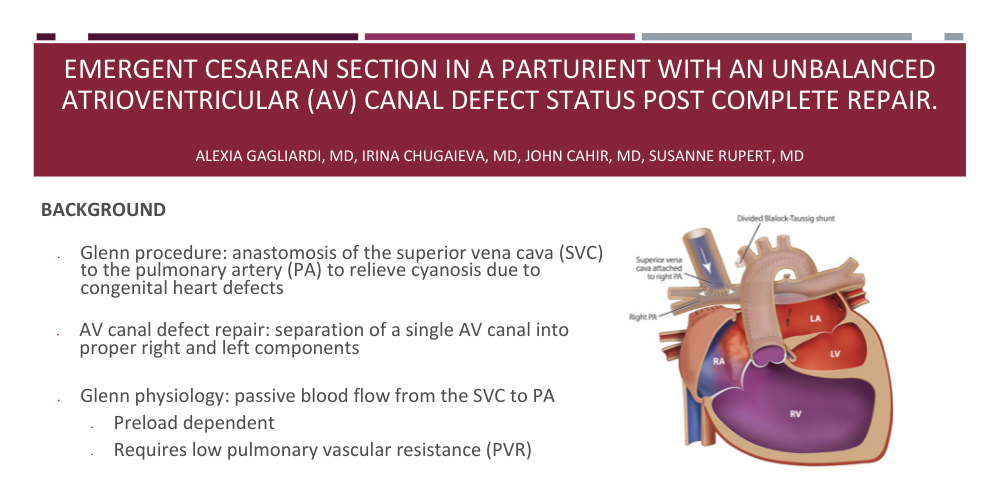
•Glenn procedure: anastomosis of the superior vena cava (SVC) to the pulmonary artery (PA) to relieve cyanosis due to congenital heart defects
•AV canal defect repair: separation of a single AV canal into proper right and left components
•Glenn physiology: passive blood flow from the SVC to PA
•Preload dependent
•Requires low pulmonary vascular resistance (PVR)
THE CASE
•A 30 y/o G1P0 with congenitalunbalanced AV canal defect s/p definitive repair with modified, bidirectional Glenn – SVC to right PA anastomosis and reconstructed right and left AV valves
•ECHO: mildly reduced function, mild bilateral AV valve stenosis with moderate regurgitation.
•Modified WHO Class was II-III. Functional status I.
•At 37 weeks: category II FHR with persistent fetal bradycardia
•Emergent C-section with general anesthesia (propofol, phenylephrine infusion, 5-mg boluses ephedrine, vasopressin available)
•ETO2 maintained < 30 mmHg, PEEP limited to 5 mmHg
•IVFs: 1200 mL of LR, EBL: 450 mL
LEARNING POINTS
•Pre-load dependent physiology in the setting of emergent c-section
•Potential compromise to pre-load:
•IVC compression avoided with left uterine displacement, blood loss, PPV
•Low dose phenylephrine primary vasopressor (SVR>PVR) - vasopressin available
•Minimize PVR: avoid hypoxia/hypercarbia
•optimal TV, optimal PEEP (5)