516 posters, 59 topics, 63 sessions, 1,127 authors, 353 institutions
ePostersLive by SciGen Technologies S.A. All rights reserved.
2026 SOAP Annual Meeting
April 29 - May 3, 2026 | Montreal, Quebec Canada

2340903
Anesthetic Considerations for Mitral Valve Replacement During Pregnancy
Poster Presenter
Authors
Affiliations
Part of Topic
HEART: CONGENITAL AND VALVE CHALLENGES
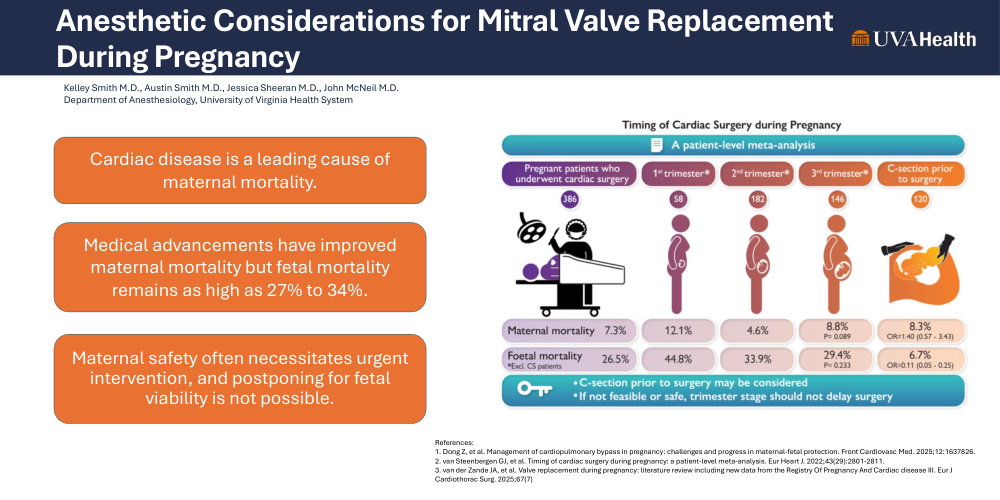
Care of the pregnant patient with cardiac disease represents a unique opportunity for multidisciplinary coordination. Cardiac disease in pregnancy is a leading cause of maternal mortality and the need for surgical intervention has steadily increased over time.1 While advancements in obstetric and cardiac care have improved such that maternal mortality now approaches that of non-pregnant women, fetal mortality remains as high as 27% to 34%.
We present the case of a 25-year-old primigravida at 15 weeks gestation who underwent a mitral valve replacement after being diagnosed with Staphylococcal endocarditis complicated by a mobile vegetation and leaflet perforation resulting in severe valvular regurgitation. The decreased systemic vascular resistance and increased heart rate in pregnancy allows regurgitant lesions to be better tolerated than stenotic lesions in this population. This is counterbalanced by the detrimental increases in cardiac output and blood volume in a population prone to heart failure. After admission to the cardiac ICU, she was additionally maintained on clevidipine to decrease afterload and improve forward flow.
Intraoperative goals were discussed between anesthesia, cardiac surgery, perfusion, and maternal fetal medicine. In addition to minimizing cardiopulmonary bypass and clamp time, it was decided to maintain normothermia and perfusion pressures greater than 70mmHg to support the fetus. Though not performed in this case, pulsatile flow on cardiopulmonary blood flow has also shown benefits in fetal survival. Cardiopulmonary bypass lasted 77 minutes with 58-minute cross-clamp time. Given the non-viable age of the fetus, fetal heart tones were only checked before and after surgery. She was extubated without complication and discharged home on post-operative day 5 with IV antibiotics. After a short re-admission for pleural effusions that was managed with diuretics, she has continued an otherwise uncomplicated pregnancy three months later.
As in our case, maternal safety often necessitates urgent intervention, while postponing surgery for fetal viability is not possible. Our case highlights the complex multidisciplinary teamwork required to care for an expectant mother with a cardiac emergency while also supporting the pregnancy. It provides hope that advancements in evidence-based care can lead to a positive outcome for mother and fetus.