875 posters, 25 topics, 3,440 authors, 1,061 institutions
ePostersLive by SciGen Technologies S.A. All rights reserved.
SAGES 2026 Annual Meeting Emerging Technology Session
March 25-28, 2026 | Tampa, FL, USA

P095
Venous Thromboembolism After Ventral Hernia Repair: National Impact on 30-Day Mortality, Readmission, and Length of Stay
Part of Topic
Abdominal Wall Hernias
Venous Thromboembolism After Ventral Hernia Repair: National Impact on 30-Day
Mortality, Readmission, and Length of Stay
Jonathan S Selway, BS1; Carlos Balthazar da Silveira, MD2; Sakura Horiuchi, MD1; Paul Kang1; Vikram Deka, MD2; Conrad Ballecer, MD2; Thomas Gillespie,
MD, FACS1
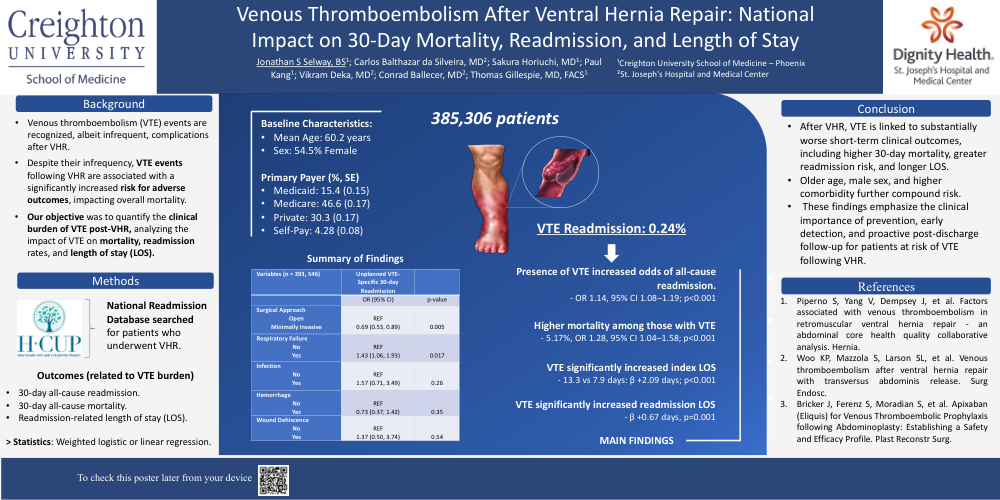
385,306 patients
Background Conclusion
Presence of VTE increased odds of all-cause
readmission.
- OR 1.14, 95% CI 1.08–1.19; p<0.001
Higher mortality among those with VTE
- 5.17%, OR 1.28, 95% CI 1.04–1.58; p<0.001
MAIN FINDINGS
• Venous thromboembolism (VTE) events are
recognized, albeit infrequent, complications
after VHR.
Methods
National Readmission
Database searched
for patients who
underwent VHR.
Outcomes (related to VTE burden)
• After VHR, VTE is linked to substantially
worse short-term clinical outcomes,
including higher 30-day mortality, greater
readmission risk, and longer LOS.
• Older age, male sex, and higher
comorbidity further compound risk.
• These findings emphasize the clinical
importance of prevention, early
detection, and proactive post-discharge
follow-up for patients at risk of VTE
following VHR.
References
• Our objective was to quantify the clinical
burden of VTE post-VHR, analyzing the
impact of VTE on mortality, readmission
rates, and length of stay (LOS).
• 30-day all-cause readmission.
• 30-day all-cause mortality.
• Readmission-related length of stay (LOS).
> Statistics: Weighted logistic or linear regression.
Baseline Characteristics:
• Mean Age: 60.2 years
• Sex: 54.5% Female
Primary Payer (%, SE)
• Medicaid: 15.4 (0.15)
• Medicare: 46.6 (0.17)
• Private: 30.3 (0.17)
• Self-Pay: 4.28 (0.08)
Summary of Findings
VTE Readmission: 0.24%
• Despite their infrequency, VTE events
following VHR are associated with a
significantly increased risk for adverse
outcomes, impacting overall mortality.
1. Piperno S, Yang V, Dempsey J, et al. Factors
associated with venous thromboembolism in
retromuscular ventral hernia repair - an
abdominal core health quality collaborative
analysis. Hernia.
2. Woo KP, Mazzola S, Larson SL, et al. Venous
thromboembolism after ventral hernia repair
with transversus abdominis release. Surg
Endosc.
3. Bricker J, Ferenz S, Moradian S, et al. Apixaban
(Eliquis) for Venous Thromboembolic Prophylaxis
following Abdominoplasty: Establishing a Safety