875 posters, 25 topics, 3,440 authors, 1,061 institutions
ePostersLive by SciGen Technologies S.A. All rights reserved.
SAGES 2026 Annual Meeting Emerging Technology Session
March 25-28, 2026 | Tampa, FL, USA

P091
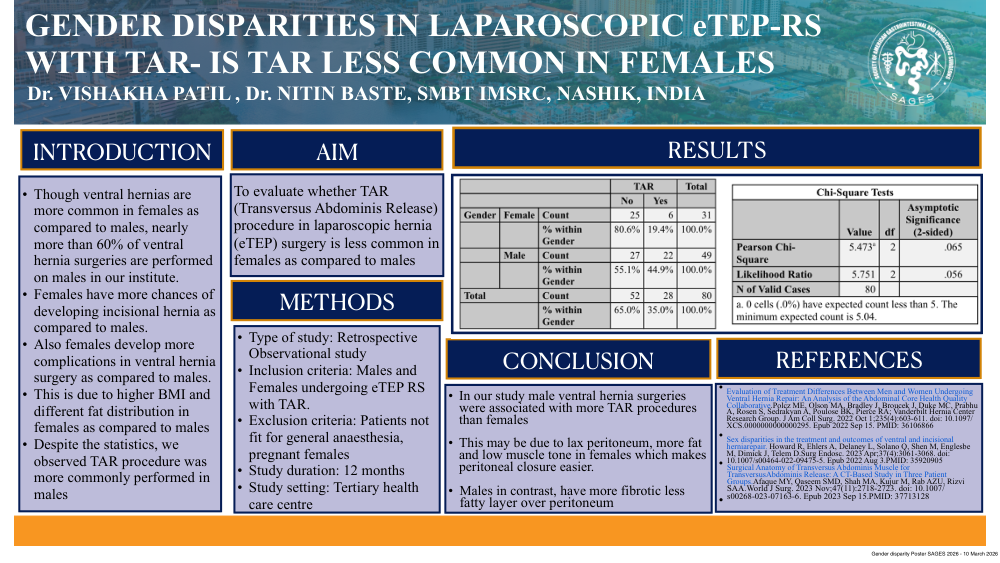
A RETROSPECTIVE OBSERVATIONAL STUDY TO EVALUATE GENDER DISPARITIES IN LAPAROSCOPIC eTEP-RS (ENHANCED VIEW TOTALLY EXTRA PERITONEAL RIVES STOPPA) WITH TAR (TRANSVERSUS ABDOMINIS RELEASE)
Poster Presenter
Authors
Affiliations
Part of Topic
Abdominal Wall Hernias
Background:
Incisional hernia by their nature are much more complicated than inguinal or any other
ventral hernia , both in pathophysiology as well as repair.
While laparoscopic repair of hernia is becoming a gold standard nowadays due to its
obvious advantages such as no extra scar,faster recovery, decreased risk of recurrence , et
cetera, It remains a challenge operating these patients as the defect shape, size, content
can vary a great deal.
Laparoscopic eTEP-RS is a preferred method for repair although, TAR might be required in
incisional hernia to approximate the defect without tension.
Need for posterior component separation or TAR obviously depends on factors like size of
scar, hernia defect size, et cetera., But we aimed to find if there is any difference in
requirement of TAR in males and females
Females have an inherent property of more fat deposition, more pressure compliant
abdominal wall and more laxity, hence they might not require TAR as often as men in
incisional hernia repair.
With the above hypothesis, we have conducted an observational study to assess the gender
disparity in requirements of TAR for incisional hernia repair.