875 posters, 25 topics, 3,440 authors, 1,061 institutions
ePostersLive by SciGen Technologies S.A. All rights reserved.
SAGES 2026 Annual Meeting Emerging Technology Session
March 25-28, 2026 | Tampa, FL, USA

P088
Risk Factors for Surgical Site infections Following Parastomal Hernia Repair: A National Data Analysis
Poster Presenter
Part of Topic
Abdominal Wall Hernias
RISK FACTORS FOR SURGICAL SITE INFECTIONS FOLLOWING PARASTOMAL HERNIA REPAIR: A NATIONAL DATA ANALYSIS
•Parastomal hernias have a reported incidence of 17-50% after stoma creation
•1 in 3 cases require operative intervention often with mesh
•Risk factors for parastomal hernias: obesity, diabetes, smoking, and immunosuppressant use
•Surgical site infections (SSI) from parastomal hernia repair are not well understood with limited, large-scale, contemporary risk factors analyses
•Objective: Identify independent predictors of SSI associated with parastomal hernia repair and the effects in operative outcomes using the ACS-NSQIP database
•Retrospective study of the 2015-2023 ACS-NSQIP database was utilized to identify parastomal hernia repairs by CPT and ICD-10 codes
•Descriptive analyses and logistic regression models performed for outcomes analysis
•Multivariate logistic regressions were adjusted for 65 and older, emergent and elective case status, sex, race, and ASA class
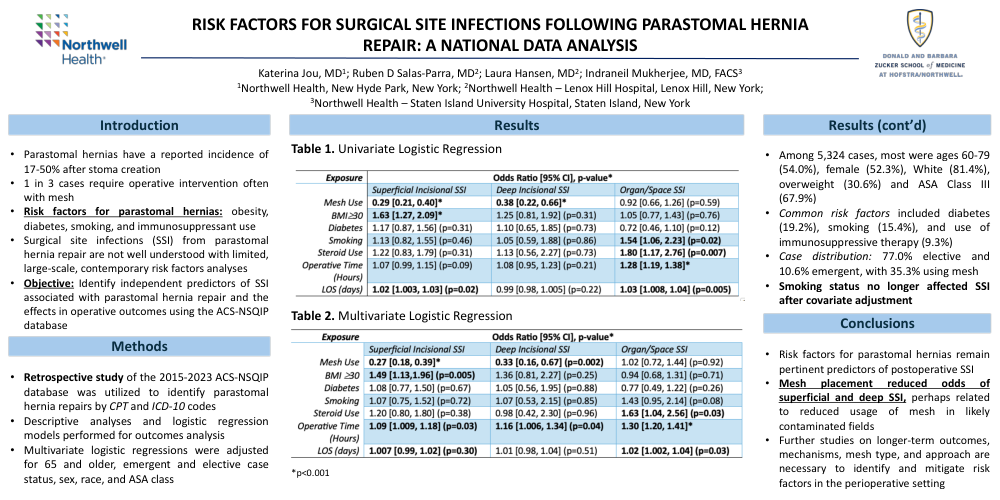
•Among 5,324 cases, most were ages 60-79 (54.0%), female (52.3%), White (81.4%), overweight (30.6%) and ASA Class III (67.9%)
•Common risk factors included diabetes (19.2%), smoking (15.4%), and use of immunosuppressive therapy (9.3%)
•Case distribution: 77.0% elective and 10.6% emergent, with 35.3% using mesh
•Smoking status no longer affected SSI after covariate adjustment
•Risk factors for parastomal hernias remain pertinent predictors of postoperative SSI
•Mesh placement reduced odds of superficial and deep SSI, perhaps related to reduced usage of mesh in likely contaminated fields
•Further studies on longer-term outcomes, mechanisms, mesh type, and approach are necessary to identify and mitigate risk factors in the perioperative setting