875 posters, 25 topics, 3,440 authors, 1,061 institutions
ePostersLive by SciGen Technologies S.A. All rights reserved.
SAGES 2026 Annual Meeting Emerging Technology Session
March 25-28, 2026 | Tampa, FL, USA

MSS858
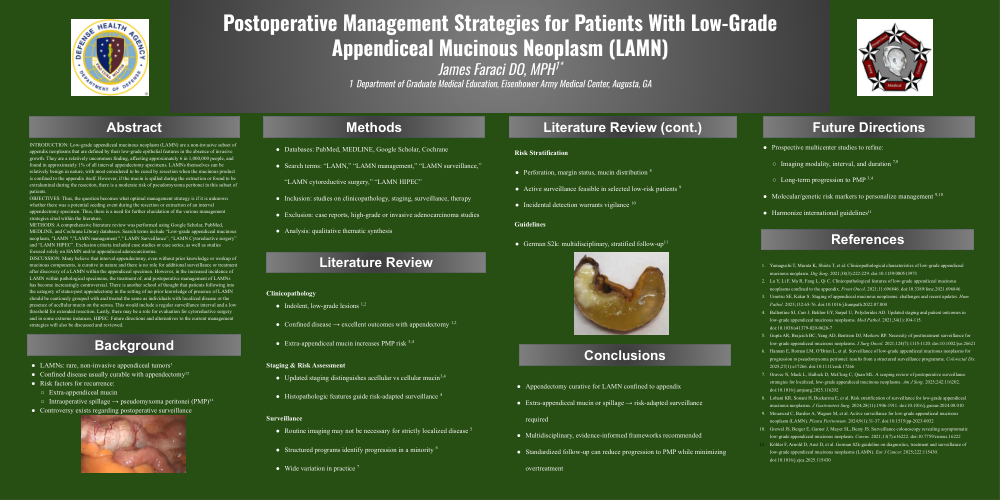
Postoperative Management Strategies for Patients with Low-Grade Appendiceal Mucinous Neoplasm (LAMN)
Poster Presenter
Authors
Affiliations
Part of Topic
General Surgery
Abstract
INTRODUCTION: Low-grade appendiceal mucinous neoplasm (LAMN) are a non-invasive subset of appendix neoplasms that are defined by their low-grade epithelial features in the absence of invasive growth. They are a relatively uncommon finding, affecting approximately 6 in 1,000,000 people, and found in approximately 1% of all interval appendectomy specimens. LAMNs themselves can be relatively benign in nature, with most considered to be cured by resection when the mucinous product is confined to the appendix itself. However, if the mucin is spilled during the extraction or found to be extraluminal during the resection, there is a moderate risk of pseudomyxoma peritonei in this subset of patients.
OBJECTIVES: Thus, the question becomes what optimal management strategy is if it is unknown whether there was a potential seeding event during the resection or extraction of an interval appendectomy specimen. Thus, there is a need for further elucidation of the various management strategies cited within the literature.
METHODS: A comprehensive literature review was performed using Google Scholar, PubMed, MEDLINE, and Cochrane Library databases. Search terms include “Low-grade appendiceal mucinous neoplasm, "LAMN ","LAMN management "," LAMN Surveillance”, “LAMN Cytoreductive surgery” and “LAMN HIPEC”. Exclusion criteria included case studies or case series, as well as studies focused solely on HAMN and/or appendiceal adenocarcinoma.
DISCUSSION: Many believe that interval appendectomy, even without prior knowledge or workup of mucinous components, is curative in nature and there is no role for additional surveillance or treatment after discovery of a LAMN within the appendiceal specimen. However, in the increased incidence of LAMN within pathological specimens, the treatment of, and postoperative management of LAMNs has become increasingly controversial. There is another school of thought that patients following into the category of status-post appendectomy in the setting of no prior knowledge of presence of LAMN should be cautiously grouped with and treated the same as individuals with localized disease or the presence of acellular mucin on the serosa. This would include a regular surveillance interval and a low threshold for extended resection. Lastly, there may be a role for evaluation for cytoreductive surgery and in some extreme instances, HIPEC. Future directions and alternatives to the current management strategies will also be discussed and reviewed.
Background
-
LAMNs: rare, non-invasive appendiceal tumors¹
-
Confined disease usually curable with appendectomy¹²
-
Risk factors for recurrence:
-
Extra-appendiceal mucin
-
Intraoperative spillage → pseudomyxoma peritonei (PMP)³⁴
-
Controversy exists regarding postoperative surveillance
Methods
-
Databases: PubMed, MEDLINE, Google Scholar, Cochrane
-
Search terms: “LAMN,” “LAMN management,” “LAMN surveillance,” “LAMN cytoreductive surgery,” “LAMN HIPEC”
-
Inclusion: studies on clinicopathology, staging, surveillance, therapy
-
Exclusion: case reports, high-grade or invasive adenocarcinoma studies
-
Analysis: qualitative thematic synthesis
Literature Review
Clinicopathology
-
Indolent, low-grade lesions 1,2
-
Confined disease → excellent outcomes with appendectomy 1,2
-
Extra-appendiceal mucin increases PMP risk 3,4
Staging & Risk Assessment
-
Updated staging distinguishes acellular vs cellular mucin3,4
-
Histopathologic features guide risk-adapted surveillance 4
Surveillance
-
Routine imaging may not be necessary for strictly localized disease 5
-
Structured programs identify progression in a minority 6
Wide variation in practice 7
Risk Stratification
-
Perforation, margin status, mucin distribution 8
-
Active surveillance feasible in selected low-risk patients 9
-
Incidental detection warrants vigilance 10
Guidelines
German S2k: multidisciplinary, stratified follow-up11Conclusion
-
Appendectomy curative for LAMN confined to appendix
-
Extra-appendiceal mucin or spillage → risk-adapted surveillance required
-
Multidisciplinary, evidence-informed frameworks recommended
-
Standardized follow-up can reduce progression to PMP while minimizing overtreatment
Future Directions
-
Prospective multicenter studies to refine:
-
Imaging modality, interval, and duration 7,8
-
Long-term progression to PMP 3,4
-
Molecular/genetic risk markers to personalize management 9,10
-
Harmonize international guidelines¹¹