875 posters, 25 topics, 3,440 authors, 1,061 institutions
ePostersLive by SciGen Technologies S.A. All rights reserved.
SAGES 2026 Annual Meeting Emerging Technology Session
March 25-28, 2026 | Tampa, FL, USA

MSS853
THE DOUBLE OBSTRUCTION: A CASE REPORT OF INCIDENTALLY FOUND ABDOMINAL COCOON SYNDROME DURING EXPLORATION FOR CECAL BASCULE
Poster Presenter
Authors
Affiliations
Part of Topic
General Surgery
THE DOUBLE OBSTRUCTION: A CASE REPORT OF INCIDENTALLY FOUND ABDOMINAL COCOON SYNDROME DURING EXPLORATION FOR CECAL BASCULE
Trey K Nettles, MD; Justin G Hale, DO; Salvatore Parascandola, MD
Department of General Surgery. Dwight D. Eisenhower Army Medical Center
INTRODUCTION
Idiopathic sclerosing encapsulating peritonitis, also known as Abdominal Cocoon Syndrome (ACS), and cecal bascule are two distinct and rare pathologies that can cause intestinal obstruction. For ACS, most available literature consists primarily of individual case reports, with 240 total cases reported in the literature through 20221. We present a case report of a 35-year-old female who presented to the Emergency Department with acute worsening of chronic abdominal pain and signs of bowel obstruction who was ultimately diagnosed and successfully treated for both conditions.
HISTORY OF PRESENT ILLNESS
35F Egyptian-American presented to the ED with acute onset of diffuse abdominal pain and obstipation. Cross sectional imaging findings were notable for cecal bascule and high-grade small bowel obstruction. General Surgery subsequently consulted for operative management. Patient reported sudden, constant, sharp abdominal pain,10/10 in severity, located primarily within the epigastric and right lower quadrant, nonpalliating, non-radiating, and without associated nausea or vomiting. Patient denied history of prior similar episodes, but did express chronic bloating following meals, crampy abdominal pain, and constipation. She reported one prior SBO approximately 6 years ago that was treated nonoperatively. Her surgical history was notable for C-section, lap appendectomy, and Yolk Sac tumor excision with chemotherapy (6 cycles, bleomycin, etoposide and cisplatin) in Egypt around twenty years prior. Records regarding the yolk sac tumor were unavailable at time of evaluation.
IMAGING
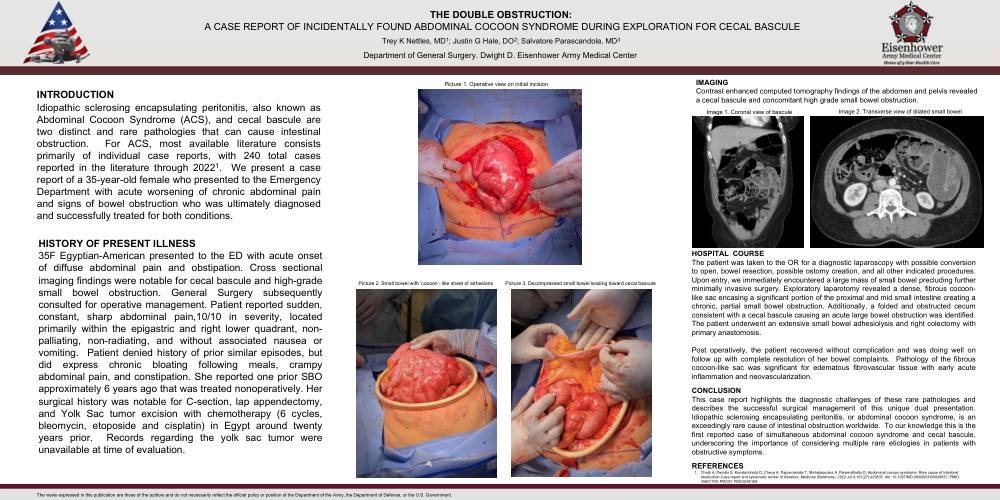
Contrast enhanced computed tomography findings of the abdomen and pelvis revealed a cecal bascule and concomitant high grade small bowel obstruction
HOSPITAL COURSE
The patient was taken to the OR for a diagnostic laparoscopy with possible conversion to open, bowel resection, possible ostomy creation, and all other indicated procedures. Upon entry, we immediately encountered a large mass of small bowel precluding further minimally invasive surgery. Exploratory laparotomy revealed a dense, fibrous cocoon-like sac encasing a significant portion of the proximal and mid small intestine creating a chronic, partial small bowel obstruction. Additionally, a folded and obstructed cecum consistent with a cecal bascule causing an acute large bowel obstruction was identified. The patient underwent an extensive small bowel adhesiolysis and right colectomy with primary anastomosis. Post operatively, the patient recovered without complication and was doing well on follow up with complete resolution of her bowel complaints. Pathology of the fibrous cocoon-like sac was significant for edematous fibrovascular tissue with early acute inflammation and neovascularization.
CONCLUSION
This case report highlights the diagnostic challenges of these rare pathologies and describes the successful surgical management of this unique dual presentation. Idiopathic sclerosing encapsulating peritonitis, or abdominal cocoon syndrome, is an exceedingly rare cause of intestinal obstruction worldwide. To our knowledge this is the first reported case of simultaneous abdominal cocoon syndrome and cecal bascule, underscoring the importance of considering multiple rare etiologies in patients with obstructive symptoms.
REFERENCES
1. Chorti A, Panidis S, Konstantinidis D, Cheva A, Papavramidis T, Michalopoulos A, Paramythiotis D. Abdominal cocoon syndrome: Rare cause of intestinal obstruction-Case report and systematic review of literature. Medicine (Baltimore). 2022 Jul 8;101(27):e29837. doi: 10.1097/MD.0000000000029837. PMID: 35801789; PMCID: PMC9259168.