875 posters, 25 topics, 3,440 authors, 1,061 institutions
ePostersLive by SciGen Technologies S.A. All rights reserved.
SAGES 2026 Annual Meeting Emerging Technology Session
March 25-28, 2026 | Tampa, FL, USA

P845
Need for Speed: Does Operative Time Improve with Robotic Single Port Inguinal Hernia Repairs?
Poster Presenter
Part of Topic
Robotics / Advanced Technologies
Need for Speed: Does Operative Time Improve with Robotic Single Port Inguinal Hernia?
Jorge A Dorantes, MD; Laura Barbosa-Novoa, MD; Khaled Y Omar, MD; Ava K Voss, MD; Michelle Gallas, PhD; Anthony M Gonzalez, MD, FASMBS
Baptist Health South Florida
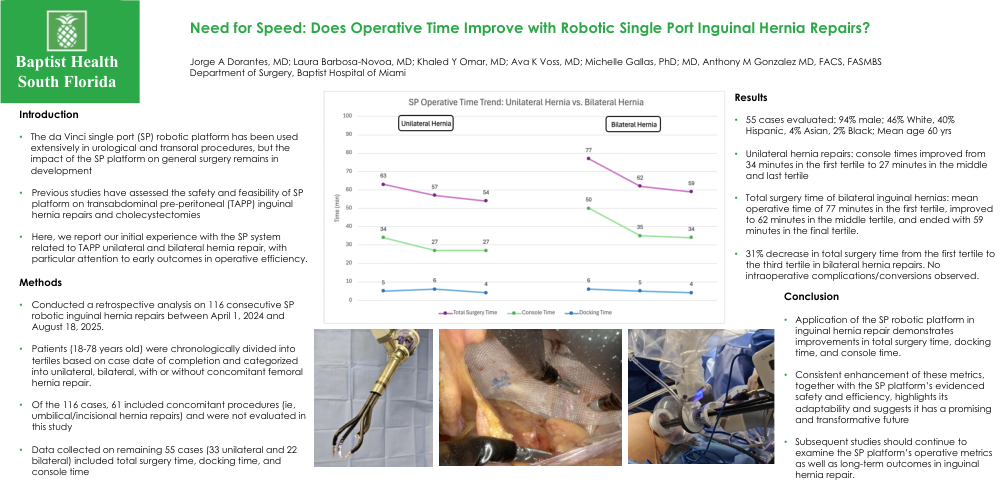
Introduction: While the da Vinci single port (SP) platform has been cleared for use in urological and transoral procedures, the impact of SP robotic systems on general surgery remains in development. Previous studies have assessed the safety and feasibility of the SP platform on transabdominal pre-peritoneal (TAPP) inguinal hernia repairs and cholecystectomies. Here, we report our initial experience with the SP system as it pertains to TAPP unilateral and bilateral hernia repair, with particular attention to early outcomes in operative efficiency.
Methods: We conducted a retrospective analysis on 116 consecutive SP robotic inguinal hernia repairs between April 1, 2024 and August 18, 2025. All patients (18-78 years old) were chronologically divided into tertiles based on case date of completion and categorized into unilateral, bilateral, with or without concomitant femoral hernia repair. Of the 116 cases, 61 included concomitant procedures (ie, umbilical/incisional hernia repairs) and were not evaluated in this study. Data collected on remaining 55 cases (33 unilateral and 22 bilateral) included total surgery time, docking time, and console time.
Results: Of the 55 cases evaluated, 94% were male (46% White, 40% Hispanic, 4% Asian, and 2% Black). Mean age was 60 years. Unilateral and bilateral inguinal SP hernia repairs revealed progressive reductions in operative metrics across tertiles. For unilateral hernia repairs, console times improved from 34 minutes in the first tertile to 27 minutes in the middle and last tertile. Total surgery time of bilateral inguinal hernias saw significant improvement, with a mean operative time of 77 minutes in the first tertile, improving to 62 minutes in the middle tertile, and ending with 59 minutes in the final tertile: this represents a 31% decrease in total surgery time from the first tertile in bilateral hernia repairs. No intraoperative complications or conversions were observed.
Conclusion: Application of the SP robotic platform in inguinal hernia repair demonstrates improvements in total surgery time, docking time, and console time. The consistent enhancement of these metrics, together with the SP platform's evidenced safety and efficiency, highlights its adaptability and suggests it has a promising and transformative future. Subsequent studies should continue to examine the SP platform's operative metrics as well as long-term outcomes in inguinal hernia repair.