875 posters, 25 topics, 3,440 authors, 1,061 institutions
ePostersLive by SciGen Technologies S.A. All rights reserved.
SAGES 2026 Annual Meeting Emerging Technology Session
March 25-28, 2026 | Tampa, FL, USA

P842
MAGNETIC-ASSISTED ROBOTIC SURGERY IN REDUCED-PORT LAPAROSCOPIC BARIATRIC PROCEDURES: 165 CASES BY A SOLO-SURGEON
Poster Presenter
Authors
Affiliations
Part of Topic
Robotics / Advanced Technologies
MAGNETIC-ASSISTED ROBOTIC SURGERY IN REDUCED-PORT LAPAROSCOPIC BARIATRIC PROCEDURES: 165 CASES BY A SOLO-SURGEON
INTRODUCTION:
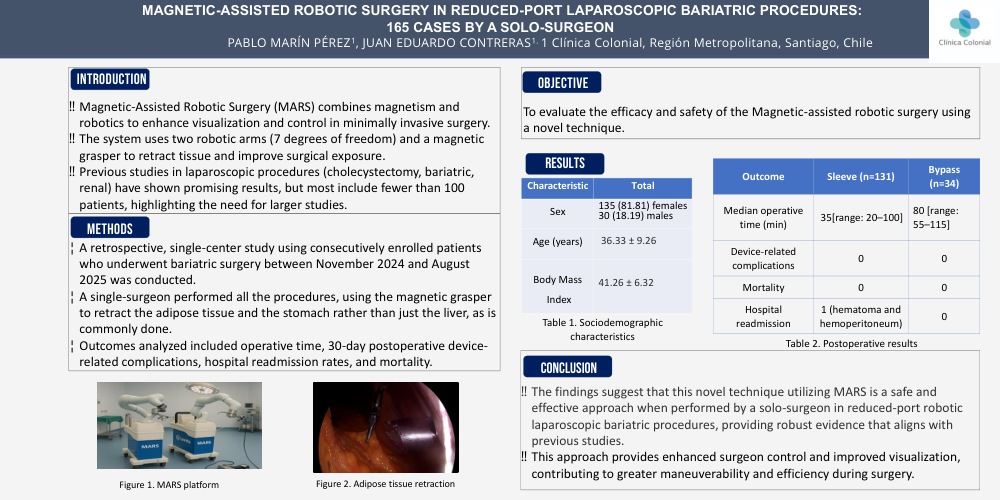
Magnetic-assisted robotic surgery (MARS) is a novel technique that combines magnetism and robotic surgery, developed to maximize the benefits of minimally invasive surgeries by enhancing the surgeon's visualization and control throughout the procedure. This robotic-assisted platform consisted of two robotic arms with 7 degrees of freedom controlled by a foot pedal during the surgery. The system utilizes a magnetic grasper to retract the desired tissue, improving visualization of the surgeon's field. Previous studies have shown promising results in various laparoscopic surgeries, such as cholecystectomy, bariatric, and renal procedures. Most of the previously reported studies have included fewer than 100 patients, highlighting the need for larger, more comprehensive studies to provide stronger evidence.
OBJECTIVE:
To evaluate the efficacy and safety of the Magnetic-assisted robotic surgery using a novel technique.
METHODS:
A retrospective, single-center study using consecutively enrolled patients was conducted. Patients undergoing bariatric robotic surgery between November 2024 and August 2025 at a clinic facility in Santiago, Chile, were included. All procedures were performed by a single surgeon without the need for a surgical assistant. This surgeon utilized the magnetic grasper to retract the adipose tissue rather than just the liver, as is commonly done, thereby improving maneuverability and reducing the surgery time. Outcomes analyzed were operative time, 30-day postoperative complications related to the device, hospital readmission rates, and mortality. Python 3.11.5 was used to perform statistical analyses.
RESULTS:
One hundred sixty-five patients, predominantly females (81.81%) and with a mean age of 36.33 ± 9.26 and BMI of 41.26 ± 6.32, underwent bariatric robotic surgery during this time period. Thirty-four patients underwent gastric bypass, while 131 had a gastric sleeve surgery. Mean surgery time in sleeve gastrectomy was 35 minutes (range of 20-100), whereas for gastric bypass was 80 minutes (range of 55-115). Only one patient required hospital readmission due to a hematoma and hemoperitoneum, while no device-related complications or mortality occurred within the 30-day postoperative period
CONCLUSION:
The findings suggest that this novel technique utilizing the MARS system is a safe and effective approach when performed by a solo surgeon in reduced-port robotic laparoscopic bariatric procedures, providing robust evidence that aligns with previous studies. This approach provides enhanced surgeon control and improved visualization, which contributes to greater maneuverability and efficiency during surgery.