875 posters, 25 topics, 3,440 authors, 1,061 institutions
ePostersLive by SciGen Technologies S.A. All rights reserved.
SAGES 2026 Annual Meeting Emerging Technology Session
March 25-28, 2026 | Tampa, FL, USA

P841
FIRST 132 SINGLE-SURGEON LAPAROSCOPIC CASES USING MAGNETIC-ASSISTED ROBOTIC SURGERY
Poster Presenter
Part of Topic
Robotics / Advanced Technologies
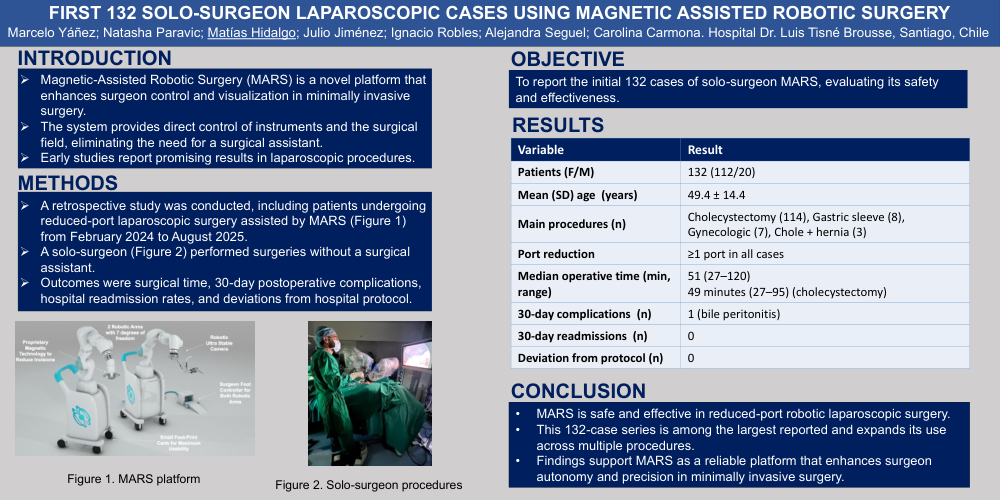
FIRST 132 SOLO-SURGEON LAPAROSCOPIC CASES USING MAGNETIC-ASSISTED ROBOTIC SURGERY
INTRODUCTION
Robotic surgery integration in minimally invasive surgeries has represented an advanced approach in surgical practice. Magnetic-Assisted Robotic Surgery (MARS) is a novel technology developed to maximize the benefits of minimally invasive surgery for patients, while enhancing surgeon control and visualization. This technology allows the surgeon to achieve direct and comprehensive control of instruments and the surgical field, eliminating the need for a surgical assistant. Prior studies using this platform have reported promising results in diverse laparoscopic surgeries, such as cholecystectomy, bariatric, and renal procedures, although the sample size was generally limited to fewer than 100.
OBJECTIVE
To report the initial 132 cases of solo-surgeon MARS, evaluating its safety and effectiveness .
METHODS
A retrospective, single-center study was conducted using consecutively enrolled medical records from patients undergoing reduced-port laparoscopic surgery assisted by MARS from February 2024 to August 2025 at a hospital in Santiago, Chile. A solo-surgeon performed all surgeries without a surgical assistant. Outcomes were surgical time, 30-day postoperative complications, hospital readmission rates, and deviations from hospital protocol. Continuous data were reported as the mean ± SD or median (range) according to their distribution, and categorical variables as frequencies and percentages. Python 3.11.5, was used to perform statistical analyses.
RESULTS
One hundred thirty-two patients were included in the analysis, comprising 112 females and 20 males, with a mean age of 49.4 years (SD = 14.4). The surgeries performed included 114 laparoscopic cholecystectomies, 8 gastric sleeves, 7 laparoscopic gynecologic procedures, and 3 laparoscopic cholecystectomies with inguinal hernia repair. In all the surgeries, at least 1 less port/incision was used. The median operative time was 51.0 minutes (range = 27.0–120.0 minutes). For cholecystectomy, the median time was 49 minutes (range = 27–95). A patient reported bile peritonitis from the Luschka duct, requiring reoperation. Patient recovered well and was discharged on postoperative day seven. No deviation from hospital protocol was reported.
CONCLUSION
This study provides valuable evidence regarding the safety and effectiveness of the MARS system when performed by a solo-surgeon in reduced-port robotic laparoscopic procedures. With 132 cases, it is one of the largest series, confirming prior findings in cholecystectomy and expanding to bariatric, hernia, and gynecologic surgeries. Results support MARS as a reliable platform enhancing surgeon autonomy and precision across minimally invasive procedures.