875 posters, 25 topics, 3,440 authors, 1,061 institutions
ePostersLive by SciGen Technologies S.A. All rights reserved.
SAGES 2026 Annual Meeting Emerging Technology Session
March 25-28, 2026 | Tampa, FL, USA

P825
Kinematic Analysis of Suturing Tasks Using Senhance® Robotic System through augmentOR™ Portal
Poster Presenter
Authors
Yike Xu, Sara S Lazzaretti, Jeffrey P Spalazzi, Janette Gil, Edward Chekan
Affiliations
Part of Topic
Robotics / Advanced Technologies
Title: Kinematic Analysis of Suturing Tasks Using Senhance® Robotic System through augmentOR™ Portal
Keywords: Senhance® Surgical System, augmentOR™ Portal, Force Feedback (FFB), Suturing Performance, Kinematic Analysis
Background:
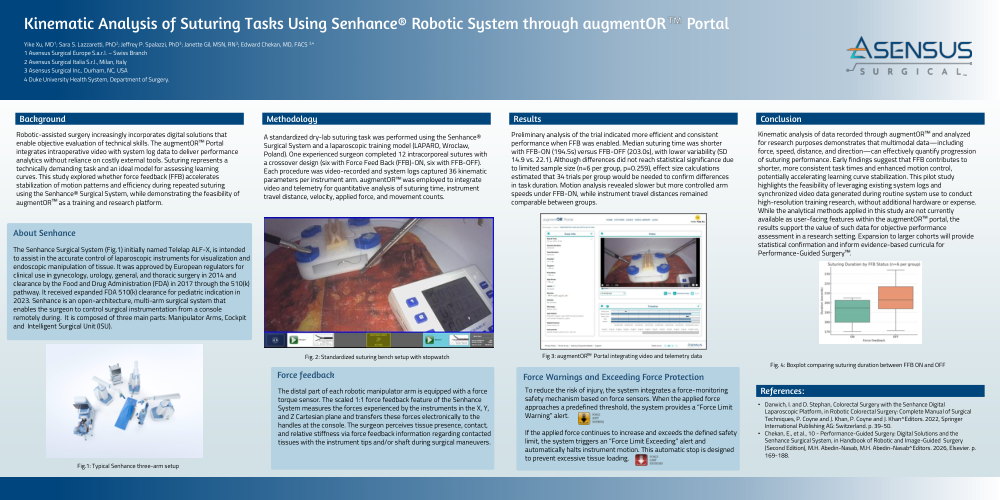
Robotic-assisted surgery increasingly incorporates digital solutions that enable objective evaluation of technical skills. The augmentOR™ Portal integrates intraoperative video with system log data to deliver performance analytics without reliance on costly external tools. Suturing represents a technically demanding task and an ideal model for assessing learning curves. This study explored whether force feedback (FFB) accelerates stabilization of motion patterns and efficiency during repeated suturing using the Senhance® Surgical System, while demonstrating the feasibility of augmentOR™ as a training and research platform.
Methods:
A standardized dry-lab suturing task was performed using the Senhance® Surgical System and a LAPARO training module. One experienced surgeon completed 12 intracorporeal sutures with a crossover design (six with FFB-ON, six with FFB-OFF). Each procedure was video-recorded and system logs captured 36 kinematic parameters per instrument arm. augmentOR™ was employed to integrate video and telemetry for quantitative analysis of suturing time, instrument travel distance, velocity, applied force, and movement counts.
Results:
Preliminary analysis of the trial indicated more efficient and consistent performance when FFB was enabled. Median suturing time was shorter with FFB-ON (194.5s) versus FFB-OFF (203.0s), with lower variability (SD 14.9 vs. 22.1). Although differences did not reach statistical significance due to limited sample size (n=6 per group, p=0.259), effect size calculations estimated that 34 trials per group would be needed to confirm differences in task duration. Motion analysis revealed slower but more controlled arm speeds under FFB-ON, while instrument travel distances remained comparable between groups.
Conclusions:
Kinematic analysis through augmentOR™ demonstrates that multimodal data—including force, speed, distance, and direction—can effectively quantify progression of suturing performance. Early findings suggest that FFB contributes to shorter, more consistent task times and enhanced motion control, potentially accelerating learning curve stabilization. This pilot study underscores the feasibility of using augmentOR™ for training research, enabling high-resolution analysis with existing system logs and video integration, without additional hardware or expense. Expansion to larger cohorts will provide statistical confirmation and inform evidence-based curricula for Performance-Guided Surgery™.
Acknowledgments:
The authors thank Robin Chriqui and Lior Alpert (Asensus Surgical Israel Ltd.) for their contributions to data integration and digital solutions support.