875 posters, 25 topics, 3,440 authors, 1,061 institutions
ePostersLive by SciGen Technologies S.A. All rights reserved.
SAGES 2026 Annual Meeting Emerging Technology Session
March 25-28, 2026 | Tampa, FL, USA

P823
Robotic Intrathoracic Fixation of Rib Acute Fractures (RIFRAF): First Institutional Experience Demonstrating Safety and Efficiency Compared to Open and Video Assisted Thoracoscopic Surgery Approaches
Poster Presenter
Part of Topic
Robotics / Advanced Technologies
ROBOTIC INTRATHORACIC FIXATION OF RIB ACUTE FRACTURES (RIFRAF): FIRST INSTITUTIONAL EXPERIENCE DEMONSTRATING SAFETY AND EFFICIENCY COMPARED TO OPEN AND VIDEO ASSISTED THORACOSCOPIC SURGERY APPROACHES
Zana Alattar, MD; Morgan Crigger, MD; Allison Tompeck, MD; Taylor Kreul; Amy Vansdadia; Zoe Frias; Samara Hanna; Kimberly Larson; University of Arizona College of Medicine Phoenix
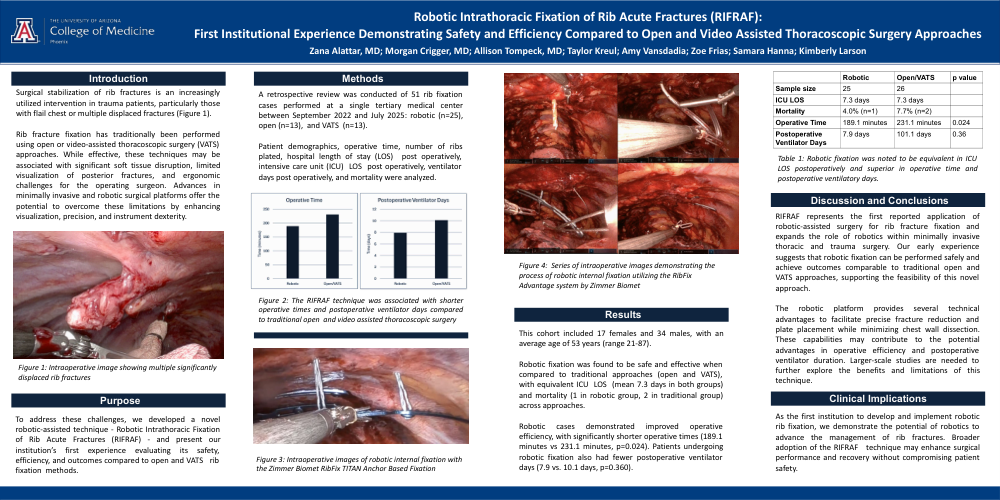
Purpose: Rib fracture fixation has traditionally been performed using open or video-assisted thoracoscopic surgery (VATS) approaches. We developed a novel robotic-assisted technique—Robotic Intrathoracic Fixation of Rib Acute Fractures (RIFRAF)—and present our institution’s first experience evaluating its safety, efficiency, and outcomes compared to open and VATS methods.
Methods: A retrospective review was conducted of 51 rib fixation cases performed at a single tertiary medical center between September 2022 and July 2025: robotic (n = 25), open (n=13), and VATS (n = 13). Patient demographics, operative time, number of ribs plated, hospital length of stay (LOS) post operatively, intensive care unit (ICU) LOS post operatively, ventilator days post operatively, and mortality were analyzed.
Results: This represents the first reported clinical series of robotic-assisted rib fixation. The cohort included 17 females and 34 males, with an average age of 53 years (range 21–87). Robotic fixation was found to be safe and effective when compared to traditional approaches (open and VATS), with equivalent ICU LOS (mean 7.3 days in both groups) and mortality (1 in robotic group, 2 in traditional group) across approaches. Robotic cases however demonstrated improved operative efficiency, with significantly shorter operative times (189.1 minutes vs. 231.1 minutes, p = 0.024). Patients undergoing robotic fixation also had fewer postoperative ventilator days (7.9 vs. 10.1 days, p = 0.360).
Conclusion: RIFRAF represents the first reported application of robotic-assisted surgery for rib fracture fixation. Our early experience suggests that robotic fixation is safe, yields outcomes comparable to traditional open and VATS approaches, and offers potential advantages in operative efficiency and ventilator duration. Larger-scale studies are needed to further explore the benefits and limitations of this technique.
Clinical Implications: As the first institution to develop and implement robotic rib fixation, we demonstrate the potential of robotics to advance the management of rib fractures. Broader adoption of the RIFRAF technique may enhance surgical performance and recovery without compromising patient safety.