875 posters, 25 topics, 3,440 authors, 1,061 institutions
ePostersLive by SciGen Technologies S.A. All rights reserved.
SAGES 2026 Annual Meeting Emerging Technology Session
March 25-28, 2026 | Tampa, FL, USA

P802
Early experience with robotic inguinal hernia repair in a publicly funded tertiary Canadian centre
Poster Presenter
Authors
Stephanie R Skanes, Naser Alali, Jeffrey Hawel, Rachel Hart, Christopher M Schlachta, Juan Glinka, Ahmad Elnahas
Affiliations
Part of Topic
Robotics / Advanced Technologies
Introduction
•Minimally invasive approaches for inguinal hernia repair (IHR) are associated with reduced postoperative pain, faster recovery, and fewer wound complications compared with open surgery.
•In Canada, minimally invasive IHR represents only 8% of cases, compared with 25% in the United States, largely due to higher costs and technical demands of laparoscopic suturing.
•Robotic IHR may offer a shorter learning curve, though clear patient and provider-level advantages remain unproven.
•This study evaluates the early adoption of robotic IHR compared to laparoscopic IHR in a publicly funded Canadian tertiary centre.
Methods
•We conducted a retrospective single institutional cohort study of all robotic and laparoscopic IHRs performed by two surgeons between January 1 and August 1, 2025.
•Demographic, operative, and clinical variables were collected.
•Outcomes of interest included operative and recovery room times, postoperative pain, consumable costs, along with intra- and post-operative complications.
•Continuous variables were compared using Student’s t-test and categorical variables using Fisher’s Exacttesting.
Results
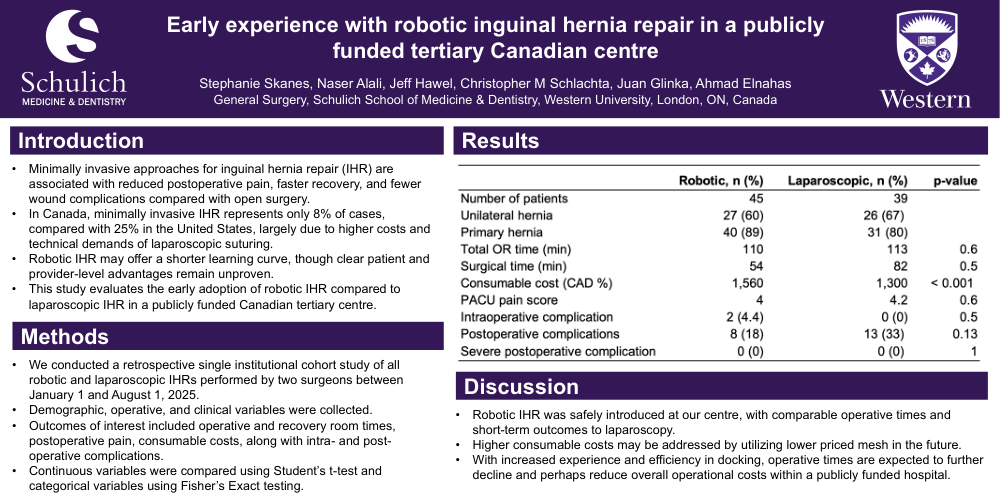
- See table 1
Discussion
•Robotic IHR was safely introduced at our centre, with comparable operative times and short-term outcomes to laparoscopy.
•Higher consumable costs may be addressed by utilizing lower priced mesh in the future.
•With increased experience and efficiency in docking, operative times are expected to further decline and perhaps reduce overall operational costs within a publicly funded hospital.