875 posters, 25 topics, 3,440 authors, 1,061 institutions
ePostersLive by SciGen Technologies S.A. All rights reserved.
SAGES 2026 Annual Meeting Emerging Technology Session
March 25-28, 2026 | Tampa, FL, USA

P078
INNOVATIVE LOW-COST MODELS FOR MASTERING CRITICAL STEPS IN TAPP HERNIA REPAIR
Poster Presenter
Part of Topic
Abdominal Wall Hernias
Introduction:
Transabdominal preperitoneal (TAPP) repair is widely used but has a prolonged learning curve. Critical-step errors may lead to complications, yet accessible procedure-specific simulators remain limited. We developed a low-cost physical model to practice three key TAPP steps.
Methods
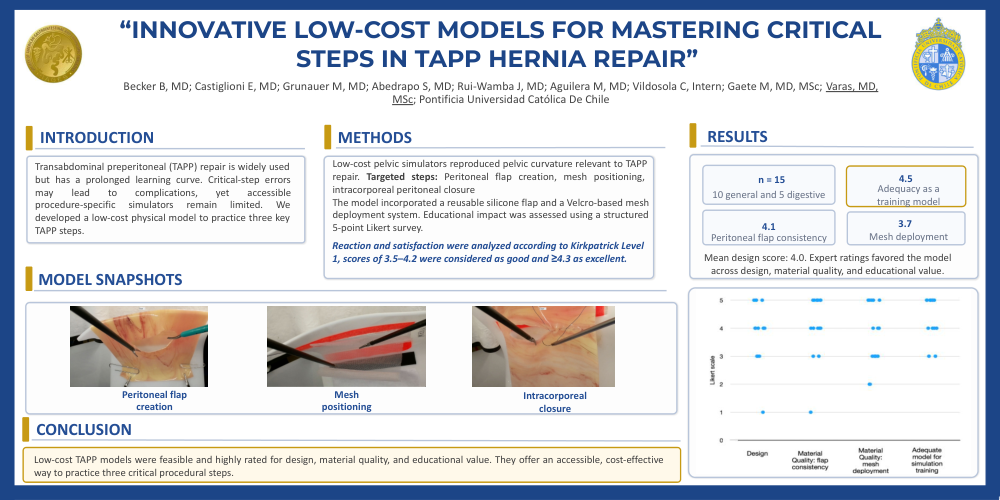
Low-cost pelvic simulators reproduced pelvic curvature relevant to TAPP repair. Targeted steps: Peritoneal flap creation, mesh positioning, intracorporeal peritoneal closure
The model incorporated a reusable silicone flap and a Velcro-based mesh deployment system. Educational impact was assessed using a structured 5-point Likert survey.
Reaction and satisfaction were analyzed according to Kirkpatrick Level 1, scores of 3.5–4.2 were considered as good and ≥4.3 as excellent.
RESULTS
n=15, 10 general, 5 digestive
Mean design score: 4.0. Expert ratings favored the model across design, material quality, and educational value.
4.5 Adequacy as a training model, 4.1 peritoneal flap consistency, 3.7 mesh deployment
Conclusion
Low-cost TAPP models were feasible and highly rated for design, material quality, and educational value. They offer an accessible, cost-effective way to practice three critical procedural steps.