875 posters, 25 topics, 3,440 authors, 1,061 institutions
ePostersLive by SciGen Technologies S.A. All rights reserved.
SAGES 2026 Annual Meeting Emerging Technology Session
March 25-28, 2026 | Tampa, FL, USA

P075
Outcomes of Immunocompromised Patients Undergoing Elective Ventral Hernia Repair: A Propensity-Matched Analysis of the ACS-NSQIP Database
Poster Presenter
Part of Topic
Abdominal Wall Hernias
OUTCOMES OF IMMUNOCOMPROMISED PATIENTS UNDERGOING ELECTIVE VENTRAL HERNIA REPAIR: A PROPENSITY-MATCHED ANALYSIS OF THE ACS-NSQIP DATABASE
Bryan Vintimilla, MD; Ethan Shyu, BS; Jamie Benson, MD; Jordan Taylor, MD; Tanuja Damani, MD, FACS; Xavier Pereira, MD; Division of General Surgery, New York University Langone Health, New York, NY
INTRODUCTION: Immunosuppression status is traditionally considered a risk factor for wound complication in ventral hernia repair (VHR). However, a systematic classification is still not available, and existing studies are conflicting. Furthermore, there is a paucity of data regarding the impact of immunosuppression in minimally invasive VHR. Consequently, this study aims to examine the outcomes of immunocompromised patients undergoing elective VHR across open, laparoscopic, and robotic cohorts.
METHODS AND PROCEDURES: Adult patients who underwent elective VHR in 2023 were identified from the American College of Surgeons National Surgical Quality Improvement Program (ACS-NSQIP) database. Patients were categorized as immunocompetent or immunocompromised based on steroid use. Propensity score matching (PSM) 1:1 was performed separately for open, laparoscopic, and robotic approaches. Covariates included age, BMI, diabetes, smoking, COPD, hypertension, ASA class, bleeding disorders, preoperative sepsis, hernia size, and use of subcutaneous flaps. A backwards stepwise multivariable logistic regression model was additionally built to assess independent predictors of 30-day morbidity.
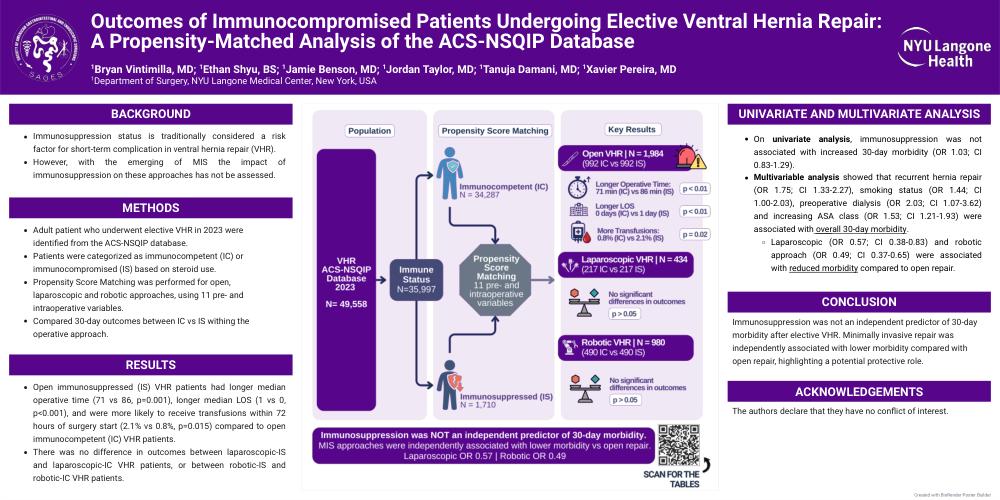
RESULTS: Open immunosuppressed (IS) VHR patients had longer median operative time (71 vs 86, p=0.001), longer median LOS (1 vs 0, p<0.001), and were more likely to receive transfusions within 72 hours of surgery start (2.1% vs 0.8%, p=0.015) compared to open immunocompetent (IC) VHR patients. There was no difference in outcomes between laparoscopic-IS and laparoscopic-IC VHR patients, or between robotic-IS and robotic-IC VHR patients. On univariate analysis, immunosuppression was not associated with increased 30-day morbidity (OR 1.03; CI 0.83-1.29). Multivariable analysis showed that recurrent hernia repair (OR 1.75; CI 1.33-2.27), smoking status (OR 1.44; CI 1.00-2.03), preoperative dialysis (OR 2.03; CI 1.07-3.62) and increasing ASA class (OR 1.53; CI 1.21-1.93) were associated with overall 30-day morbidity. Laparoscopic (OR 0.57; CI 0.38-0.83) and robotic approach (OR 0.49; CI 0.37-0.65) were associated with reduced morbidity compared to open repair.
CONCLUSION: Immunosuppression was not an independent predictor of 30-day morbidity after elective VHR. Minimally invasive repair was independently associated with lower morbidity compared with open repair, highlighting a potential protective role.