875 posters, 25 topics, 3,440 authors, 1,061 institutions
ePostersLive by SciGen Technologies S.A. All rights reserved.
SAGES 2026 Annual Meeting Emerging Technology Session
March 25-28, 2026 | Tampa, FL, USA

P752
NAVIGATING PANCREATIC HEAD TUMORS: A SINGLE SURGEON'S COMPREHENSIVE EXPERIENCE IN A LOCAL SUBURBAN TERTIARY CENTRE.
Poster Presenter
Part of Topic
Pancreas
INTRODUCTION
Pancreatic head tumours remain among the most surgically challenging malignancies, with pancreaticoduodenectomy associated with substantial morbidity despite advances in perioperative care and minimally invasive techniques. Outcomes are known to vary based on tumour biology, gland characteristics, surgical approach, and institutional experience. While high-volume academic centres dominate the literature, real-world data from suburban tertiary centres serving defined local populations are less frequently reported.
This study evaluates pancreatic head tumour management in a suburban tertiary centre serving a local population, analysing tumour characteristics, surgical techniques, complications, recovery, and outcomes to provide practical insights applicable to similar practice settings.
METHODS AND PROCEDURES
A retrospective analysis reviewed 47 consecutive cases from 2021 to 2025. Data covered patient demographics (age, sex, ASA grades 1–4), tumor details (histopathology, CA 19.9, staging), symptoms like jaundice, imaging, procedures (Whipple, triple bypass, others), pancreatico-jejunostomy (PJ) techniques, operative metrics (time, blood loss), complications (delayed gastric emptying [DGE], pancreatic fistula, surgical site infection [SSI], leaks), recovery (hospital/ICU stay, oral intake), and 30-day morbidity/mortality. Python (pandas) calculated means, percentages, correlations, and chi-square tests (p<0.05 significant). Generative AI supported statistical computations and chart creation (~20% contribution); all results were rigorously reviewed and edited by the author for clinical accuracy.
RESULTS
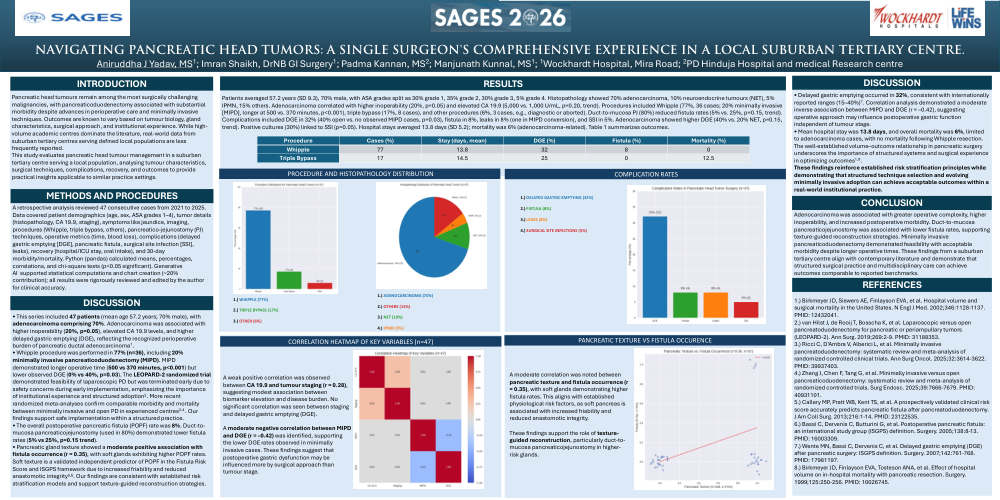
Patients averaged 57.2 years (SD 9.3), 70% male, with ASA grades split as 30% grade 1, 35% grade 2, 30% grade 3, 5% grade 4. Histopathology showed 70% adenocarcinoma, 10% neuroendocrine tumours (NET), 5% IPMN, 15% others. Adenocarcinoma correlated with higher inoperability (20%, p=0.05) and elevated CA 19.9 (5,000 vs. 1,000 U/mL, p=0.20, trend). Procedures included Whipple (77%, 36 cases; 20% minimally invasive [MIPD], longer at 500 vs. 370 minutes, p<0.001), triple bypass (17%, 8 cases), and other procedures (6%, 3 cases, e.g., diagnostic or aborted). Duct-to-mucosa PJ (80%) reduced fistula rates (5% vs. 25%, p=0.15, trend). Complications included DGE in 32% (40% open vs. no observed MIPD cases, p=0.03), fistula in 8%, leaks in 8% (one in MIPD conversion), and SSI in 5%. Adenocarcinoma showed higher DGE (40% vs. 20% NET, p=0.15, trend). Positive cultures (30%) linked to SSI (p=0.05). Hospital stays averaged 13.8 days (SD 5.2); mortality was 6% (adenocarcinoma-related).
|
Procedure |
Cases (%) |
Stay (days, mean) |
DGE (%) |
Fistula (%) |
Mortality (%) |
|
Whipple |
77 |
13.8 |
32 |
8 |
0 |
|
Triple Bypass |
17 |
14.5 |
25 |
0 |
12.5 |


A weak positive correlation was observed between CA 19.9 and tumour staging (r = 0.28), suggesting modest association between biomarker elevation and disease burden. No significant correlation was seen between staging and delayed gastric emptying (DGE).A moderate negative correlation between MIPD and DGE (r = –0.42) was identified, supporting the lower DGE rates observed in minimally invasive cases. These findings suggest that postoperative gastric dysfunction may be influenced more by surgical approach than tumour stage.

A moderate correlation was noted between pancreatic texture and fistula occurrence (r = 0.35), with soft glands demonstrating higher fistula rates. This aligns with established physiological risk factors, as soft pancreas is associated with increased friability and reduced anastomotic integrity.These findings support the role of texture-guided reconstruction, particularly duct-to-mucosa pancreaticojejunostomy in higher-risk glands.
DISCUSSION
• This series included 47 patients (mean age 57.2 years; 70% male), with adenocarcinoma comprising 70%. Adenocarcinoma was associated with higher inoperability (20%, p=0.05), elevated CA 19.9 levels, and higher delayed gastric emptying (DGE), reflecting the recognized perioperative burden of pancreatic ductal adenocarcinoma1.
• Whipple procedure was performed in 77% (n=36), including 20% minimally invasive pancreaticoduodenectomy (MIPD). MIPD demonstrated longer operative time (500 vs 370 minutes, p<0.001) but lower observed DGE (0% vs 40%, p=0.03). The LEOPARD-2 randomized trial demonstrated feasibility of laparoscopic PD but was terminated early due to safety concerns during early implementation, emphasizing the importance of institutional experience and structured adoption2. More recent randomized meta-analyses confirm comparable morbidity and mortality between minimally invasive and open PD in experienced centres3,4 . Our findings support safe implementation within a structured practice.
• The overall postoperative pancreatic fistula (POPF) rate was 8%. Duct-to-mucosa pancreaticojejunostomy (used in 80%) demonstrated lower fistula rates (5% vs 25%, p=0.15 trend).
• Pancreatic gland texture showed a moderate positive association with fistula occurrence (r = 0.35), with soft glands exhibiting higher POPF rates. Soft texture is a validated independent predictor of POPF in the Fistula Risk Score and ISGPS framework due to increased friability and reduced anastomotic integrity5,6. Our findings are consistent with established risk stratification models and support texture-guided reconstruction strategies.
• Delayed gastric emptying occurred in 32%, consistent with internationally reported ranges (15–40%)7. Correlation analysis demonstrated a moderate inverse association between MIPD and DGE (r = –0.42), suggesting operative approach may influence postoperative gastric function independent of tumour stage.
• Mean hospital stay was 13.8 days, and overall mortality was 6%, limited to adenocarcinoma cases, with no mortality following Whipple resection. The well-established volume–outcome relationship in pancreatic surgery underscores the importance of structured systems and surgical experience in optimizing outcomes1,8.
These findings reinforce established risk stratification principles while demonstrating that structured technique selection and evolving minimally invasive adoption can achieve acceptable outcomes within a real-world institutional practice.
CONCLUSION
Adenocarcinoma was associated with greater operative complexity, higher inoperability, and increased postoperative morbidity. Duct-to-mucosa pancreaticojejunostomy was associated with lower fistula rates, supporting texture-guided reconstruction strategies. Minimally invasive pancreaticoduodenectomy demonstrated feasibility with acceptable morbidity despite longer operative times. These findings from a suburban tertiary centre align with contemporary literature and demonstrate that structured surgical practice and multidisciplinary care can achieve outcomes comparable to reported benchmarks.
REFERENCES
1.) Birkmeyer JD, Siewers AE, Finlayson EVA, et al. Hospital volume and surgical mortality in the United States. N Engl J Med. 2002;346:1128-1137. PMID: 12432041.
2.) van Hilst J, de Rooij T, Bosscha K, et al. Laparoscopic versus open pancreatoduodenectomy for pancreatic or periampullary tumors (LEOPARD-2). Ann Surg. 2019;269:2-9. PMID: 31188353.
3.) Ricci C, D’Ambra V, Alberici L, et al. Minimally invasive pancreatoduodenectomy: systematic review and meta-analysis of randomized controlled clinical trials. Ann Surg Oncol. 2025;32:3614-3622. PMID: 39937403.
4.) Zhang J, Chen F, Tang G, et al. Minimally invasive versus open pancreaticoduodenectomy: systematic review and meta-analysis of randomized controlled trials. Surg Endosc. 2025;39:7666-7679. PMID: 40931101.
5.) Callery MP, Pratt WB, Kent TS, et al. A prospectively validated clinical risk score accurately predicts pancreatic fistula after pancreatoduodenectomy. J Am Coll Surg. 2013;216:1-14. PMID: 23122535.
6.) Bassi C, Dervenis C, Butturini G, et al. Postoperative pancreatic fistula: an international study group (ISGPS) definition. Surgery. 2005;138:8-13. PMID: 16003309.
7.) Wente MN, Bassi C, Dervenis C, et al. Delayed gastric emptying (DGE) after pancreatic surgery: ISGPS definition. Surgery. 2007;142:761-768. PMID: 17981197.
8.) Birkmeyer JD, Finlayson EVA, Tosteson ANA, et al. Effect of hospital volume on in-hospital mortality with pancreatic resection. Surgery. 1999;125:250-256. PMID: 10026745.