875 posters, 25 topics, 3,440 authors, 1,061 institutions
ePostersLive by SciGen Technologies S.A. All rights reserved.
SAGES 2026 Annual Meeting Emerging Technology Session
March 25-28, 2026 | Tampa, FL, USA

P072
COMPARISON OF LAPAROSCOPIC VERSUS OPEN REPAIR FOR PEDIATRIC INDIRECT INGUINAL HERNIA
Part of Topic
Abdominal Wall Hernias
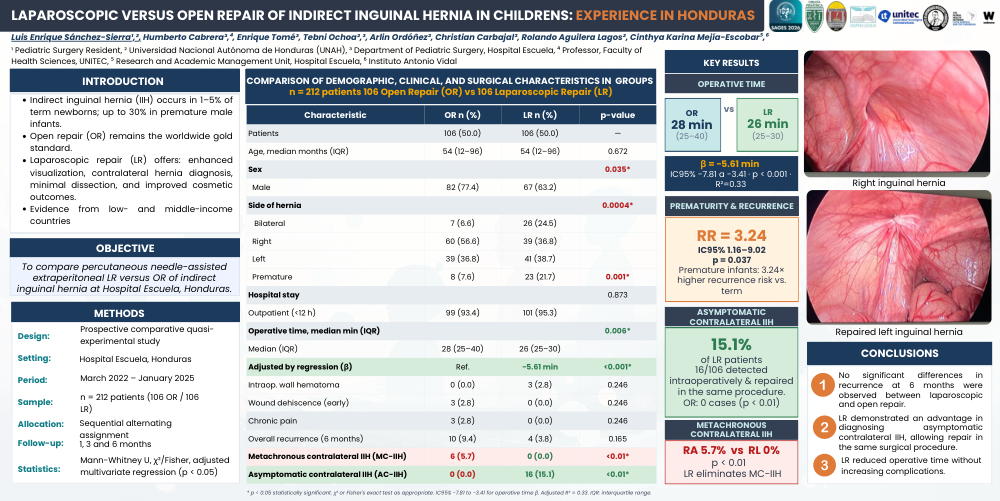
LAPAROSCOPIC VERSUS OPEN REPAIR OF INDIRECT INGUINAL HERNIA IN CHILDRENS: EXPERIENCE IN HONDURAS
Luis Enrique Sánchez-Sierra 1,2 , Humberto Cabrera³,⁴, Enrique Tomé³, Tebni Ochoa 2,3 Arlin Ordóñez³, Christian Carbajal³, Rolando Aguilera Lagos², Cinthya Karina Mejía-Escobar⁵,⁶
¹Pediatric Surgery Resident, ²Universidad Nacional Autónoma de Honduras (UNAH), ³Department of Pediatric Surgery, Hospital Escuela, ⁴Professor, Faculty of Health Sciences, UNITEC,⁵Research and Academic Management Unit, Hospital Escuela, ⁶Instituto Antonio Vidal.
INTRODUCTION
Indirect inguinal hernia (IIH) occurs in 1–5% of term newborns; up to 30% in premature male infants. Open repair (OR) remains the worldwide gold standard. Laparoscopic repair (LR) offers: enhanced visualization, contralateral hernia diagnosis, minimal dissection, and improved cosmetic outcomes. Evidence from low- and middle-income Countries.
OBJECTIVE
To compare percutaneous needle-assisted extraperitoneal LR versus OR of indirect inguinal hernia at Hospital Escuela, Honduras.
METHODS
Design: Prospective comparative quasi-experimental study. Setting: Hospital Escuela, Honduras. Period: March 2022 – January 2025. Sample: n = 212 patients (106 OR / 106 LR). Allocation: Sequential alternating assignment. Follow-up: 1, 3 and 6 months. Statistics: Mann-Whitney U, χ²/Fisher, adjusted multivariate regression (p < 0.05)
RESULTS


CONCLUSIONS
- No significant differences in recurrence at 6 months were observed between laparoscopic and open repair.
- LR demonstrated an advantage in diagnosing asymptomatic contralateral IIH, allowing repair in the same surgical procedure.
- LR reduced operative time without increasing complications.