875 posters, 25 topics, 3,440 authors, 1,061 institutions
ePostersLive by SciGen Technologies S.A. All rights reserved.
SAGES 2026 Annual Meeting Emerging Technology Session
March 25-28, 2026 | Tampa, FL, USA

P738
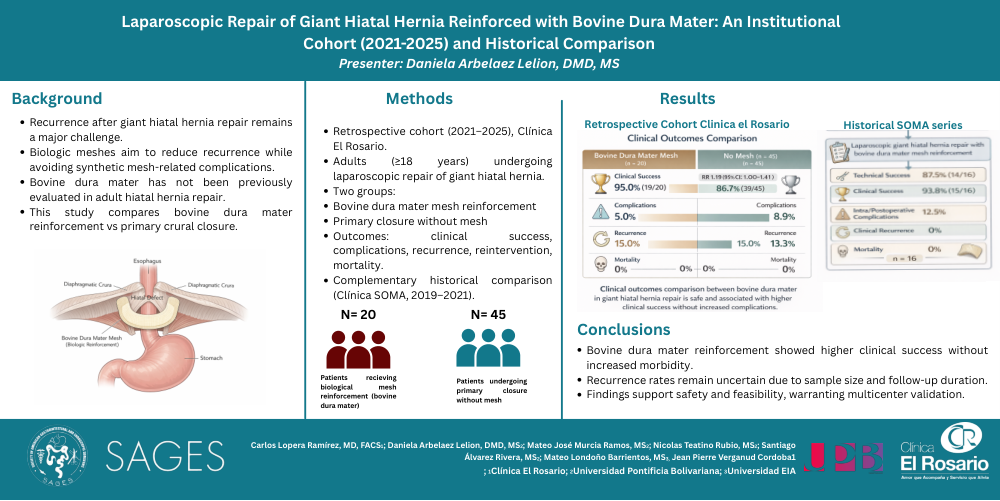
Laparoscopic Repair of Giant Hiatal Hernia Reinforced with Bovine Dura Mater: An Institutional Cohort (2021-2025) and Historical Comparison
Part of Topic
New Technologies / Techniques
Background:
Recurrence after giant hiatal hernia repair remains a major challenge.
Biologic meshes aim to reduce recurrence while avoiding synthetic mesh-related complications.
Bovine dura mater has not been previously evaluated in adult hiatal hernia repair.
This study compares bovine dura mater reinforcement vs primary crural closure.
Methods:
Retrospective cohort (2021–2025), Clínica El Rosario.
Adults (≥18 years) undergoing laparoscopic repair of giant hiatal hernia.
Two groups:
Bovine dura mater mesh reinforcement
Primary closure without mesh
Outcomes: clinical success, complications, recurrence, reintervention, mortality.
Complementary historical comparison (Clínica SOMA, 2019–2021).
Results:
El Rosario cohort (n = 65)
Mesh group: 20 patients
No mesh group: 45 patients
? Clinical success
Mesh: 95.0% (19/20)
No mesh: 86.7% (39/45)
RR 1.19 (95% CI 1.00–1.41)
? Postoperative complications
Mesh: 5.0%
No mesh: 8.9%
? Clinical recurrence
Mesh: 15.0%
No mesh: 13.3%
? Mortality
0% in both groups
Historical SOMA series (n = 16, bovine dura mater):
Clinical success: 93.8%
Clinical recurrence: 0%
Mortality: 0%
Conclusions
Bovine dura mater reinforcement showed higher clinical success without increased morbidity.
Recurrence rates remain uncertain due to sample size and follow-up duration.
Findings support safety and feasibility, warranting multicenter validation.