875 posters, 25 topics, 3,440 authors, 1,061 institutions
ePostersLive by SciGen Technologies S.A. All rights reserved.
SAGES 2026 Annual Meeting Emerging Technology Session
March 25-28, 2026 | Tampa, FL, USA

P710
Benign Multicystic Peritoneal Mesothelioma: A Surgical Case Report
Poster Presenter
Part of Topic
Miscellaneous / Other
BENIGN MULTICYSTIC PERITONEAL MESOTHELIOMA: A SURGICAL CASE REPORT
Utsav Soni, MD1; Clairissa Kaylor, OMS2; Mostafa Elbahrawy, MD1; Reem Younes, MD1; Jane Park, MD1; Govardhana Yannam, MD1; 1Community Medical Center - Rutgers Health; 2Touro College of Osteopathic Medicine
Introduction
•Benign multicystic peritoneal mesothelioma (BMPM) is a rare noncancerous abdominal cystic neoplasm that arises from the peritoneum.
•It predominantly affects females of reproductive age with prior pelvic inflammatory conditions.1,2
•Definitive diagnosis and treatment includes surgical resection with pathological evaluation.
•This report discusses the case of a postmenopausal symptomatic patient who underwent surgical intervention for BMPM.
Case Presentation
•A 58-year-old female presented to the Emergency Department for abdominal pain and distension that has been progressively worsening for six months.
•She also reported increased urinary frequency, constipation and nausea.
•On physical examination, a palpable mass was present in the right periumbilical region.
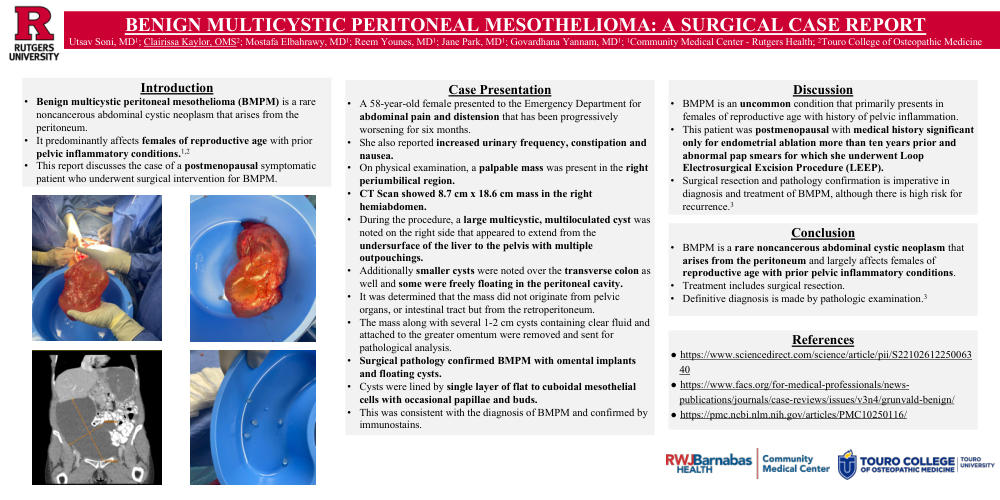
•CT Scan showed 8.7 cm x 18.6 cm mass in the right hemiabdomen.
•General surgery was consulted and the patient was scheduled for diagnostic laparoscopy.
•During the procedure, a large multicystic, multiloculated cyst was noted on the right side that appeared to extend from the undersurface of the liver to the pelvis with multiple outpouchings.
•Additionally smaller cysts were noted over the transverse colon as well and some were freely floating in the peritoneal cavity.
•Due to the size of the mass, decision was made to convert to an open laparotomy.
•The peritoneal lining covering the mass was divided and mobilized.
•It was determined that the mass did not originate from pelvic organs, or intestinal tract but from the retroperitoneum.
•The mass along with several 1-2 cm cysts containing clear fluid and attached to the greater omentum were removed and sent for pathological analysis.
•Surgical pathology confirmed BMPM with omental implants and floating cysts.
•Cysts were lined by single layer of flat to cuboidal mesothelial cells with occasional papillae and buds.
•This was consistent with the diagnosis of BMPM and confirmed by immunostains.
Discussion
•BMPM is an uncommon condition that primarily presents in females of reproductive age with history of pelvic inflammation.
•This patient was postmenopausal with medical history significant only for endometrial ablation more than ten years prior and abnormal pap smears for which she underwent Loop Electrosurgical Excision Procedure (LEEP).
•Surgical resection and pathology confirmation is imperative in diagnosis and treatment of BMPM, although there is high risk for recurrence.3
Conclusion
•BMPM is a rare noncancerous abdominal cystic neoplasm that arises from the peritoneum and largely affects females of reproductive age with prior pelvic inflammatory conditions.
•Treatment includes surgical resection.
•Definitive diagnosis is made by pathologic examination.3
References