875 posters, 25 topics, 3,440 authors, 1,061 institutions
ePostersLive by SciGen Technologies S.A. All rights reserved.
SAGES 2026 Annual Meeting Emerging Technology Session
March 25-28, 2026 | Tampa, FL, USA

P707
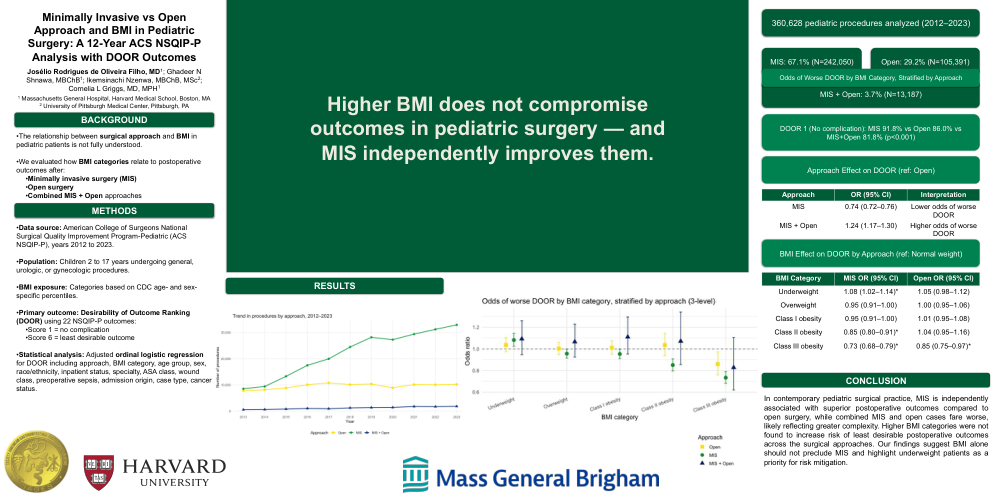
Minimally Invasive vs Open Approach and BMI in Pediatric Surgery: A 12-Year Acs NSQIP-P Analysis with DOOR Outcomes
Part of Topic
Miscellaneous / Other
BACKGROUND
The relationship between surgical approach and BMI in pediatric patients is not fully understood. They evaluated how BMI categories relate to postoperative outcomes after MIS, Open surgery, and Combined MIS + Open approaches.
METHODS
Data source: ACS NSQIP-P, years 2012 to 2023. Population: Children 2 to 17 years undergoing general, urologic, or gynecologic procedures. BMI exposure: Categories based on CDC age- and sex-specific percentiles. Primary outcome: Desirability of Outcome Ranking (DOOR) using 22 NSQIP-P outcomes (Score 1 = no complication, Score 6 = least desirable outcome). Statistical analysis: Adjusted ordinal logistic regression for DOOR including approach, BMI category, age group, sex, race/ethnicity, inpatient status, specialty, ASA class, wound class, preoperative sepsis, admission origin, case type, cancer status.
RESULTS
360,628 pediatric procedures analyzed (2012-2023). MIS: 67.1% (N=242,050). Open: 29.2% (N=105,391). MIS + Open: 3.7% (N=13,187). Higher BMI does not compromise outcomes in pediatric surgery -- and MIS independently improves them. DOOR 1 (No complication): MIS 91.8% vs Open 86.0% vs MIS+Open 81.8% (p<0.001). Approach Effect on DOOR (ref: Open): MIS OR 0.74 (0.72-0.76), MIS + Open OR 1.24 (1.17-1.30). BMI Effect on DOOR by Approach (ref: Normal weight): MIS Underweight 1.08 (1.02-1.14), Overweight 0.95 (0.91-1.00), Class I obesity 0.95 (0.91-1.00), Class II obesity 0.85 (0.80-0.91), Class III obesity 0.73 (0.68-0.79). Open Underweight 1.05 (0.98-1.12), Overweight 1.00 (0.95-1.06), Class I obesity 1.01 (0.95-1.08), Class II obesity 1.04 (0.95-1.16), Class III obesity 0.85 (0.75-0.97). *Statistically significant (95% CI does not cross 1.00).
CONCLUSION
In contemporary pediatric surgical practice, MIS is independently associated with superior postoperative outcomes compared to open surgery, while combined MIS and open cases fare worse, likely reflecting greater complexity. Higher BMI categories were not found to increase risk of least desirable postoperative outcomes across the surgical approaches. Their findings suggest BMI alone should not preclude MIS and highlight underweight patients as a priority for risk mitigation.