875 posters, 25 topics, 3,440 authors, 1,061 institutions
ePostersLive by SciGen Technologies S.A. All rights reserved.
SAGES 2026 Annual Meeting Emerging Technology Session
March 25-28, 2026 | Tampa, FL, USA

P676
Predictors for Mortality Following Minimally Invasive Hepatectomy: a 10-year Analysis of the NSQIP Database
Poster Presenter
Part of Topic
Liver
Predictors for Mortality Following Minimally Invasive Hepatectomy: a 10-year Analysis of the NSQIP Database
Authors: Maria Clara Morais MD (1); Aditya Godbole MBBS (1), Mattia Ballo MD (1,2), Filippo Filicori MD (1).
Affiliations: 1. Department of Surgery, Lenox Hill Hospital, 100 E 77th St, New York, NY 10075, USA; 2. Department of Surgical, Oncological and Gastroenterological Sciences, General Surgery 2 Hepato-Pancreato-Biliary Surgery and Liver Transplantation, Padua University Hospital, PD, Italy.
ABSTRACT
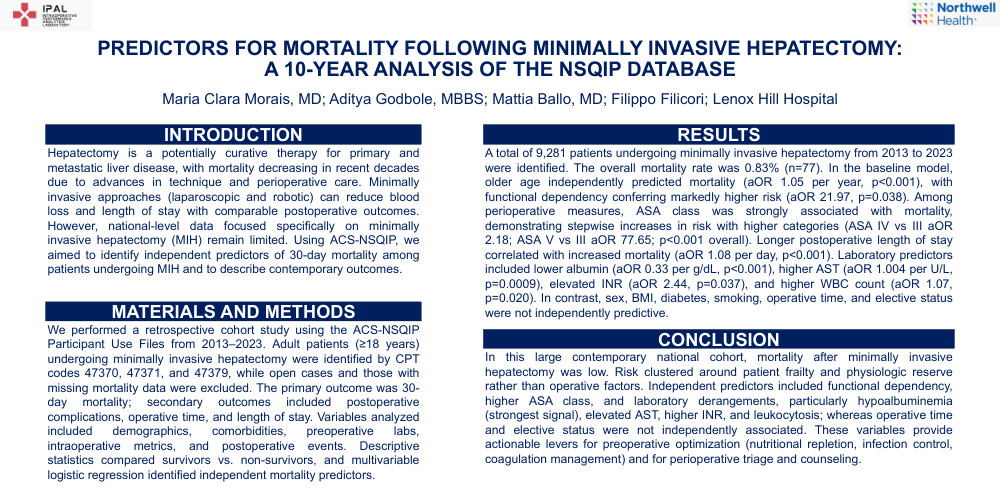
Introduction: Hepatectomy is a potentially curative therapy for primary and metastatic liver disease, with mortality decreasing in recent decades due to advances in technique and perioperative care. Minimally invasive approaches (laparoscopic and robotic) can reduce blood loss and length of stay with comparable postoperative outcomes. However, national-level data focused specifically on minimally invasive hepatectomy (MIH) remain limited. Using ACS-NSQIP, we aimed to identify independent predictors of 30-day mortality among patients undergoing MIH and to describe contemporary outcomes.
Material and Methods: We performed a retrospective cohort study using the ACS-NSQIP Participant Use Files from 2013–2023. Adult patients (≥18 years) undergoing minimally invasive hepatectomy were identified by CPT codes 47370, 47371, and 47379, while open cases and those with missing mortality data were excluded. The primary outcome was 30-day mortality; secondary outcomes included postoperative complications, operative time, and length of stay. Variables analyzed included demographics, comorbidities, preoperative labs, intraoperative metrics, and postoperative events. Descriptive statistics compared survivors vs. non-survivors, and multivariable logistic regression identified independent mortality predictors.
Results: A total of 9,281 patients undergoing minimally invasive hepatectomy from 2013 to 2023 were identified. The overall mortality rate was 0.83% (n=77). In the baseline model, older age independently predicted mortality (aOR 1.05 per year, p<0.001), with functional dependency conferring markedly higher risk (aOR 21.97, p=0.038). Among perioperative measures, ASA class was strongly associated with mortality, demonstrating stepwise increases in risk with higher categories (ASA IV vs III aOR 2.18; ASA V vs III aOR 77.65; p<0.001 overall). Longer postoperative length of stay correlated with increased mortality (aOR 1.08 per day, p<0.001). Laboratory predictors included lower albumin (aOR 0.33 per g/dL, p<0.001), higher AST (aOR 1.004 per U/L, p=0.0009), elevated INR (aOR 2.44, p=0.037), and higher WBC count (aOR 1.07, p=0.020). In contrast, sex, BMI, diabetes, smoking, operative time, and elective status were not independently predictive.
Conclusion: In this large contemporary national cohort, mortality after minimally invasive hepatectomy was low. Risk clustered around patient frailty and physiologic reserve rather than operative factors. Independent predictors included functional dependency, higher ASA class, and laboratory derangements, particularly hypoalbuminemia (strongest signal), elevated AST, higher INR, and leukocytosis; whereas operative time and elective status were not independently associated. These variables provide actionable levers for preoperative optimization (nutritional repletion, infection control, coagulation management) and for perioperative triage and counseling.