875 posters, 25 topics, 3,440 authors, 1,061 institutions
ePostersLive by SciGen Technologies S.A. All rights reserved.
SAGES 2026 Annual Meeting Emerging Technology Session
March 25-28, 2026 | Tampa, FL, USA

P669
Hospital Outcomes After IVC Filter Placement In Gastrointestinal And Hepatobiliary Patients: A 2018-2023 Statewide Analysis
Poster Presenter
Part of Topic
Image Guided Interventions (Including Combined Radiologic / Endoscopic / Surgical Procedures)
Hospital Outcomes After IVC Filter Placement in Gastrointestinal and Hepatobiliary Patients: A 2018–2023 Statewide Analysis
Adyasha Pradhan, Nadia F. Linton, Maya Hamaker, Indraneil Mukherjee
Background: Patients with gastrointestinal (GI) and hepatobiliary–pancreatic (HPB) diseases face an elevated risk of venous thromboembolism (VTE) but often cannot tolerate anticoagulation due to active or high-risk bleeding. In these clinical scenarios, inferior vena cava (IVC) filters serve as a mechanical alternative for pulmonary embolism prevention. Despite widespread use, data on the utilization patterns and hospital outcomes associated with IVC filter placement in GI and HPB inpatients remain limited. Understanding length of stay, hospital charges, discharge disposition, and resource concentration in this population is essential for informing care pathway design and institutional resource allocation. Objective: To evaluate length of stay, hospital charges, discharge disposition, and resource concentration following IVC filter placement in adult inpatients with GI and HPB diagnoses across New York State from 2018 to 2023.
Methods: We conducted a retrospective analysis of adult inpatient discharges in New York State using the Statewide Planning and Research Cooperative System (SPARCS) de-identified database from 2018 to 2023. Cases were included if they had an IVC filter procedure and a primary GI or HPB diagnosis, including malignancies. Diagnoses were identified using Clinical Classifications Software Refined (CCSR) categories for colorectal, stomach, bile duct, and liver cancers, hepatic failure, and intestinal infection. Outcomes analyzed included length of stay (LOS), total hospital charges, and discharge disposition, categorized as home, non-home facility, hospice, expired, or against medical advice (AMA). Descriptive and comparative statistics were calculated. Resource concentration was assessed by examining the proportion of total charges attributable to the highest-cost patients.
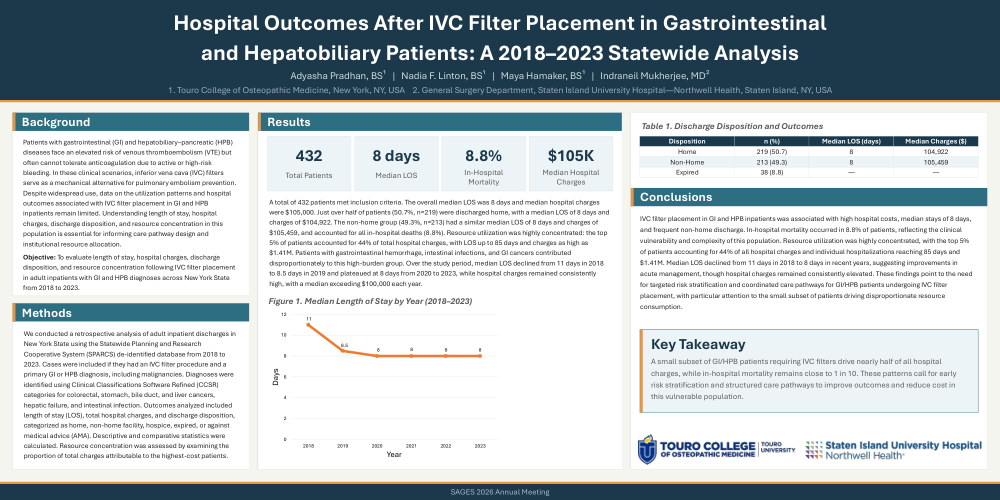
Results: A total of 432 patients met inclusion criteria. The overall median LOS was 8 days and median hospital charges were $105,000. Just over half of patients (50.7%, n=219) were discharged home, with a median LOS of 8 days and charges of $104,922. The non-home group (49.3%, n=213) had a similar median LOS of 8 days and charges of $105,459, and accounted for all in-hospital deaths (8.8%). Resource utilization was highly concentrated: the top 5% of patients accounted for 44% of total hospital charges, with LOS up to 85 days and charges as high as $1.41M. Patients with gastrointestinal hemorrhage, intestinal infections, and GI cancers contributed disproportionately to this high-burden group. Over the study period, median LOS declined from 11 days in 2018 to 8.5 days in 2019 and plateaued at 8 days from 2020 to 2023, while hospital charges remained consistently high, with a median exceeding $100,000 each year.
Conclusions: IVC filter placement in GI and HPB inpatients was associated with high hospital costs, median stays of 8 days, and frequent non-home discharge. In-hospital mortality occurred in 8.8% of patients, reflecting the clinical vulnerability and complexity of this population. Resource utilization was highly concentrated, with the top 5% of patients accounting for 44% of all hospital charges and individual hospitalizations reaching 85 days and $1.41M. Median LOS declined from 11 days in 2018 to 8 days in recent years, suggesting improvements in acute management, though hospital charges remained consistently elevated. These findings point to the need for targeted risk stratification and coordinated care pathways for GI/HPB patients undergoing IVC filter placement, with particular attention to the small subset of patients driving disproportionate resource consumption.