875 posters, 25 topics, 3,440 authors, 1,061 institutions
ePostersLive by SciGen Technologies S.A. All rights reserved.
SAGES 2026 Annual Meeting Emerging Technology Session
March 25-28, 2026 | Tampa, FL, USA

P666
A Case of Mesentero-axial Type of Acute Gastric Volvulus Reduced Using Upper Endoscopic Water-Immersion Technique
Part of Topic
Image Guided Interventions (Including Combined Radiologic / Endoscopic / Surgical Procedures)
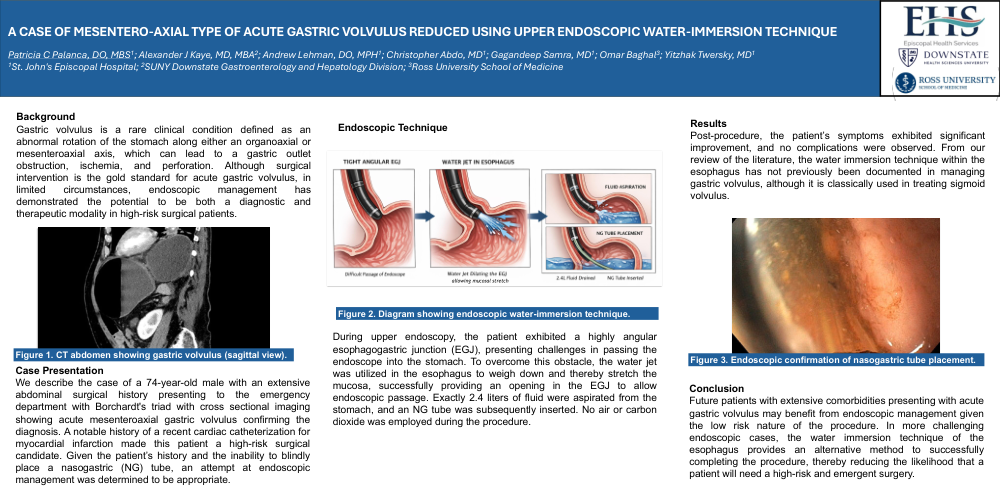
A CASE OF MESENTERO-AXIAL TYPE OF ACUTE GASTRIC VOLVULUS REDUCED USING UPPER ENDOSCOPIC WATER-IMMERSION TECHNIQUEPatricia C Palanca, DO, MBS1; Alexander J Kaye, MD, MBA2; Andrew Lehman, DO, MPH1; Christopher Abdo, MD1; Gagandeep Samra, MD1; Omar Baghal3; Yitzhak Twersky, MD1; 1St. John's Episcopal Hospital; 2SUNY Downstate Gastroenterology and Hepatology Division; 3Ross University School of Medicine
Gastric volvulus is a rare clinical condition defined as an abnormal rotation of the stomach along either an organoaxial or mesenteroaxial axis, which can lead to a gastric outlet obstruction, ischemia, and perforation. Although surgical intervention is the gold standard for acute gastric volvulus, in limited circumstances, endoscopic management has demonstrated the potential to be both a diagnostic and therapeutic modality in high-risk surgical patients. We describe the case of a 74-year-old male with an extensive abdominal surgical history presenting to the emergency department with Borchardt's triad with cross sectional imaging showing acute mesenteroaxial gastric volvulus confirming the diagnosis. A notable history of a recent cardiac catheterization for myocardial infarction made this patient a high risk surgical candidate. Given the patient’s history and the inability to blindly place a nasogastric (NG) tube, an attempt at endoscopic management was determined to be appropriate. During upper endoscopy, the patient exhibited a highly angular esophagogastric junction (EGJ), presenting challenges in passing the endoscope into the stomach. To overcome this obstacle, the water jet was utilized in the esophagus to weigh down and thereby stretch the mucosa, successfully providing an opening in the EGJ to allow endoscopic passage. Exactly 2.4 liters of fluid were aspirated from the stomach, and an NG tube was subsequently inserted. No air or carbon dioxide was employed during the procedure. Post-procedure, the patient’s symptoms exhibited significant improvement, and no complications were observed. From our review of the literature, the water immersion technique within the esophagus has not previously been documented in managing gastric volvulus, although it is classically used in treating sigmoid volvulus. Future patients with extensive comorbidities presenting with acute gastric volvulus may benefit from endoscopic management given the low risk nature of the procedure. In more challenging endoscopic cases, the water immersion technique of the esophagus provides an alternative method to successfully completing the procedure, thereby reducing the likelihood that a patient will need a high-risk and emergent surgery.